
A Song for Europe
Host
Wilfred Thomas (1956)
David Jacobs (1957, 60, 62-66)
Pete Murray (1959)
Katie Boyle (1961)
Rolf Harris (1967)
Cilla Black (1968, 73)
Michael Aspel (1969, 76)
Cliff Richard (1970-72)
Jimmy Savile (1974)
Lulu (1975)
Terry Wogan (1977-96, 98, 2003-08)
Dale Winton (1997)
Ulrika Jonsson (1998-99)
Katy Hill (2000-01)
Claire Sweeney and Christopher Price (2002)
Gaby Roslin (2004)
Natasha Kaplinsky (2005-06)
Fearne Cotton (2007)
Claudia Winkleman (2008)
Graham Norton (2009-10)
Mel Giedroyc (2016-19)
Måns Zelmerlöw (2018-19)
Co-hosts
Judges:
Carrie Grant (2004, 08, 16)
Lorraine Kelly (2004)
Harry Hill (2004)
Bruno Tonioli (2005-06, 10, 17)
Jonathan Ross (2005-06)
Natalie Cassidy (2005)
Patrick O'Connell (2005)
Kelly Osbourne (2006)
Fearne Cotton (2006)
John Barrowman (2007-08)
Mel Giedroyc (2007)
Andrew Lloyd Webber (2009)
Alesha Dixon (2009)
Duncan James (2009)
Lulu (2009)
Arlene Phillips (2009)
Emma Bunton (2009)
Dima Bilan (2009)
Pete Waterman (2010)
Jade Ewen (2010)
Katrina Leskanich (2016)
Jay Revell (2016)
Sophie Ellis-Bextor (2017)
CeCe Sammy (2017)
Rylan Clark-Neal (2018-9)
Rochelle Humes (2018)
Tom Fletcher (2018)
Marvin Humes (2019)
Mollie King (2019)
Broadcast
as Festival of British Popular Songs: BBC Television Service, 7 May 1956 to 12 February 1957 (11 episodes in 2 series)
BBC Television Service, 2 February 1959 to 31 March 1995 (1967 as part of The Rolf Harris Show, 1968 & 73 as part of Cilla, 1969 & 75 as part of Lulu, 1970-72 as part of It's Cliff Richard, 1974 as part of Clunk-Click, 1985-88 & 90-92 as part of Wogan)
(Broadcast on BBC Radio 2 (long wave only) in 1977; not broadcast in 1979 - see Trivia)
as The Great British Song Contest: BBC1/BBC Radio 2, 1 March 1996 to 12 March 1999 (1996 & 99 as part of Top of the Pops and 1997-98 as part of National Lottery Draw)
BBC One/BBC Radio 2, 14 January 2000 to 2 March 2003
as Making Your Mind Up: BBC One, 28 February 2004 to 17 March 2007 (4 specials)
as Your Decision: BBC One, 1 March 2008
as Your Country Needs You: BBC One, 3 January 2009 to 12 March 2010 (5 episodes in 1 series + 1 special)
as You Decide: BBC Four/Two, 26 February 2016 to 8 February 2019 (4 specials)
Synopsis
The UK qualifying competition for the Eurovision Song Contest.
This has followed various formats over the years. In the nineties having one singer sing six to eight songs for the public to choose from via phone vote was all the rage, then having different acts sing different songs was "in". The conclusion has been reached via different ways over the years, veering between a straight phone in popularity contest, Eurovision-esque regional points scoring and back to straight phone voting again.
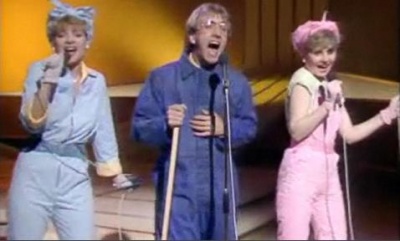 Casablanca sing their hearts out in 1983.
After the triumphant 0 points scored by Jemini in 2003, it changed its name to Making Your Mind Up in 2004 in an attempt to look like it was making more of an effort, although it's hardly Melodifest.
In 2008, the format was monickered Your Decision, and made more use of Wogan who was given various casting votes and a wildcard to ensure that the judges didn't step out too far of line with the popular vote.
At the start of 2009, the format was again renamed to Your Country Needs You with Andrew Lloyd Webber seeking a performer or performers to sing a song - which he would write the music and Diane Warren would write the lyrics for - to represent the UK at the Eurovision Song Contest. It started with a reality show style talent hunt and six finalists were chosen. The Emperors of Soul, The Twins, Mark, Jade, Charlotte and Damien were the six acts. For the first and second weeks they would perform a song and then the panel gave their critical view. The phone lines were then opened for you, the great British public, to vote. The votes were then totalled up and the bottom two were then left on stage for Andrew to decide who he wished to keep in the contest. The semi-final saw each contestant having to sing twice with the phone lines opening after each act had sung once. In the final, Dima Bilan (last year's Eurovision winner) was invited into the studio to sing his winning entry and the final three sung a song of their choice, their best song of the series and their version of Andrew and Diane's song It's My Time. The lines were opened after the first song and the winner was announced who then reprised their version of the song they would be singing in Moscow.
A much curtailed format of Your Country Needs You was introduced in March 2010. Rather than taking place over four weeks, the selection process took place in just one show. In the programme, six acts performed live, after which the judges, led by Pete Waterman, whittled the field down to three. The chosen acts then each performed the UK's entry for Eurovision, That Sounds Good To Me, which Pete Waterman, together with his old partner Mike Stock had written for the contest. Once each act had performed the song, the phone lines opened, and the public voted on who they wanted to perform the song, representing the UK at the Eurovision Song Contest in Oslo.
The BBC decided to drop the format in 2011, and instead opted to make a decision internally as to who would represent the UK at that year's contest. They chose reformed boyband Blue, comprised of Lee Ryan, Simon Webbe, Antony Costa, and Duncan James. There was a token nod to the format in the title of a documentary aired a few weeks before the contest - Eurovision: Your Country Needs Blue. Blue would eventually finish in 11th place in Dusseldorf, three places behind X Factor irritants Jedward, representing Ireland.
After five years of internal selections had produced very modest results, Eurovision You Decide was resurrected in 2016. A one-off final, in which Mel Giedroyc and a guest host present six songs for the viewers' approval. Behind the scenes, respected music producer Hugh Goldsmith sought something good, the songs were validated by Eurovision fan group OGAE, and many performers came from musical theatre and other talent shows. After four years, none of the chosen songs had made any sort of impression on the voting audiences, and the BBC selected its own entry once more.
Champions
Includes results of The Festival of British Songs in 1956, which ran independently of the Eurovision Song Contest.
From 1956-63, 76-91, 95-2008 and 2016-19, the entries were songs and performers, viewers voted on the song as sung by that performer. From 1964-75 and 92-94, the performer was chosen by the BBC and the viewers voted on the song. From 2009-10, the song was chosen by the BBC and the viewers voted on the performer.
From 2011-15 and since 2020, both song and performer were chosen by the BBC without viewers voting. We include these to make a complete list of BBC entries to the Eurovision Song Contest.
| Year | Song | Performer | Composer | Lyricist |
|---|---|---|---|---|
| 1956 | Everybody Falls In Love With Someone | Denis Lotis and the Keynotes | Peter Hart | Norman Newell |
| 1957 | All | Patricia Bredin | Reynell Wreford | Alan Stranks |
| 1958 | (no contest) | |||
| 1959 | Sing, Little Birdie | Pearl Carr & Teddy Johnson | Stan Butcher | Syd Cordell |
| 1960 | Looking High, High, High | Bryan Johnson | John Watson | |
| 1961 | Are You Sure? | The Allisons | John Allison, Bob Allison | |
| 1962 | Ring-a-ding Girl | Ronnie Carroll | Syd Cordett | Stan Butcher |
| 1963 | Say Wonderful Things | Ronnie Carroll | Philip Green | Norman Newell |
| 1964 | I Love the Little Things | Matt Monro | Tony Hatch | |
| 1965 | I Belong | Kathy Kirby | Peter Lee Sterling | Phil Peters |
| 1966 | A Man Without Love | Kenneth McKellar | Cyril Ornadel | Peter Callander |
| 1967 | Puppet on a String | Sandie Shaw | Bill Martin and Phil Coulter | |
| 1968 | Congratulations | Cliff Richard | Bill Martin and Phil Coulter | |
| 1969 | Boom Bang-a-bang | Lulu | Alan Moorhouse | Peter Warne |
| 1970 | Knock, Knock (who's There?) | Mary Hopkin | John Carter and Geoff Stephens | |
| 1971 | Jack in the Box | Clodagh Rodgers | John Worsley | Johnny Arthey |
| 1972 | Beg, Steal or Borrow | The New Seekers | Tony Cole, Steve Wolfe, Graeme Hall | |
| 1973 | Power to All Our Friends | Cliff Richard | Guy Fletcher | Doug Flett |
| 1974 | Long Live Love | Olivia Newton-John | Valerie Avon & Harold Spiro | |
| 1975 | Let Me Be the One | The Shadows | Paul Curtis | |
| 1976 | Save Your Kisses for Me | Brotherhood of Man | Tony Hiller, Lee Sheriden, Martin Lee | |
| 1977 | Rock Bottom | Lynsey de Paul and Mike Moran | Lynsey de Paul and Mike Moran | |
| 1978 | The Bad Old Days | Co-Co | Stephanie de Sykes & Stuart Slater | |
| 1979 | Mary Ann | Black Lace | Peter Morris | |
| 1980 | Love Enough for Two | Prima Donna | Stephanie de Sykes & Stuart Slater | |
| 1981 | Making Your Mind Up | Bucks Fizz | John Danter | Andy Hill |
| 1982 | One Step Further | Bardo | Simon Jefferis | |
| 1983 | I'm Never Giving Up | Sweet Dreams | Ron Roker, Jan Pulsford, Phil Wigger | |
| 1984 | Love Games | Belle and the Devotions | Paul Curtis and Graham Sacher | |
| 1985 | Love Is | Vikki | James Kaleth and Vikki Watson | |
| 1986 | Runner In the Night | Ryder | Brian Wade | Maureen Darbyshire |
| 1987 | Only the Light | Rikki | Richard Peebles | |
| 1988 | Go | Scott Fitzgerald | Julie Forsyth | |
| 1989 | Why Do I Always Get It Wrong? | Live Report | Brian Hodgson and John Beeby | |
| 1990 | Give a Little Love Back to the World | Emma | Paul Curtis | |
| 1991 | A Message to Your Heart | Samantha Janus | Paul Curtis | |
| 1992 | One Step Out of Time | Michael Ball | Paul Davies, Tony Ryan, Victor Stratton | |
| 1993 | Better the Devil You Know | Sonia | Brian Teasdale and Dean Collinson | |
| 1994 | We Will Be Free (Lonely Symphony) | Frances Ruffelle | George De Angelis, Mark Dean | |
| 1995 | Love City Groove | Love City Groove | Paul Hardy, Jay Williams, Tatsiana Mais, Stephen Rudden | |
| 1996 | Ooh Aah... Just a Little Bit | Gina G | Steve Rodway | Simon Tauber |
| 1997 | Love Shine a Light | Katrina and the Waves | Kimberley Rew | |
| 1998 | Where Are You? | Imani | Scott English, Phil Manikiza, Simon Stirling | |
| 1999 | Say It Again | Precious | Paul Varney | |
| 2000 | Don't Play That Song Again | Nikki French | John Springate, Gerry Shephard | |
| 2001 | No Dream Impossible | Lindsay D. | Russ Ballard, Chris Winter | |
| 2002 | Come Back | Jessica Garlick | Martyn Baylay | |
| 2003 | Bye Bye Baby | Jemini | Martin Isherwood | |
| 2004 | Hold On to Our Love | James Fox | Gary Miller | Tim Woodcock |
| 2005 | Touch My Fire | Javine | Javine Hilton & John Themis | |
| 2006 | Teenage Life | Daz Sampson | John Matthews, Daz Sampson | |
| 2007 | Flying the Flag (For You) | Scooch | Russ Spencer, Morten Schjolin, Andrew Hill, Paul Tarry | |
| 2008 | Even If | Andy Abrahams | Andy Abraham, Paul Wilson, Andy Watkins | |
| 2009 | It's My Time | Jade Ewen | Andrew Lloyd Webber | Andrew Lloyd Webber, Diane Warren |
| 2010 | That Sounds Good to Me | Josh Dubovie | Pete Waterman, Mike Stock, Steve Crosby | |
| 2011 | I Can | Blue | Duncan James, Lee Ryan, Ciaron Bell, Ben Collier, Ian Hope, Liam Keenan, StarSign | |
| 2012 | Love Will Set You Free | Englebert Humperdinck | Martin Terefe and Sacha Skarbek | |
| 2013 | Believe in Me | Bonnie Tyler | Desmond Child, Lauren Christy, Christopher Braide | |
| 2014 | Children of the Universe | Molly | Molly Smitten-Downes, Anders Hansson | |
| 2015 | Still in Love With You | Electro Velvet | David Mindel, Adrian Bax White | |
| 2016 | You're Not Alone | Joe and Jake | Justin J Benson, Schwartz and S Kanes | |
| 2017 | I Will Never Give Up On You | Lucie Jones | The Treatment, Emmelie De Forest, Lawrie Martin | |
| 2018 | Storm | SuRie | Sean Hargreaves, Gil Lewis, Nicole Blair | |
| 2019 | Bigger Than Us | Michael Rice | Laurell Barker, John Lundvik, Jonas Thander, Anna-Klara Folin | |
| 2020 | My Last Breath | James Newman | James Newman, Iain James, Ed Drewett, Adam Argyle | |
| 2021 | Embers | James Newman | James Newman, Conor Blake, Danny Shah, Tom Hollings, Samuel Brennan | |
| 2022 | Space Man | Sam Ryder | Amy Victoria Wadge, Sam Robert Robinson, Max Wolfgang | |
| 2023 | I Wrote a Song | Mae Muller | Mae Muller, Karen Poole, Lewis Thompson | |
| 2024 | Dizzy | Olly Alexander | Olly Alexander, Danny L Harle | |
| 2025 | What the Hell Just Happened? | Remember Monday | Charlotte Steel, Holly-Anne Hull, Lauren Byrne, Tom Hollings, Sam Brennan, Thomas Stengaard, Julie Aagaard | |
Key moments
El Tel had a scary few minutes in 1980 when Happy Everything by Maggie Moone and Love Enough for Two by Prima Donna both ended up on a tie at 131 points, and there was no procedure to sort this out on any form of countback system. Eventually the tie was split by a show of hands from the regional presenters.
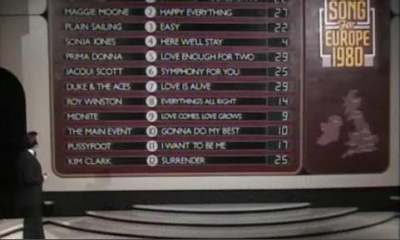 Prima Donna go to the ESC, Maggie Moone goes to Name That Tune. So who really wins?
In 2007, the contest was decided by a phone vote knocking four of the six acts out, the remaining two going into a "sing-off" (how very X-Factor). Following the sing-off between French singer Cyndi and cheesy-pop-from-1999-group Scooch, the winner was announced by hosts Terry Wogan and Fearne Cotton. Unfortunately, Wogan and Cotton both announced different winners, leading to much justified confusion among the singers, the audience, and... well, everyone. Scooch, as announced by Fearne Cotton, were in fact the winners.
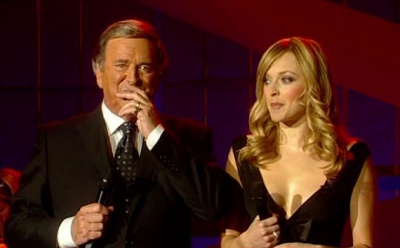 Wogan realizes where United Kingdom will end up on the scoreboard.
Esma Akkilic unfortunately forgetting the lyrics part way through her performance of Pete Waterman's 2010 song.
Who could blame her?
Trivia
The first competition, in 1956, was intended to produce an entrant for that year's Eurovision Song Contest but didn't, because the BBC missed the registration deadline! The Festival of British Popular Songs became a monthly series instead, until January 1957 when it ran as a series of three heats and a final to decide (in plenty of time) which song would go to Eurovision.
The contest was twice hit by industrial action. As a result, the 1977 contest did not appear on television and was broadcast only on Radio 2 Long Wave. This actually resulted in the BBC temporarily withdrawing from hosting the ESC itself (which at such short notice, gave rise to the likelihood that the contest would have to be cancelled altogether) but the situation was resolved in time and the ESC went ahead at the Wembley Conference Centre as planned.
The 1979 contest was not broadcast due to a dispute on the day between unions and management. The competition was still held, but off-screen and with the regional juries having to judge on audio of the rehearsals. Meanwhile BBC1 put on a film instead. The results were announced on Nationwide the next day.
Under the name 'Making Your Mind Up', the show has mainly been broadcast from BBC Television Centre, but did vacate to The Maidstone Studios for the 2007 final.
See also
Weaver's Week reviews of 2004, 2005, 2006, 2007, 2008, 2009, 2010, 2016, 2017, 2018, 2019.