
Every Second Counts
Hosts
Larry Grayson (non-broadcast pilot)
Russell Grant (non-broadcast pilot)
Co-hosts
Announcer:
Philip Talbot (1986-91)
Jonathan Booth (1992-93)
Broadcast
BBC1, 8 February 1986 to 29 October 1993 (142 episodes in 9 series)
Synopsis
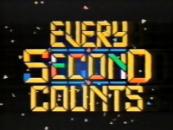
This show was notable for several things. It was a show that lasted ever such a long time, or at least it felt that way. Then there's the gloriously dated use of an LCD-display font. And there's Teesside funster Paul Daniels at the helm, helping three couples to clock up time for the final round where they could win a consumer durable or a holiday (but not both, mind).
 The original set from 1986.
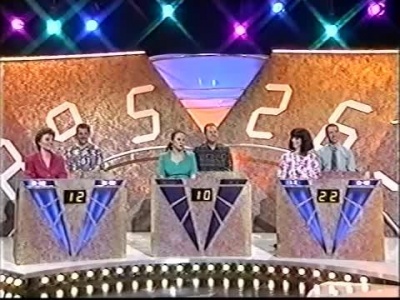 The set was redesigned; here is the look from 1993.
In the first round, one contestant from each couple sits in the "driving seat". Their partners are silent during this time and can only pull faces in the vain hope that their beloved gets the answer right. Each question had two possible answers, with contestants in the driving seats normally replying very stupidly.
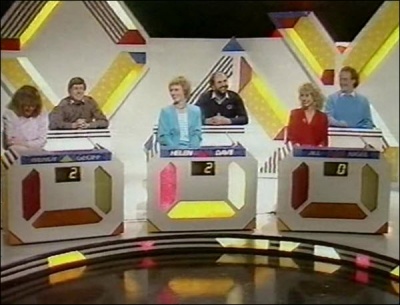 The contestants' desks. The couples got to choose which order they went in, but most - as here - opted for "ladies first".
Made-up example: "Famous Twigs."
Paul: Q. Which of these are famous twigs? Say "Twiggo!" if they are or "Twig Off!" if not. We'll begin with "Twiggy".
Contestant 1: "Twiggo!" (Ding!)
Paul: "Twig of the Dump".
Contestant 2: "Twiggo!" (duh-dum!)
Paul: "No, you daft ha'peth, it was Stig of the Dump."
Contestant 2 is now out of the round, but the remaining two players can keep answering and earn some extra time. Each correct answer in the first half of the show earns two seconds. Bonus points should have been given for making the contestants wear funny hats during some of the rounds but weren't.
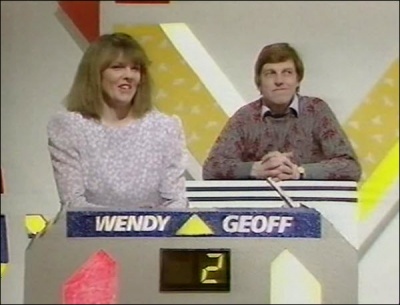 "Twig off, Paul!"
A silly twiddly jingle after a couple of rounds denotes a bonus round. Here the couple with the fewest seconds on their clock gets first pick of one of three categories, usually something like general knowledge, pop music, and/or food and drink. Paul would read out the question, usually one with many possible wrong answers such as "What was The Beatles' first No 1 single?" and both members of the team would reel off as much as they can until they hit on the right answer. If they hit it straight off they get ten seconds added to their score, otherwise the amount of time left when (if) they get it right is added to their score.
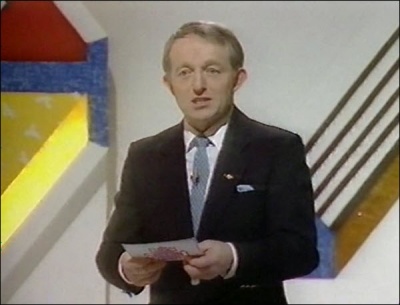 Oooh, doesn't he look young? Well no, he doesn't, actually
After the first half, points are doubled and the two players in each team swap round. This being the sexist 80s, the men nearly played in round 2. The team with the most time are the winners and go through to the final; the losers win a "lovely" clock (and also his and hers watches in later series).
The winners, in a fit of cleverness, carry through the time they've earned into the final round. They'd get a choice of two categories, and the statements for each category would have three possibilities, such as: "All these words can be preceded by the words bat, market, or blue".
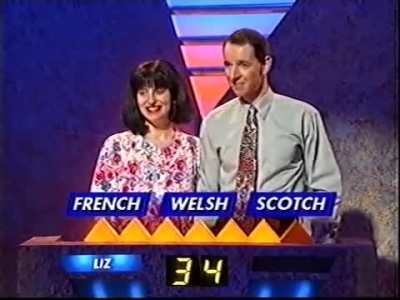 Six right answers to win the next prize.
The players would take it in turns to respond to the statements. Correct answers switch off one of the lights in front of them and switching them all off stops their clock and wins them a prize. They can then upgrade that prize by answering further sets of questions. Four lights for the first prize up, five, six and then seven for the obligatory African safari holiday. If it's obvious they don't have enough time for seven lights, they'd be given £50 for every second left because, y' know, Every Second Counts.
Overall, an enjoyable and easy-to-play-along-with show that fitted in well in the Saturday evening schedule, helped along by Daniels' professionalism and cheerful bonhomie with the contestants. Indeed, he was an excellent host for all three game shows that he hosted for the BBC (the other two being Odd One Out and Wipeout) - he certainly deserves to be remembered as much for his game show hosting as for his magic!
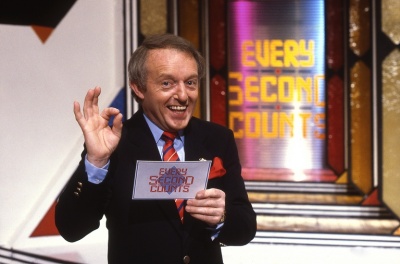 Spick and Span! - Paul Daniels
Key moments
The three-part punctuated zoom on the entrance doorway during the titles while the announcer - either Philip Talbot or Jonathan Booth - says: "And here's your host for Every... Second... Counts - Pauuul Daniels!".
We were amused by the display panel for one of the teams falling off during recording, although this had been pre-planned by the production team.
Paul Daniels sometimes brought out props for the contestants to use as part of their answers. These included talking cuddly parrots that would (deliberately, no doubt) keep talking when they shouldn't have! Similar gimmicks were also occasionally used in Wipeout once Paul had moved onto that show.
During an extra twiddly bit in the closing credits theme music, Paul would wave "Goodbye" very cheesily at the camera. (Compare and contrast with Les Dennis's "See Ya" in his later Family Fortunes episodes.)
Catchphrases
"Who's going to play first?" When the contestants had answered that question, Paul would then say, "All right, you take the front seat, you sit behind!" followed by either, "And we'll meet the next contestants" or "Let's have a look at the prizes that you could be winning on 'Every Second Counts"!
"Are you all ready to play? Say 'Yes, Paul!'"
"...But give them all a round of applause as they change seats!"
"No help from the back, please!"
"You're frozen out!"
"...And we hope you'll be taking away a couple of these prizes!"
Inventor
Curiously, this is not mentioned in the show itself. In the Russell Grant pilot, there is a credit for "Created by Charles Colorusso. Made in association with Talbot TV."
Theme music
John Mealing on top form for this show.
Trivia
Point of confusion: the contestants always got the 4-light prize and the highest prize they'd achieved, but not the prizes in-between. These prizes were always appropriate to one another (such as the 4-light prize being his and hers swimming sets and the top prize being a holiday in the Caribbean). On at least one occasion, the 4-light prize was something on the lines of a mini-TV and the top prize a complete entertainment package, but the 6-light (i.e. second-best), prize was lunch on Concorde. This rather begged the question: wasn't the latter prize actually more worth having than the top prize, if only for the amazing and unique experience that flying and dining on Concorde would have been?
One of the "warm-up" men on the programme, a Mr Bruce Thompson, once appeared as a one-man-band on Opportunity Knocks.
It was revealed both in Radio Times and in the book 'The Game Show Handbook' by David Mason that Daniels used to really go out of his way to put his contestants at ease and to go through all aspects of the show with them, including camera-angles. He also apparently used to tell them that, if there was anything they didn't understand and could therefore affect their chances on the show, for whatever reason, they could request to stop the show, even on the actual recording. We don't know how many contestants took him up on that, but it must certainly have been good to know that they had that option.
Dave and Helen Woodhouse (who you can see in the middle of the top picture above) write:
- As contestants on the first show, series 1, we can well remember the frustrations that Paul Daniels suffered during the first rehearsal. The lights didn't work and just about everything that could have gone wrong did! All went well eventually, though, and we all had a great time - made even more memorable by having dinner with Paul after the show at his favourite Chinese restaurant.
Two editions of the second series were postponed from 15 and 29 November 1986 to 25 and 31 December 1986 due to the cancellation of The Late Late Breakfast Show.
Weirdly enough, the last two series were repeated in a lunchtime slot when Wipeout - then a series into Bob Monkhouse's tenure - was taking a break during the summer of 1998.
Web links
Opening titles from the BBC Motion Graphics Archive
Videos
The first second has been counted in the very first episode.
See also
Weaver's Week review as part of a Paul Daniels appreciation.