
Secret Genius
Synopsis
"Could you possess an incredible intellect without even realising it?" Secret Genius says that it's exploring that question. The show tests puzzle-solving skills, such as spotting the missing letters from months of the year, or organising the right ice cream for the right people. 48 people compete in regional heats, whittling down to a dozen for the grand final in Oxford.
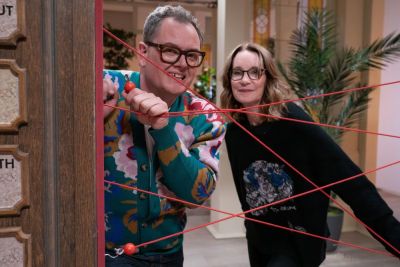 Alan Carr tries to work out what to do with a hook. Susie Dent snickers on.
Secret Genius turned out to be a people series, using the puzzles as an excuse to let people tell their stories. The first episode introduced us to the ambulance tech who remembered all her patients, the shepherd, the drag queen, the quiet civil servant, and the painfully unconfident person.
Pretty much everyone could bring a history of being ignored, dismissed, passed over, or horrendously bullied. Week after week, one contestant might allude to their formative years, and see nods of recognition from all around.
There was a structure, a contest to decide whose stories would be told. First there was a speed round, two relatively brisk problems that should be solved within twelve minutes. Four players left after this round, which felt a bit like a wasted journey.
Then there was a pairs round, one puzzle tackled by two heads. The best performer in the speed round had first choice of partner, then the next-best performer, and so on. These pairs puzzles used hidden information well – anagrams that were only visible to one of the pair, or parts of a sequence that were different from the other. Top two pairs – so four people – remained after this.
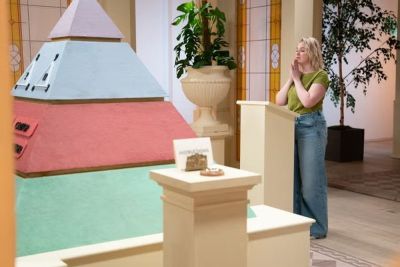 A pairs puzzle, where each partner only sees partial information.
The final was another, somewhat longer, puzzle – usually split into two or more little stages. Worst result in this puzzle left the contest, with the remaining three progressing to the final.
Broadly the same format in the final - twelve became eight through a speed round, then the "pairs" puzzle was a race to the finish with the worse player losing. Two more increasingly complex puzzles reduced four to two to the eventual winner.
Each puzzle was presented in the most viewer-friendly way possible: we saw the puzzle with one person or pair, then worked through the solution with them. Susie and Alan were watching footage in another room, and added comments to explain or clarify what was going on. After we'd finished with the first player, others took the tests, and we'd only see edited highlights of their time.
Secret Genius said that it was testing four areas of the brain: memory, verbal reasoning, numerical reasoning, and "fluid reasoning" – spotting patterns and applying them. Generally, the "speed round" puzzles would use two of these areas, the pairs puzzle would use the other two, and at least three would be tested somewhere in the final puzzle. The show was made with cleverclogs organisation Mensa, who had made sure the puzzles were good tests for the relevant area, and had members take the tests to ensure that they were properly graded.
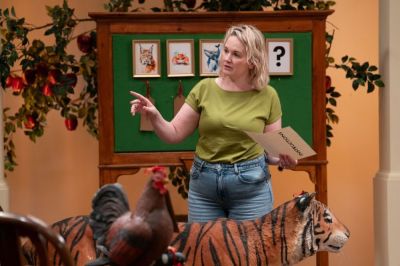 A contestant tries to work out what's going on with all these animals.
Promotion for the series went on about how pleasant it was. "This isn't humiliation, it's validation. It is about the workings of the brain, but not in the traditional academic sense. We're testing a sort of innate intelligence that a lot of people don't realise they have, and I love the idea of sending them on their way with a new confidence in their hearts," said host Susie Dent in press coverage.
"The games are just so fun, and they have such play-along-ability," said Alan Carr. "It's like Gladiators of the mind. You know when you're watching World's Strongest Man and they pull a caravan, and you're thinking, 'How do you do that?' I got that same rush watching these players tackle the games," Carr was quoted as saying.
Champion
Nathan