
The Hunt
Host
Mark Bazeley (narrator)
Co-host
Joanna Elliot (in-game announcements, credited as "voice-over")
Broadcast
CPL Productions and GroupM Motion Entertainment for Channel 4, 22 March 2026 to 7 April 2026 (9 episodes in 1 series)
Synopsis
A Channel 4 press release cantered into our inbox. Let's unpick it.
"Deep in a vast unforgiving forest, contestants are dropped into the ultimate real-world game of hide and seek - where losing means walking away with nothing and winning could mean pocketing up to £100,000. Surviving the game isn’t about being the fastest. It’s about being the smartest."
When we saw it, The Hunt turned out to be a very uneasy mix of hiding in a forest, and of forging alliances to play a social game. For viewers, it was made more uneasy by editing that kept us at a distance from the players, and a visual aesthetic that sometimes made the show actively worse.
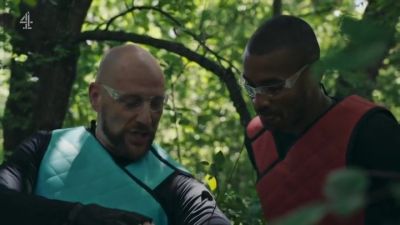 Two contestants, one Predator and one Prey, discuss how to work together to eliminate their mutual foe.
"Each episode is built around a tense, dog-eat-dog hunt, where each player becomes either a Predator or Prey."
The press release said "tense". The results announcement often said "no captures were made today", which is about as tense as wondering whether Poirot will find out the poisoner tonight.
"The Prey hold the cash, desperately trying to protect their winnings while completing challenges to win more money. The Predators must hunt them down and steal their cash. If they succeed their roles are reversed and the entire game flips, with Predators suddenly become Prey."
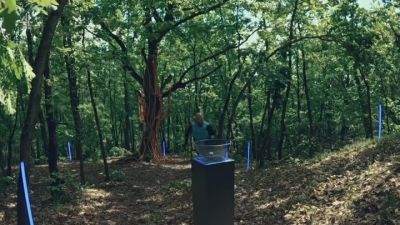 A challenge location, with wires and an alarm.
To be fair, the challenges for money were interesting - oversized The Crystal Maze games played in the middle of a forest. And the idea of roles swapping was interesting, until it became clear that the physically adept players were going to end up as Prey and the less fit folk were Predators.
"Wearing cutting-edge tracking technology, no player can hide for long in the dense forest hunting ground. Each player must keep moving to remain in the game or forfeit their money."
The press release really said that. Series winner Marc took £97,000; over the first five hunts, he made no effort to even attempt a challenge, and was almost invisible in the forest.
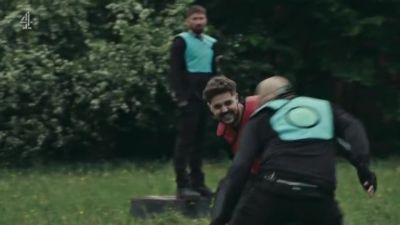 In the closing minutes of one hunt, Nathan tries to lay a hand on Roy; Marc is on a plinth and safe.
Giving praise where it is due, the producers built a great technical network in the middle of a forest in Bulgaria. A network of small network transmitters built a wireless network that could communicate with the camerapeople, and they had Bluetooth transmitters to work with "gauntlets" - large mobile phones worn on the wrist and forearm.
"Clever alliances, strategic teamwork, and mind games are the key to survival as at the end of each hunt, back at a futuristic basecamp it’s time [sic], one player will face elimination from the game."
One paragraph in the presser, yet this turned into the majority of the programme when we saw it. The hunt, it turned out, was a bit dull: they had to be spice things up by dangling the prospect of a catch, then whipping it out from under our nose.
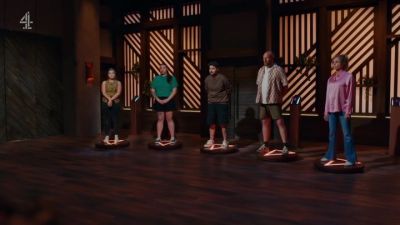 Another night on the Culling platforms.
Every day, the Prey talked amongst themselves to work out which of the Predators should be removed, a process known as a "Cull". It was massively over-wrought, trying to make a massive feature out of a simple decision. (There's a Predator stronger than most of the Prey? Cull them. If not, vote to remove an ally of your strongest rival.)
The Hunt had a strong visual identity. Players wore reversible gilets, styled to look like The Hunger Games; the hit movie franchise surely inspired the start of each hunt, with contenders standing on plinths in a circle. Headquarters was decorated to look modern and slightly futuristic, and challenges were marked with sky blue lights. But other visual decisions - a map that made no sense on screen, marking replay footage by turning the screen blurry - made it difficult to watch.
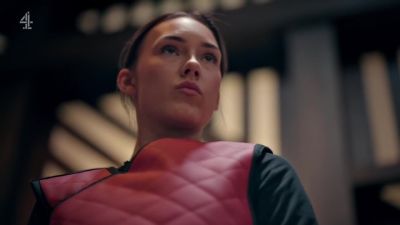 Did they commission the entire show for this shot of Mia looking like Katniss Everdeen?
"With every episode, the intensity escalates, fortunes shift, alliances shatter, and only the sharpest, strongest, and savviest will make it to the final showdown. Who will master the chase? Who will outthink the hunt? And who will walk away with the life-changing prize?"
We don't watch formats. We watch shows. And The Hunt could have been such a better show. Rules were used but never explained to the viewer. Was every single challenge won with about three seconds to spare? Really? Sound editing was hamfisted, at one point splicing together about four different conversations to make it sound like one contestant was likely to vote one way in a Cull. And the final ended as the most alienating, isolating victory ever; Marc convinced his closest ally to shaft himself, took the whole pot, and had nobody to celebrate with.
Viewers don't watch formats, they watch shows, except when they don't. Viewers did not watch this show. After some spectacularly poor live ratings - less than 200,000 for one episode - broadcast was shifted from the high-profile 9pm spot to the less-exposed 10pm hour, and all episodes were put up on the website. Channel 4 stopped selling adverts in the breaks, a clear sign they'd thrown in the towel. Although the format's been sold abroad, we don't expect a second series.
Inventor
Based on an original idea by Redseven Entertainment
Trivia
Aired on Sunday, Monday, and Tuesday nights for three weeks.