
Weaver's Week 2025-09-21
Last week | Weaver's Week Index | Next week
What did this column do on our summer holidays? Oh, the usual – we ate ice cream, we walked on the sand.
Broke a world record, too.
 Dedication, that's what we need. (BBC)
Strange Games Festival
Yes. This column, along with fifty-nine other players, took part in the World's Biggest Ever Game of Werewolf.
How can we explain this to someone who wasn't there; specifically, to someone who watches game shows on telly? "Werewolf" is a game where the uninformed majority find the enemy within the group, and where the enemy pick off a player each turn. It's the direct inspiration for The Traitors, which you're probably familiar with.
For this particular event, the wolves (the Traitors, if you will) choose to remove one player each night. Each day, the round table can choose to burn one player and take them out of the game. And the round table could also exile a player to a different village, because there were three villages, each playing a simultaneous game at the same time. Someone could be thrown out of Claudia's gothic castle in Scotland, and move to Siobhán's fairy world in Ireland, or Alan's village of merchants and thieves in London.
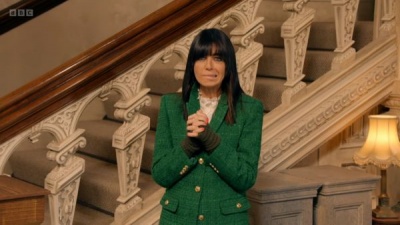 The founder of Valcarnia. (Studio Lambert)
It was played under "Wherewolf" rules, which streamlines the game and speeds it up tremendously. And everything was done to a very tight timeframe, often the village had literally seconds to decide who to burn and who to exile.
Unlike The Traitors, "Wherewolf" has a lot of roles, including the tremendously powerful Clairvoyant who can check to see if one person is evil or not. This column drew the polar opposite role, Peasant, and it was part of the village's plan to remove Peasants when there was no clear evil; we burned early, and watched the rest of the game from the sidelines. This was no bad thing, we only occasionally play regular Werewolf games, and it was best that discussion and plotting was dominated by more experienced players. (Had we survived to the final two days, we would have inherited the Angel role. Pass the crimson glow.)
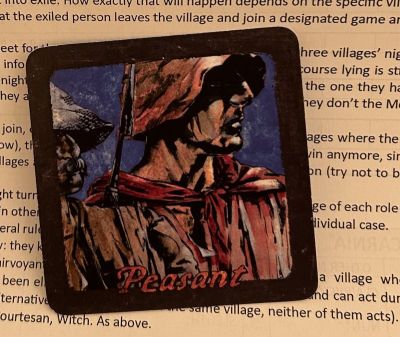 Even the most dull card is illustrated well. (Pics in this section by Weaver unless credited)
The experience left us wondering, can we apply this sort of exile mechanic back to The Traitors? Could we have a joint series between RT and the BBC, with players being exiled in real time from Claudia's gothic pile to Siobhán's place? And both series going out on both broadcasters? The logistics seem possible, all we need is the broadcasters to take on the idea.
"I'm the librarian! No, I'm the empath! No, I'm the chef!" "No, you're drunk."
World Record Werewolf wasn't the only big game at Strange Games. The event started about ten years ago as a gathering of Werewolf players, and has naturally evolved to include other associated pastimes. There was a strong representation from the people who play Mafia, they'd sit around behind numbered positions and make signs and not say a word. Someone bought Two Rooms and a Boom, which takes about as long to explain as it does to play, which is fine when it's a ten-minute game.
Having heard earlier in the summer that Blood on the Clocktower was great fun, we signed up for an introductory game. Our informant was entirely right, Blood on the Clocktower is great fun, and we returned for more games later in the weekend.
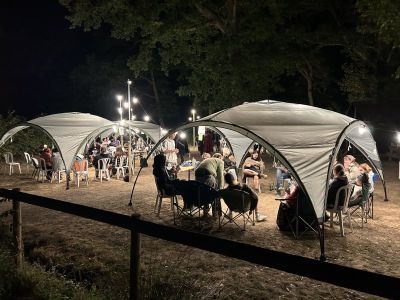 Record-setters calm themselves with another round of murder.
What is Blood on the Clocktower? It's a game of good villagers trying to root out the evil demons, so our description will again start at The Traitors. At the first round table, there's a difference: Claudia doesn't just pick out three Traitors at random, but she assigns a different role to every single player. You could be the Washerwoman, and learn that a character is in the game and who they could be. Or you might be the Undertaker, and be told the character of the player executed earlier – at least until the Evil lot kill you. Or the Imp, the sole Traitor with power to kill at night. Or you might be Drunk, and whatever you're told is unreliable.
And then players go off to their separate areas and chat, before meeting again at the round table to execute someone, and then the demon exacts their revenge, and eventually Good or Evil wins. We could explain it further, but it might be easier to point you at a video and say, here's Ken and some friends from Genius Game trying to figure it out.
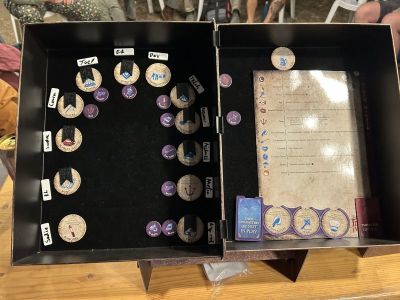 Evil wins after the town executes the mayor.
One great advantage of a special beginner's game is that the Storyteller (who runs the game) assumes nobody knows anything about the rules. Might have taken two-and-a-bit hours to push through the game, but it was a tremendous learning opportunity – the relaxed pace really helped, so did explanations as points naturally arose. And the slow pace helped some of the more confused players find their bearings, and inadvertently progress the game in their favour – in one case, by playing this column like a fiddle. We're here for it, we have nothing but admiration for any stranger who can convince us to blow up our own team's chances.
Strange Games Festival was established by players of these social deduction game, but has grown to be much more. There was a full set of tabletop role playing games – from what little we saw, mostly dice-and-combat, but we stand to be corrected by anyone with any great knowledge of the genre. There were some "megagames", RPGs where people tried to start up a galactic colony, or dealt with advancing Viking hordes; because this column hasn't yet cloned itself, we could only be in one place at one time and missed out on these.
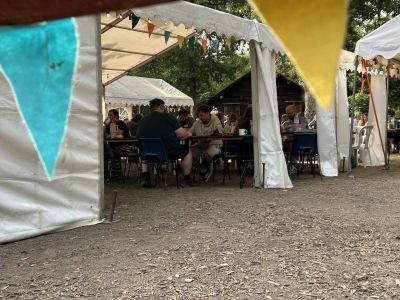 9.30am, and the board game tent is almost full.
The festival contained a massive set of board games, enough to fill the shelves of a large wall and overflow into the next building. If you wanted to find a familiar game, it was probably there. If you wanted to test a game you'd never played before but heard a lot about, it was probably there. If you want to read the rules of Wingspan, they're in the box, but your weekend is precious and it's quicker just to play and learn as you go.
"The only person I've betrayed is my own son"
SPIES is a new conversation game, still under development, and very much suited to the Strange Games environment. A bunch of spies are working for various governments, and gather in a room. Owing to budget cuts at MI3½, small groups of spies all share the same codeword; some may be interested in "Zero", others talk about their "Garden", or their "Hall".
Players talk amongst themselves, hinting at their codeword. A conversation might run, "So, how are your weeds this year?" "Well, I've got none left." "And your trellis?" "Never had a good one." "Anything more you'd like to say, petal?" "Not a thing, duckie."
The main objective of the game is for players to find and work with other players on the same team, and establish each other's codewords. Then to work out which other players are on which other teams, and associate the correct codeword with each player. To help in this endeavour, the game gives each player five missions, such as "Which team is Foxy on?" or "Find another player with the Green challenge"; these score points if completed successfully, and give certain information even if completed unsuccessfully.
 We didn't get any pictures of SPIES, so here's Robbie the cat.
SPIES plays to a tight time limit, and the scoring is based on a percentage of players associated to their correct team, and with the correct codeword, and the mission points. Everything is done through interaction with a mini website, so a phone and decent mobile signal are essential.
We played a couple of games with about ten players, which is really as small as SPIES can sensibly go. There was also a Mega-SPIES event, pushing the tech to its limit with 150 players split into three teams and at least nine codewords to guess across a whole afternoon. SPIES is a game that has to be experienced, we don't see it working on the television or streaming, but it is very good fun.
Scouting for a conclusion
At this point, we really ought to link to Chris's write-up of Strange Games, which covers a lot of the practicalities, and other things we didn't have time to cover. There was the homebrew versions of The Traitors (it's like Werewolf, but with added scones), Genius Game, escape boxes, Starship Bridge, a Puzzled Pint, and much much more. Even if this column had been able to split itself into four or five footnotes, we still wouldn't have experienced everything we wanted to see.
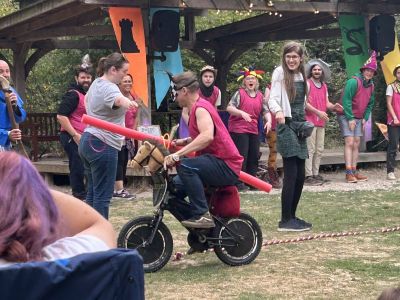 Young* warriors try to lance rings while riding teeny-tiny pedal cycles.
There were arena activities, including The Unicorn Cup, an entertainment loosely based on Jeux Sans Frontieres with jousting on bicycles and throwing axes at helmets on a stick: more smiles per minute than anything else. And there was Human Twin Tin Bots, a full-sized version of an out-of-print board game which teaches basic concepts in computer programming. Suitable for all the family, this column shared board space with a group of teenagers, and a father with his two young 'uns.
The whole event took place on a Scout and Guide campsite near Eastbourne. The site was beautifully maintained by the youngsters: toilets cleaned, archery lessons given, and some of the most delicious smoothies created. The Scouts all referred to each other by their own codenames, so Prince could talk to her brother Princess about their brother Meredith and make sure they knew where Phoenix had put the cleaning equipment. Reminded this column of Raven, where the young warriors' anonymity was preserved through a consistent pseudonym.
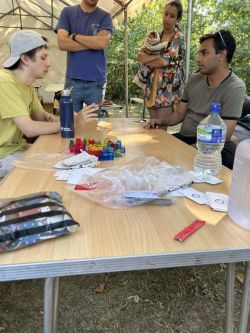 Two competitors in Genius Game face off in a death match.
What didn't we see? No cosplay, apart from a few white-clad plastic soldiers from one of the Star Journey / Battles franchises. Nothing that would pass muster as LARP, and no events that strayed outside their assigned zones. Nor was there much recorded music – apart from the food area, and the sound of Radio Active piped into the toilets, the site was entirely free of the repetitive thumpity-thump of modern culture.
The vibe was radically different from any other event, and took a bit of getting used to. It felt like the outside world had been left far behind, all the day-to-day nonsense was over the garden wall. People came as they were, and people were accepted for who they were. Introductions were brisk and precise: no need for age or location or occupation in the outside world, "Weaver, they-them, first time player" was all that's needed. Strange Games represented a chance for people to grow, to expand their horizons; on the last afternoon, we spotted Foxy from SPIES living their dream in the Clocktower Storyteller role, and doubtless making a very good impression.
We're going to conclude each section with Big Shout Outs to people who made a massive impression on us and made the event better: could be something big, could be something teeny-tiny that's stuck in our memory. For Strange Games, it's:
- Jenny, the Storyteller at Clocktower For Beginners, went slowly and patiently and walked us up the game's learning slopes.
- Nicky and Diana, inventors of SPIES, which could be as popular as it is good fun.
- Sophie, ripping an apple into two neat halves with their bare hands.
- Sebby, who helped us with tech problems and got us further links into the Clocktower pastime.
- Christian and the moderators for World Record Werewolf, extreme levels of preparation paid off with a smooth event.
- Simon, the creator and guiding mind behind Strange Games.
Journey to the End of the Night
Rewind the calendar to the last week of June, when lots and lots of people gathered in a scorching Trafalgar Square. Most of them were there to celebrate all things Canadian – great music from The Arkells and Ceileigh Cardinal, some Mounties to have your picture taken with, and lashings of poutine.
About a hundred people were there to play a game. On the hottest and most humid Saturday since the invention of ice hockey, these fools were going to scamper round the city and try to complete some tasks.
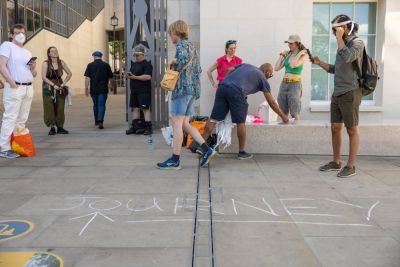 A journey of a thousand steps begins here. (Pictures in this section by Kasia Wawrzon-Stewart.)
Journey to the End of the Night traces its roots to San Francisco in 2006. It was played in New York and Minneapolis, then crossed the Atlantic to Vienna and London. The basic idea of the game is "urban tag": get from place to place without being touched by the bad team. Long-term readers of this column might remember us getting very excited about 2.8 Hours Later some time ago; that was a more clearly zombie-themed offshoot of Journey to the End of the Night. (See Weeks in 2011 and 2012, and the documentary we made for the Fifty-50 Podcast from November 2013... oh.)
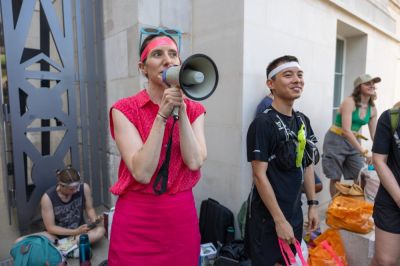 Rachel (left) makes the opening announcements .
After quite some years in abeyance, Journey to the End of the Night was revived in London last year. Rachel is the event mastermind, a former player from Minneapolis. Each event has its own style and traditions; the London revival takes place in June, begins late in the afternoon at 5pm, and finishes just as it's getting dark at 9pm.
From the looks of it, other cities tend to begin around nightfall and finish somewhere around midnight. Indeed, this weekend's event in Chicago began at 6pm, with sunset at 6.50 and effective darkness by 7.20. We suspect that it would be a significantly different game in the dark: chasers and players would be much less able to see each other.
 The mad scientist's time machine always works perfectly, right?
There is always a loose story around which Journey to the End of the Night can hang. This year, it was time travel: we were all participating in a grand experiment, travelling through space and time to repair a broken time machine, and hoping not to come into contact with the parasites and time-bugs along the way. To help us out, we were all issued with a map showing the approximate route, and being very precise about what the safe areas were – chasers couldn't catch us in a safe zone.
London's rules are that trains are a legitimate mode of transport, buses are not, and that "trains" includes the underground. So, having attached on to a group of far younger players, we all struck out for a tube station. Are we headed for Charing Cross, being the one closest to Trafalgar Square? No, Embankment, a bit further down the road, hope to out-wit the chasers. It's a good job we did; as our train pulled past the platform at Charing Cross, we saw a chaser taking the ribbon from a player. Corks, we could all have been out before the game really began.
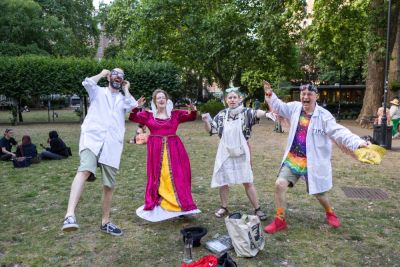 Who's Queenie?
Off at Euston and we head to the first checkpoint at Russell Square. By actually getting there without being caught, that becomes a personal best for this column, and we're able to be sent on our way by Queen Elizabeth and her retained scientists to do some timey-wimey stuff.
As it's still 30 degrees of hot and that's too hot to walk, so we head back to Euston, across to Angel, and down to the next checkpoint in Spa Fields. Here, we're to retrieve a globe-shaped crystal from a group of priests, who will give it to help bury the dead. (The plot made sense when it was written, and probably made sense when it was explained, but not when it was heard in 30 degrees of hot.)
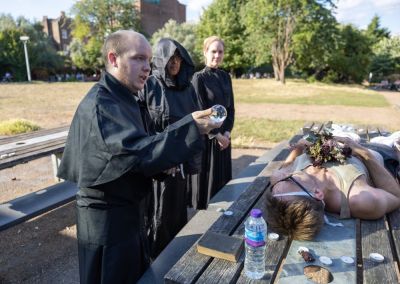 May the crystal ball prove useful.
Now, what we should have done was let the member of our team in a pirate costume pretend to be dead, and back up her claim with some pure Monty Python. "She has ceased to sail! Her mainbrace is forever spliced! She is pieces of late! She has joined the choi-arr eternal! This, good father, is an ex-pirate!"
That's what we should have done. Instead, muggins here had to hold our breath and keep eyes tightly closed (even through our sunglasses) until the priests were satisfied.
We had to walk to the next location at the Barbican, and things were going brilliantly until the final junction, when one of the chasers came zooming down the road, and seemed to have enough sprint to run a complete sprint relay himself. The Pirate was the first one he reached, and tagged her with a tap on the shoulder; this column swears that the Pirate tapped our shoulder as we passed a moment later, but she insisted we run on. We got about 200 metres, started up the ramp to the safe zone, but hadn't realised the safe zone began at the top of the ramp not the bottom, and that made us an easy target for another chaser.
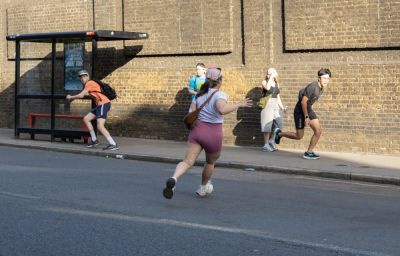 When a chaser comes, scarper.
Game over? No, not at all. Returning to ground level, we had a choice. We could play the remainder of the course, complete the tasks and finish the story. Or we could work with the Pirate and try to catch other players – bait them into walking into our trap. We chose the latter, and took up position down one of the alleys off Moorgate. While we were conferring about our best place, another of our original team ran past us, quickly followed by the same chaser who caught the Pirate. A few minutes later, the First Mate caught up with the two of us, a three-strong catching team.
Sadly, that was the end of the action. We waited about two hours on Lower Thames Street, hoping to lure runners into our little lobster pot; moments after we'd given up, we saw a couple of active runners on the south side and gave chase but they were far too fast. By the time nine o'clock rolled around, just eleven players from an original 80 had completed the course; the two that First Mate and this column had pursued came in a few minutes later, followed about half-an-hour later by a couple who had completed the course with small dogs.
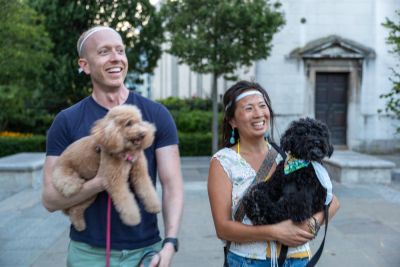 The dogs, and their humans, completed the course.
Journey to the End of the Night is a work in progress. In this column's view, this year's event was somewhat compromised by the extreme heat of the evening, making it difficult for anyone to physically run for extended periods. Each city has its own spin on the game, and it's clear that London takes advantage of the daylight and puts a lot of effort into the activities at the checkpoints – the ones we didn't get to see included a challenge to describe events in your own life, a board game using the life of Samuel Pepys as squares, and a meta-puzzle using the diary entries collected around the course. We rather hope that the organisers make more of these clever little challenges in future years, and this column has offered to assist and make that happen. Keep an eye on https://londonjourney.org for more.
Big Shout Outs from Journey to:
- Tom, Thea, and Tabitha, the pirate crew who picked up this column and gave great company. And who said they'd been alerted through Blood on the Clocktower players, and strongly recommended the game to us. How right they were!
- Dan, another of the pirate crew who actually went off and finished the course without getting caught.
- Lexi, the graphic designer whose detailed maps were excellent and clear
- Rachel, the driving force behind this whole event
DASH, the puzzle hunt
Everyone's favourite worldwide puzzle hunt returned last weekend. For the first time since 2019, a group of puzzlers gathered to pit their wits against some fiendish challenges. All the stars were there: Ken from Geniuses Do Blood on the Clocktower, Ben from The Genius Game Style Guide, David the UKGS editor, leading researchers and lawyers and statisticians, and whatever it is this column does.
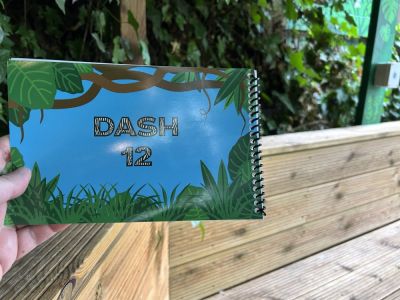 Will this do as a title card? (Pics in this section by Weaver unless credited)
DASH is, at heart, a crawl of pubs and cafés, with a puzzle to solve at each. Solve the puzzle, earn some points, and find out where to go next. The event takes place in cities worldwide, from Melbourne to Toronto to Brno, and there's a global leaderboard to find out where you finish.
The first challenge was to get to the start point, at the Primrose Hill lookout. Here's a hack for the next time some blighter asks you to go up Primrose Hill: come at it from Swiss Cottage, the incline is much less steep. A number of gameskeepers were familiar faces, event runner Gareth had tapped up some friends from his Clocktower group, many of whom had been to Strange Games a few weeks earlier. Registration took place – albeit somewhat less efficiently than we might have hoped – and the contest got going a mere half-hour after the advertised time.
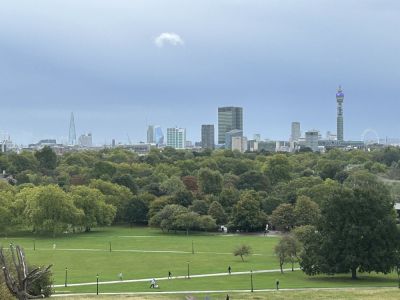 Looks wet over the Bewilderness.
DASH's puzzles this year were themed around an animal sanctuary; they're available online. We began with a bit of a warm-up, a piece of whimsy involving the collective names for animals, and exactly how many of them there were. Then came a lovely puzzle, fitting together an ant's nest and then overlaying it with transparent squares that might make words, and a mind-boggling extraction for the answer.
The late start meant that it was already lunchtime before we began the next puzzle; foolishly, we chose to honour the organisers' advice and do puzzle then food. This was an error. It was a 75-minute marathon, three smaller puzzles. There was a bunch of cryptic crossword clues, a sound puzzle that only worked in some North American accents, and a two-page wall of text that partly clued an arrangement of city blocks. Then the answers went into a grid of letters, which was then cut up and re-arranged. None of these components met with our approval, we were hungry and frustrated, and there was at least one instance when someone stepped outside to get the frustration out of their system. The final solve (after 85 minutes) was a hit-and-hope based on anagramming some letters that may or may not have been right. Once we'd caught our breath, the politest thing our group could say was that it was one small puzzle short of being a mediocre Puzzled Pint.
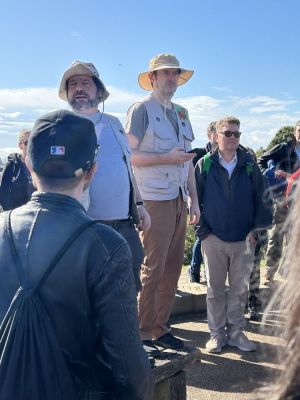 Organisers Michael and Jan address the crowd.
A spot of lunch restored our mental equilibrium, and a much more pleasant puzzle followed at the Regents' Park Café. This one filled in the stripes of a zebra – but which zebra were we working with, and how would the message resolve? Our mood was further lifted by some pleasant jazz wafting in from the nearby bandstand.
The animal themes from this year's DASH invited the organisers to take a route close to the London Zoo; if we'd wanted to, we could have walked through part of the zoo grounds on the way to this puzzle. We were also advised to take a walk through the park's rose garden and by the pond; a lovely walk, though perhaps not one we could budget within the time. DASH has a strict time limit of 10 hours to solve the puzzles, and that's to include over 6 hours of puzzles, walks from site to site, ordering something to drink at every location, reviewing the facilities because you've ordered something to drink, and a spot of lunch. Something needed to give, and sadly we think the lovely walk is the most obvious candidate.
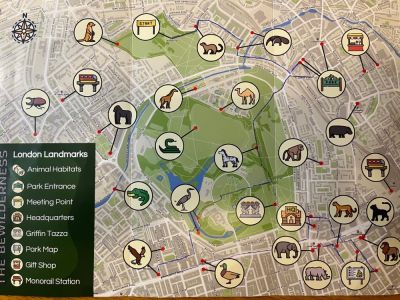 The event's map marked the real location of some animals (Rob)
Two puzzles were done in the Marylebone area; one involved a deck of cards with pictures and partial letter-forms, which had to be ordered every which way. The other was a simple piece of mechanics, everyone had their own deck of cards with instructions to follow and trivia to complete. There was also a rubber duck.
Setup for the latter puzzle was unfortunately complex; DASH coincided with what the Dutch call a «demohatie», and planned to use a pub that was packed to the rafters with people who had been on that protest. It put the volunteer gameskeepers in an impossible position – decamp to a less dangerous spot, or ask players to jeopardise their personal safety by playing with rubber ducks in the middle of a crowd spoiling for a fight? There is no easy answer, there is no correct answer within the DASH people's control.
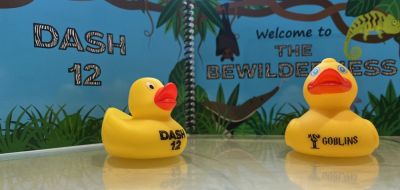 The DASH 2025 duck meets his counterpart from 2015. (Rob)
After that, we moved to a pub near Great Portland Street for a set of Japanese-inspired puzzles: some paths, some walls, some number challenges. Each was linked to another puzzle of the same type, which is a very clever idea. This set worked for the team member who was experienced with the forms, and made little sense to anyone else. Then a bunch of animal names spelled out phonetically took us through the park, a puzzle we were able to short-cut through and give ourselves enough time to complete.
On arrival at the final pub, one of our team wondered if there were DASH people downstairs; this column went off to investigate (and to use the facilities). No, there aren't DASH people downstairs. These are Clocktower players, and is that a group having their story told by young Foxy? So it is! Aren't they the lucky ones.
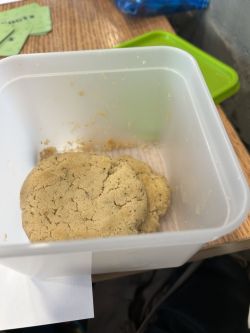 This column brought cookies from a recipe by {SPOILER FOR A PUZZLE}
DASH had handed out a guidebook to the animal sanctuary at the start; we'd used it throughout the day, and the final meta puzzle was no exception. In the final analysis, we ended with 429 marks, tied fourth amongst Standard teams in London; perhaps we'd have been third if we hadn't lost a couple of minutes running for safety and dodging the haters.
Overall, DASH was fun, though we'd completely forgotten how exhausting it was. Never mind exercise to outsprint people at Journey to the End of the Night, we need to hit the gym to prepare for DASH next year! More seriously, we think there was a lot crammed into the day – a full set of puzzles, something like 9km of walk, and all under the cosh of a super-strict time limit. We're reminded of Coco Chanel's fashion advice: always take something off an outfit, it gives everything else the chance to shine.
Big Shout Outs:
- Freya, Richard, and Rob, the other members of Turning Procrastination Into an Art Form, Except the Box to Type In the Name is Like the Margins of Fermat's Arithmetica and Too Small to Contain Our Marvellous Full Name, So We Will Have to Truncate It.
- The jazz band in Regent's Park. More puzzles should be solved to a live band playing quiet be-bop.
- Ed and Amy, gameskeepers in The Metropolitan, for extreme grace and resilience under impossible pressure.
- Someone we spoke to outside the Queen's Head and Artichoke pub, who helped us explain DASH in a simple way.
- Michael, Jan, and Gareth, the London leads, who wrangled 300 people into a maze of twisty passages without us falling over each other.
Particular thanks to Chris, who shared all of these cool things with us; we wouldn't have done any of them without his thoughtfulness.
In other news

Tim Davie is wrong "Eurovision has never been about politics", claimed the BBC's current Director-General this week. This is complete cobblers; the Eurovision network was set up amongst public service broadcasters so that they could co-operate in the face of the communist threat from the Soviet Union and its satellite states. The Eurovision Song Contest was established, in part, to celebrate European culture as distinct from the popular songs brought over by the Americans.
Eurovision is a completely political project. It is in favour of peace, and against war. It is in favour of sharing culture, and against isolationist tendencies. It is in favour of making sports available at no cost – we learned this week that Eurovision Sports has rights to curling's top tournaments, and the orienteering world cup, and the world skate championship.
It's a political decision to share these pieces of culture, just as it's a political decision for the overtly political appointee Tim Davie to bury his head in the sand and pretend that the political is somehow neutral.
Quizzy Mondays
Only Connect saw the Pear Trees defeat the Caraxians by 28-22, rather running away with it in Missing Vowels. Spot of the night has to be the Caraxians getting "Mock" things after just two clues. Fun fact of the night was that Freddie Mercury and Queen had a whale of a time performing for Groucho Marx after they'd named two albums after Marx Brothers films. There was also a bonus laundry quiz, a rendition of "Old MacDonald had a farm", and Victoria continued to read from Paradise Lost at the end of the show.
Trinity Hall Cambridge played London School of Economics on University Challenge; the LSE won 215-135. Decent performances from both sides, LSE 58% correct overall and 68% on their bonuses; Trinity Hall were 63% on their bonuses. Both sides picked up four penalties for incorrect interruptions, and the questions showed a strong bias towards religion and philosophy and politics – perhaps this helped LSE a little, but cannot account for the entire difference.
Surprise of the night was Amol Rajan's unusual pronunciation of "guerilla", the irregular military involved in skirmish actions rather than a full-on battle. It looks like "gorilla", the great ape, but is most usually pronounced "geer-illa". Rajan appears to revert to the word's Spanish origins, and when giving an answer pronounced it "gaer-reeya". The purpose of the host is to communicate quickly and easily, which wouldn't be possible when we have to think about what Rajan just said.
Eric Davis won on Mastermind, taking the History of Coventry and only losing his perfect specialist round after the buzzer on the very last question. Once again, all four contenders had excellent specialist sets, and it was the general knowledge that won it in the end.
This week, RuPaul's Drag Race begins competition (BBC3, Thu), and it's the first proper performance on Strictly Come Dancing (BBC1, Sat). Winners emerge on The Traitors Ireland (RTÉ1, Tue), on The Inheritance (C4, Tue), and Masterchef Goes Large (BBC1, Fri).
To have Weaver's Week emailed to you on publication day, receive our exclusive TV roundup of the game shows in the week ahead, and chat to other ukgameshows.com readers, sign up to our Google Group.