
Weaver's Week 2025-09-07
Last week | Weaver's Week Index | Next week
We got there in the end.
Made by Two Four, shown on BBC1, 30 July – 28 August
The first episode of any new series is always going to be difficult. The first episode of a reality show can be really difficult. We're bombarded with endless new faces, new format points, and it can all get terribly confusing. We viewers need to have time to breathe, a moment to soak up what just happened before we move on to the next idea.
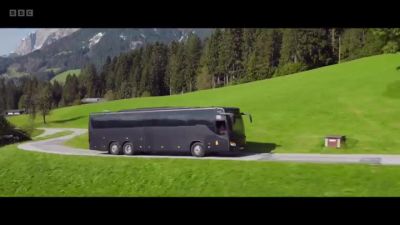 The bus is on the road again. (all pics: Two Four)
The Traitors is a masterclass in how to do a first episode very well: introduce us to some of the characters as they wait for a train, an action that naturally builds up tension. Then introduce us to others on the steam-powered journey to the castle. And then Claudia guides us through the opening exchanges, the fake elimination and the chat with all the players and the selection of the players and so on and so on and so on. The show knows that we're in unfamiliar territory, and makes every effort to keep the introductions as simple and straightforward as possible. Every element is on the screen for a reason, nothing is hurried, there are no false leads.
Compare and contrast to the opening minutes of Destination X. People arrive in the departures lounge at Baden-Baden airport, and everyone sits – well, not quite in silence, but in an uncomfortable hush. Some of them are our players; some attempt to mouth words to each other. Some of them are extras, who will depart the room in a blizzard of huff when their plane is cancelled. Then there are scavenger hunts for various items around the lounge, and a contest to re-pack the contents of a suitcase so it's exactly 10kg – have we stumbled onto a rejected game from In for a Penny With Stephen Mulhern? It's a frantic and confused opening, perhaps it's meant to disorient the contestants, but it certainly made the viewers think "What the X just happened?"
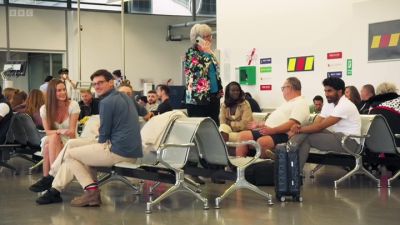 Some of these people are contestants. Not all are. We're confused already.
Eventually, after about twenty minutes, the basics of the show are established. For Claudia, it's a party for adults with lashings of wine and redemptive scones and the odd occasional murder. For Destination X, it's a trip around Europe in a room on wheels.
The wheels on the bus go round and round
At this point, we'd like to tell the tale of a typical Destination X episode. Except, there is no typical episode, each edition had some twist or alteration from the basic formula. Sure, that keeps the show varied, and means the players and viewers never know what's going to turn up. It also means the viewer can get a little frustrated at having to follow all the maddening inconsistencies, and think less of the programme as a result.
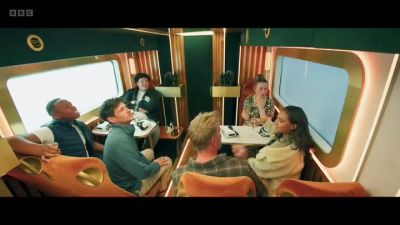 The contestants spend all their time on this bus, with no view.
Basically, the bus starts from wherever the last leg ended. The players are shown living on the bus – either the main travel bus, or the sleeping coach. We never needed to see the portapotty bus, or the spare bus in case of breakdowns, and we certainly never got to see Rob Brydon's gold-plated limousine pulled by the finest engines money can buy.
The bus drives along roads, which is exactly what one would expect a bus to do. There are no clear windows on the bus, the contestants can only see a grey shade. Perhaps they can discern which way the sun is shining, perhaps that will help them to work out the predominant direction of travel. Very occasionally, the producers will allow the windows to clear, this will be to give the contestants a clue as to where they are, or where they're going, or both, or neither.
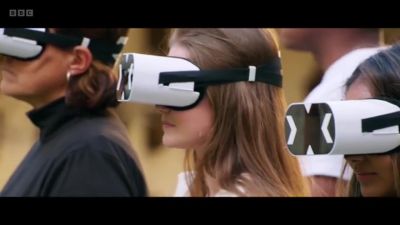 Our models wear this season's must-have accessory, the X goggles.
Once or twice in the episode, the bus will stop and the contestants will emerge. They wear "X goggles", virtual reality headsets that can be blacked out and stop the players from seeing where they are. It's a high-tech and somewhat fussy version of the blindfolds they have on The Traitors.
When they're off the bus, the players will be given a mission. Sometimes, it'll be to extract information from the scene, perhaps by metaphorically stabbing each other in the back. Sometimes, it'll be a physical challenge where the winners get lots of info and the losers might get a soup on of fact through osmosis. Back on the bus, there's a lot of swapping of information – some of the facts may be true, some data points may only be given to certain contenders and not to others.
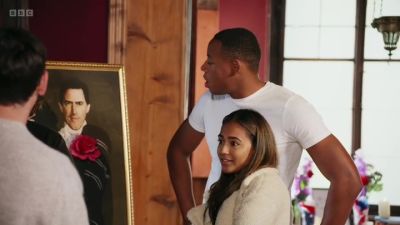 For this challenge, the players had to work out which other show features paintings of the host.
Eventually, all or some of the players visit The Map Room, and try to work out the final destination for the episode. Whoever is furthest away will lose, and be off the bus entirely.
Rob comes onto the bus, says who's been eliminated, and then the bus drives off to show where they really are. He also explains some of the clues used in the episode – how the Alsatian dog was to indicate they were in Alsace, the helmets "Grace" and "Kelly" to indicate Monaco, and "Paul got mixed up..." for the town of Pula.
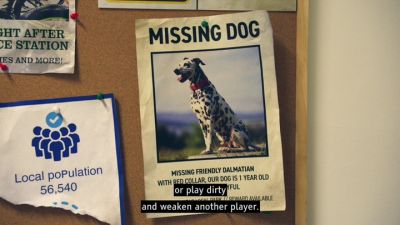 "Local PoPulation..."
The wiper on the bus goes swish swish swish
The pattern we've described above was the dominant theme, but only a couple of episodes played out in this manner. Almost every time, there was some sort of variation. People won exemptions, one time a player could add 250km to another player's distance. Another time each player could reduce their error – or increase someone else's error – in the hope that a better result could be achieved. And quite often, players were allowed to skip the Map Room entirely because they'd won in the main game earlier.
One episode was a complete outlier – the players took challenges in the city of Venice, and didn't travel on the bus at all. This may have been to comply with the European Working Time Directives, which guarantee a day off for the drivers. It may have been to inject a welcome change of pace, or get the players off the bus for an extended period for their own sanity. The episode built up to a grand prize, of a one-person free pass at the next episode's Map Room – except the prize was unused because the player won exemption in the next episode's main game, so the entire Venice episode had zero effect on the show.
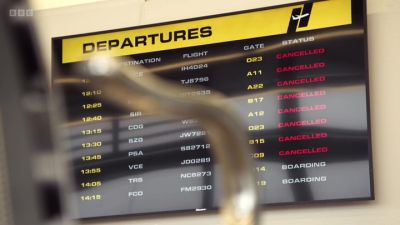 Well, that's rather given the route away: the first episode had airport codes of everywhere they'd end up visiting.
The players who didn't get on the initial cohort? They remained in the game, followed the bus round for a few legs, then rejoined during the third episode – at the cost of one of the original players. When The Traitors pulled this stunt in its first series, it was swift and brutal and they got away with it; when they repeated the trick this year, it didn't quite work. When this year's series of The Fortune Hotel threw one couple out before they'd checked in, we expected them to return – but no, they were out. (We'll have more to say about The Fortune Hotel next week.)
For the producers, having people join late can be an advantage, it keeps the show somewhere around the optimum level of six-to-ten people right through the tour. But there are risks – the newcomers are certain to stir up hostility from people who have been there all along, and might be bounced from the game at the earliest opportunity – or sidelined and literally ignored.
The clues left us nonplussed. Very often, they relied upon cultural stereotypes; we can easily forgive them for picking a bunch of Bratwurst as a hint that "you are in Bavaria", but we felt that too many of the challenges were rooted in superficial ideas – wine tasting in northern Italy, football in Croatia, gambling for Monaco.
 The contestants are in this massive box. What's outside the box? That is interesting...
There were red herrings, but they were never properly explained, and many of them just seemed to be chaff. The producers eschewed an opportunity to make tight and satisfying clues, where the right answers would prove you're right, and the wrong ones would be demonstrably wrong.
For instance, the opening episode had the players see things outside of a wooden box. The distracting clues were the footballer Kevin de Bruyne, tulips, a St Bernard dog, and Swiss roll; the correct clues were footballer Zinedine Zidane, roses with a V on top, an Alsatian, and patisseries. Everyone shared their information, and surely players will have worked out that they were in France.
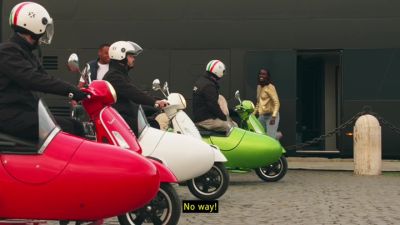 Late in the series, players were driven around on little motorbikes.
It's worth noting that the challenges were purely for information, they had no bearing on the prize fund. The winner was going to take £100,000 whatever happened. The team could succeed admirably, they could all fail miserably, it didn't matter to the prize. It might matter to their opponents; there were some challenges where people played for (or against) each other, and others where you had to read people to win. The Venice episode ended with a challenge to match the player with their special person; it takes talent to get all seven answers correct.
But the challenges tended to hit the same beats. A lot of memory tests – remember this code, remember that sequence. We weren't shown much evidence that players were using contextual clues to work out where they were – sure, plenty of scrabbling for a quick look in the opening few episodes, but when one player said "It's hot, so I know we're not in Paris", this was an unusual way of playing. It would be possible for Destination X to rely on existing clues, with a few extras put in place by the producers; they chose to have almost all the clues inserted from the production side.
The beeper on the bus goes beep beep beep
At heart, Destination X is roughly one-fifth geographic knowledge and four-fifths a people game. It's social networking; the winners will know who to share a clue with, who has helped you out in the past and who you want to keep on the right side for the future. A transactional contest? Certainly. One where loyalty is strained until it breaks? Absolutely.
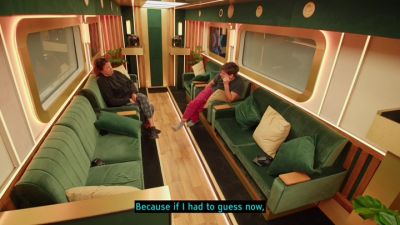 Does Claire trust Nick? Discuss: there's nothing else to do here.
It's said that British audiences don't particularly like "game play" – the way contestants build their own cliques, and divide into little groups who pool resources. (Perhaps this is one reason why Survivor has consistently flopped over here: the only way to win Survivor is to convince other people that you can help them, that they can trust you, and then betray that trust.) Because the audience dislike such social trading, players a) aren't shown examples of good social trading to emulate and improve, and b) don't have this at the top of their mind when on the bus. And so the cycle continues.
The net result is that we're left with players who are deliberately and overtly keeping information from each other. Some people are going to feel badly excluded, and hurt. The conditions on the bus are psychologically damaging: you can't look out of the window because there's no window, you can't read a book or listen to music, all you can do is talk to the handful of other people, some of whom you wouldn't help if they were on fire. Heck, if the contestants hadn't volunteered for this experience, we'd wonder if they were somehow being tortured.
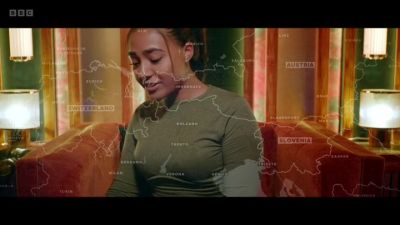 A rare shot of a player in the map room.
Sad to say, it felt like the contestants were being given some sort of psychological damage. Tempers were frayed, the atmosphere on the bus was so thick that even the most skilful editors couldn't hide it from view, or drown it out with off-brand Muzak. By the time we got to the final episode, everyone was tired and emotional, and one contender was barely on speaking terms with the other two.
The final episode completely ripped up the show's conceit – rather than ask where we are, players were told "Hey, we've made it to Rome!" A series of tasks awaited them, and the best performer would win the show's £100,000 jackpot. There had been no fiddling with the prize – we were told on day one that it's a £100,000 jackpot, nothing added, nothing taken away.
Destination X was presented as a simple question, easy to understand, easy to answer: where the X are we? But that's not a terribly interesting question. The show posed a deeper question: how few people does it take to pool clues and work out where the X we are? And can that set of people remain constant throughout the course of the journey?
Really, that social question is all there is to go on. Destination X doesn't work as a travelogue, it's Coach Trip without the sightseeing (because, you know, blacked-out windows). It doesn't work as a cleverclogs show, the clues remind us of The Masked Singer in their obviousness and high opinion of themselves. It doesn't work as a challenges show.
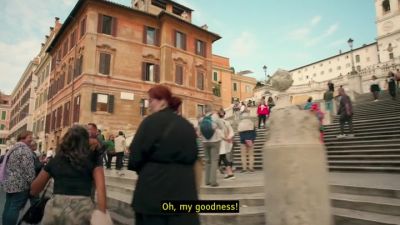 The final destination was the Spanish Steps in Rome. First there's a winner.
Back in the day, when Big Brother messed about with nominations, there had to be a sound narrative reason for this; after the first few twiddles, it became clear the Big Brother producers wanted to overtly manipulate who was in the contest, and fiddled with the noms almost every week. The show became fake and phoney, and we could tell this because they'd abandoned their core idea. Destination X gave up on its own core idea in the very first series: by the end, actually plonking of your X on the map was an unusual event.
This column watched this show. We didn't particularly enjoy it. And yet the viewing figures were more than respectable – overnight figures of around 2 million, consolidating after a week to around 3 million. Which, for the height of a hot summer, is really very decent. It's no particular surprise that BBC1 has chosen to renew Destination X for a second series – it's done far better than an average replacement show.
But will this column be back for a second tour of Europe with Rob Brydon? It won't be our first choice of entertainment, but we could be persuaded. We'd love them to pick a lane and go with it – is Destination X about the geography, or the clever clues, or is it a people show, or a challenge programme? The current hybrid makes a weak effort to be all things to all people, and does nothing well.
In other news
The Traitors Ireland began this week. We're keeping our powder dry on this series, as we expect it to turn up on BBC3 before too long. We are, however, very pleased to hear that some of the contestants spoke Irish to each other, with a fluency that the more monolingual contenders couldn't quite keep up with. It's only a few years since Channel 4's Big Brother got all stroppy when a couple of contestants conversed in their native Welsh.
BAFTA Cymru award nominations are out. We have two game show related nods:
- Luned Tonderai, director for Miriam Death of a Reality Star (Expectation Factual, C4)
- Y Llais, entertainment programme (Boom Cymru, S4C)
The latter is, of course, The Voice of Holland of Cymru.
Channel 4 has commissioned The Apocalypse, leaving a group in an abandoned town without running water, heating, or electricity. Sounds like a reboot of BBC3's I Survived a Zombie Apocalypse, only without all the PANTZ – or that nice Greg James.
We've rather enjoyed Here's What You Do, where three game show developers ask questions in a novel round. Multiplying multiple choices; Wriggle Room where you bet on how confident you are of being in the right area, and that's just part of this week's episode. Next week should have three new games. Reminds us of that Radio 4 show from about fifteen years ago where panellists brought their own rounds and quizzed each other.
Quizzy Mondays
A red-letter week for Lincoln University, who won their very first game of University Challenge. Lancaster the unfortunate losers, eventually missing out because someone thought the Severn entered England in Gloucestershire (which is where it exits England). Lincoln left some space for improvement next time, an overall scoring rate of 46% is below some losing sides, and 42% on bonuses means we fear Lincoln could be first team out in the next phase. Still, it's an achievement to have made the last 16, and more than any Oxford University college has managed so far.
After last week's fireworks, Only Connect returned to something approximating normality as the Sorcerers beat the Jive Bunnies by 19-16. Winning move was when the Sorcerers dredged up an example for the sequence:
evilish (evil) rude (rude) rat (troublemaker)
Prefix the words with D, C, B, A to form synonyms of the word in brackets, so lone (solo) the most obvious example. Not sure Victoria would have taken the explanation on its own, and she surely won't in the next round. Jive Bunnies had a bit of a 'mare on the wall, but almost made up for it in Missing Vowels.
Very high scores on Mastermind, where Diane Howe followed up a Perfect Round on Catherine Parr with a near-perfect general knowledge set. A total score of 26 marks her out as a serious contender. Ian Walmsley, young bartender Jonnie Walker, and Maurizio Giacometto all scored 20 points or more, which would have been a winning score in most recent shows.
The familiar friends of Pointless return this week (BBC1, from Mon). Start of a new run for Taskmaster (C4, Thu); start of a new walk for Am Dro! (S4C, Sun). It's the final for Cooking With the Stars (ITV, Sun).
To have Weaver's Week emailed to you on publication day, receive our exclusive TV roundup of the game shows in the week ahead, and chat to other ukgameshows.com readers, sign up to our Google Group.