
Weaver's Week 2025-09-28
Last week | Weaver's Week Index | Next week
Game show historians remember the "Prisoner's Dilemma" fad. Two contestants would emerge from the game, with a splendid cash prize in front of them. And they had a choice of what to do with that money. They could choose to share it equally, and if both chose to share, that's what happened. But either one could choose to steal the money, and keep it all for themself. Ah, but if both players chose to steal, they both lost out.
"Prisoner's dilemma" first crossed our radar with the short Channel 4 series Trust Me, hosted by "Nasty" Nick Bateman just after his time on Big Brother. The apotheosis of the genre was Shafted, a massive flop for ITV and a show so rancid the majority of episodes have never been shown. Although a vestigial dilemma continued on the Love Island final until a few years ago, the last real example was on The Bank Job back in 2012.
 To share, or the [taps tablet] other thing.
Throughout its history, television has always presented the "prisoner's dilemma" as a one-off, the participants meet and play one round, and then never see each other again. Television has also presented the dilemma as a two-player game, because it is difficult enough to explain a multiple-player dilemma, and almost impossible when just one round is played.
Could a television programme attempt to model an iterated "prisoner's dilemma"? Could a television programme attempt to apply the logic behind the theory to a multi-player competition? Would it also give us cause to remember our economics classes, particularly the concept of "public goods"?
And would it have Liz Hurley looking glamorous?
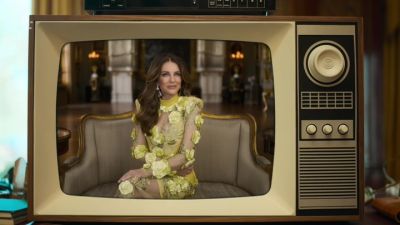 Hello, darlings. I'm dead.
Made by Studio Lambert and shown on Channel 4 for the last month, The Inheritance dressed up dusty and dry economic theory in a wrapping of glamour and poshness.
The basic story is that Liz Hurley is dead. Deceased. She has ceased to be. Her safety pins are no longer fastened. She has joined the chorus infernal. [You did this last week – Ed]
Er, yes Liz Hurley is "The Deceased", though that doesn't stop her from addressing the players through video messages (quaintly, played off some very 1990s video cassettes). Her representative on earth is Robert Rinder, the celebrity lawyer. He plays "The Executor", charged with enforcing the bizarre stipulations laid out in The Deceased's will.
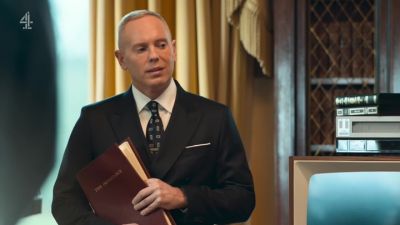 Robert Rinder, all the charisma of a damp blanket.
Thirteen members of the public have rocked up to The Deceased's estate in Hampshire, expecting to get their hands on a sizeable chunk of The Deceased's fortune; owing to some slow operations at the probate office, none of the thirteen claimants have been able to read the will, so are constantly surprised by what happens.
An average day on the estate
Unlike certain buses we could catch, The Inheritance has a reasonably consistent structure from one day to the next.
The show begins with a discussion of what happened yesterday, and how all of the players are feeling about things. Soon enough, they all gather to hear about today's "Request". It transpires that The Deceased was a high-end businesswoman, and had her fingers in a lot of pies. Fashion and society balls and luxury make-up kits, of course. But she was also involved with farming, and antiques, and held her own music festival on the estate grounds.
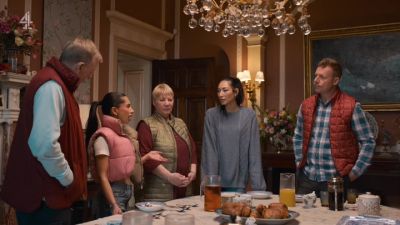 Some of the contestants gather over croissants.
In order to wind up her business affairs, the contestants are asked to complete some last make-up boxes, or sort out the sheep from the goats, or restore some of the antiques for collection, or pitch tents so that guests can sleep in them. Each item successfully completed will earn some money for the team (always said on screen as "release some money from the inheritance"). Part performance is usually rewarded; if the team complete 40 of the 100 make-up boxes, they'll earn money for those 40; if they find six of the eight prize chickens, that will earn some dosh.
To complicate matters further, the players are usually split across two or three locations. They might be able to talk to each other over walkie-talkies, or they might have to rely on each other to do the job. Transport may be provided, or it might not. No individual player is able to see everything that goes on; that is a privilege reserved for us viewers. We can see who's pulling their weight and who is taking a more lackadaisical approach to their tasks.
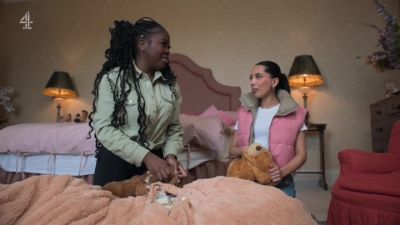 In today's task, Tia and Hafsa stuff some teddy bears.
Eventually, the Request comes to a conclusion, it's filled about half of the one-hour show. Then the players split off into little groups, talk amongst themselves about tactics and plot who might put themselves forward as a Claimant.
Claimants emerge at "The Division Ceremony". Robert Rinder, the Executor, confirms how much money was released. That cash is in a locked box, placed in the middle of the room. Anyone who thinks they were the day's strongest link can put themself forward as a Claimant, and make their case.
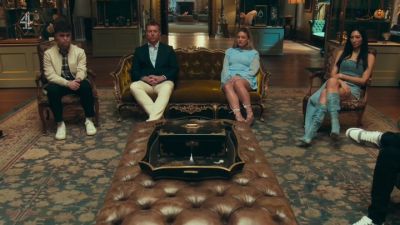 Jesse, Matt, Emma, and Zara are tonight's claimants. But who is the strongest link?
The other players – those who don't wish to be tonight's Claimants – form a jury. They're entitled to ask questions, tease out what happened, assess whether someone appears to be telling the truth, and work out in their own mind who the most deserving player was. By some means – democracy, draw straws, beating each other into a bloody pulp – the jury works out which Claimant is the winner.
That winning Claimant becomes the Prime Beneficiary, and takes sole charge of the cash. Down in the privacy of the strong room, our winner has a choice. They can keep the entire amount – and are obliged to retain half of it. But our Prime Beneficiary can gift up to half of the money to members of the jury, in whatever proportion they think fit. Claimants who failed in their claim are not allowed to be gifted anything.
(An unspoken rule of the show seemed to be that gifts had to be in multiples of £200. When Prime is dealing with relatively small prizes, like £2800, and there are eight people on the jury, someone is mechanically going to have to come away with nothing.)
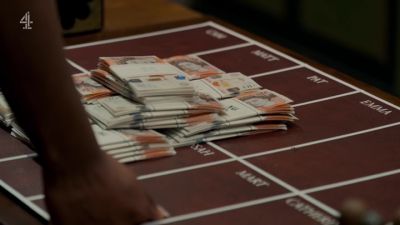 A large pile of dirty cash. How will it be divided?
Now, all of this is done in secret, away from the other players. Prime is at liberty to disclose what they did, but they do not have to, and they do not have to be truthful. Prime can say that they gifted someone £400, and that lie will hold – until that someone goes down to the strong room, opens their own money box, and finds no gift from Prime.
From time to time, the Prime Beneficiary is also asked to "cut" a player from the will. That player is eliminated from the game, though they do keep the money they've earned so far. Only the players with the least money are at risk of being cut before the final.
What did our head think of this show?
As an intellectual exercise, The Inheritance had a certain fascination. It demonstrated a couple of ideas from economics that we've never seen before.
Prisoner's dilemma, but iterated over lots of nights. Every night, the players pick one of their number to distribute the money. Will the money be distributed fairly? If it isn't, then the player might well have kept enough to remain in the game until the end, but it is going to be very difficult to trust them again. Stealing from your opponents on night four might hang round a player's neck, like a millstone or a scarlet letter, and brand them as untrustable for the rest of the show.
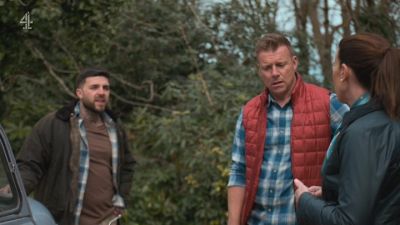 Cam, Matt, and Claire, auditioning for the next Murders at Midsummer remake.
Even amongst players who didn't get to distribute gifts, the show had elements of a prisoner's dilemma. Remember how the Requests saw the group split up, different people saw different things? It would be possible for someone to work with their friends, and promise them a great slice of the spoils, if they all pretended their aspect was harder / more gruesome / took more effort than it really was. Again, this is a risky strategy: tall tales may win favour once, but if you're constantly claiming that you worked harder than the next person even though the result was poor, your credibility will be strained.
Would it be better to lay low, keep a quiet profile, scoop up a few hundred most nights, and not be an obvious choice for the cuts? Work hard, work efficiently, hope for your time in the sun? That seemed to be a modestly successful strategy, three of the four industrious players made the final week, and two of those reached the overall final. But one was removed for being inscrutable, and another got cut simply for being bottom of the leaderboard. And they grew resentful of being under-rewarded, having their efforts taken for granted by the rest of the group. Could they be "public goods" workers, consistently undervalued by a profit-seeking society?
 Without Hannah and Emma, the team would have won about 2p.
As the game progressed, we began to wonder about rent-seekers, how hard work for a communal pot was not being rewarded. That, sadly, is a hallmark of late-stage capitalism, where some people do all the hard work, and others are given the money accrued. But Channel 4 explored this concept further in 2023's Rise and Fall, and the producers were right to leave it as a fleeting thought.
The heart has a few points
All this dry economic theory is well and good, but most viewers will have watched The Inheritance for a bit of spectacle. It is an entertainment show, and we expect to be entertained. By and large, we were disappointed.
Although it was made by Studio Lambert of The Traitors fame, they failed to capture any great sense of fun. We put that down to the host: Robert Rinder is a diffident and reserved character, in another life he could have been a John Major-a-gram. While Claudia Winkleman holds out the promise of scones and adventure, Robert is formal and stilted, offering us nothing more than weak tea and a weaker handshake. The Inheritance was walking on eggshells throughout.
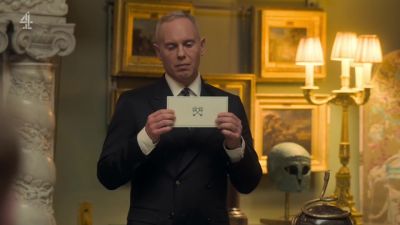 Rob's entry into Host Holding A Question Card. 4/10, must try harder.
"Hello darlings!" Elizabeth Hurley was somewhat under-used, she'd recorded all of her pieces to camera before becoming The Deceased, and never appeared on screen for more than a minute. The ultimate celebrity cameo? Wouldn't surprise us. She was a rare burst of colour and glamour and decadence, and then disappeared from the screen with her catchphrase, "Ciao, for now!"
Some points were concealed from both players and viewers. We were all told how much money had been won in the daily challenges, but even we viewers were not told where the money had been lost. We're viewers, we get a deity's view of proceedings, so do please tell us. Had, for instance, there been a failure when stuffing the teddy bear? Or was the re-creation of the painting somehow deemed not quite up to scratch?
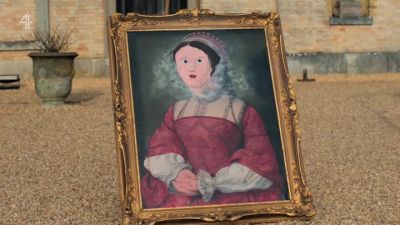 This is fine.
The casting felt like it had been done to tick boxes: we had a couple of older retired people, some arrogant business people, a couple of social media "influencers", and a few colourful characters for folk to identify with. We're not convinced that it was great to have "Matt" and "Mart" as contestants, it's very difficult to tell those names apart when spoken at any speed.
Socially, we could see the group begin to fall apart as the shows progressed. An alliance formed on the opening day between Cam, Tia, Jesse, and Hasfah; after one of them chose to lie about the money, they were exiled from the group but eventually proved to have the swing vote in the final.
Another friendship, between Emma and Hannah and Ferg, was mostly about working hard and not being rewarded for it. Claire and Matt and Mart had a rumbustious relationship, we saw them as a loose alliance, but maintained more through bickering and eventually crumbling in the second half of the series. James, Pat, and Zara were the first three to be cut from the will, and we never quite got a social read on them.
The Inheritance was a very slow burn; a flashpoint around half-way through, and plenty of kindling for the final episodes. One of the older players accused a younger one of being "na ve"; that might be forgivable, but to say they were "a naïve little girl" is sexist and ageist at the same time, completely beyond the pale. But that was one episode, and while the bigotry continued to resonate, it was not the centre of attention on screen.
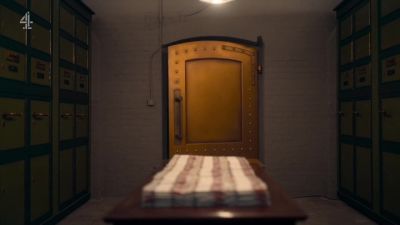 A hundred grand in bundles of cash.
Instead, we were rather led up the garden path, expecting the little mouse to roar – one of the underdogs was voted Prime Beneficiary on the penultimate night, and eliminated an inscrutable opponent. The final episode was to choose one person to split a prize of 100,000 (with a completely pointless side-bar to have one player remove themself and take 20,000). Would the little mouse have taken all the money and left their friends disappointed? In the event, we'll never know, because the swing vote remained loyal to their original alliance, and the appointed person chose a non-selfish division.
Did The Inheritance tell us anything much about anything much?
To be honest, not really. The basic lesson: people will stab each other in the back for £400, which didn't come as any surprise. The sanctimonious viewer might say "the love of money is the root of all evil", the judgemental viewer might say "this player was bad, and this player was bad, and this player was horrible, and I'm bad for hate-watching this".
We found the programme to be austere, remote, diffident, and a difficult watch. It was hard to get too invested in the players' collective journey, and had two of the hardest workers been cut or walked in episode 6 – which briefly seemed a very likely outcome – we might have abandoned the show there and then. Viewing figures remained depressed throughout, overnights of 700,000 are poor for Channel 4, and only about twice what Countdown can expect to get.
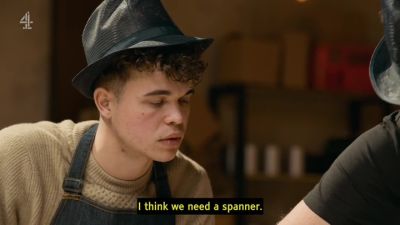 Jesse thinks the group needs a spanner. Contestant, look around you.
Throughout The Inheritance, we felt a bit manipulated, a bit led on by the edit: pieces to camera and footage from the games were cut in such a way as to lead us to expect one outcome, only for our expectation to be subverted. Do that occasionally, it's a fair narrative technique; do it all the time, it becomes tiresome. So did the background music; nothing wrong with Tom Howe and Steve Tait's composed music, but the editors ensured there was barely a moment of quiet in the whole show.
Studio Lambert has a high reputation in the industry, and it's not a reputation we have strong evidence to share. Sure, they've got The Traitors right, but how much of that is down to the original IDTV format's brilliance? Studio Lambert do Race Across the World, manipulating emotions since 2018; Gogglebox, telling the viewing public what to think about television; and they did the unspeakably vile Love Thy Neighbour.
Studio Lambert also take risks, like on The Circle and Rise and Fall and BBC3 comedy-drama Boarders. Erring on the side of charity, we'll chalk this one up as another risk, and one that didn't quite pay off. We hope that all concerned can use it as a learning experience, the players about themselves, and the producers for what the viewing audience wants and what we do not.
In other news
TV Times magazine turned 70 this month, and still holds its annual TV Times Awards. Game show folk nominated are:
- TV Icon Of Today: Mary Berry, Stephen Fry, Ant and Dec, David Tennant, Bradley Walsh (also David Attenborough, Lenny Henry, David Jason, Joanna Lumley, and Helen Mirren)
- Presenter: Ant and Dec (for Got Talent), Joel Dommett (The Masked Singer), Claudia Winkleman (The Traitors) (also non-game work from Tom Allen, Susan Calman, Alison Hammond, Alex Jones, Gethin Jones, Susanna Reid, and Helen Skelton)
- Factual Show: Race Across the World (and nine others)
- Entertainment Show: Blankety Blank, Got Talent, Gladiators, I'm a Celebrity, The Wheel, Strictly Come Dancing, The 1% Club, Bake Off, The Traitors (and Gogglebox).
Shortlists have been selected by the magazine, voting by the public closes in mid-October.
Das Awooga! We hear that RTL television is to make a German version of Gladiators, beginning next year. Very much look forward to the inevitable international competition, featuring the best contenders from Sheffield and Cologne, and whoever the best hosts turn out to be.
Bringing the matter to a head The EBU will hold a vote on a motion to exclude KAN (the broadcaster from Israel) and prevent them from competing in next year's Eurovision Song Contest. There has been mounting pressure from broadcasters, with RT (Ireland), RTVE (Spain), and AVROTROS (Netherlands) all saying they will not take part if KAN are in; other broadcasters may also withdraw.
In a letter sent to broadcasters, the EBU president Delphine Ernotte-Cunci acknowledged an unprecedented diversity of views over KAN s participation, and saying a resolution required a broader democratic basis . Democracy is a process, not a vote; the important part is that every broadcaster is heard, and that broadcasters are held to account by the people they serve.
Quizzy Mondays
A very sharp end to Mastermind this week. Ben Abbott won the round, taking the history of Hereford cathedral, and backing it up with a strong general knowledge round. However, his round included a pass, and Alan McDermaid did not. Alan suggested the Shakespeare play was called A Midsummer's Night Dream; it's actually A Midsummer Night's Dream, and the difference was enough to make the answer wrong. Alan lost by one point, level with Meg Tapp; Elizabeth Rounding completed the foursome.
5ks make it through to the next round of Only Connect, after a high-scoring and well-fought round. The key question may have been an expansion of SETI through synonyms; Grapevines didn't spot it, 5ks picked up the bonus point, and had slightly better Missing Vowels. Always a shame that a team has to leave the contest, and the Grapevines could have gone far in another series.
A one-sided University Challenge saw Merton Oxford beat Durham 235-120. Merton was right in 63% of the questions they faced, the fourth-best performance of the series so far; their bonus rate of 71% was the third-best performance. Merton look strong on philosophy and on history. Durham were outclassed on the buzzers, and didn't help themselves with a 42% bonus rate.
Fun moment of the night came when Durham confused Madame de Sta l (salonni re in the French revolution) with Fanny Cradock (cook in the television revolution).
Something new for teatimes: House of Games (3) with Richard Osman has new episodes (BBC2, weekdays), and Four in a Bed begins some new shows (C4, weekdays). The return of Strictly Come Dancing It Takes Two (BBC2, weekdays).
Big Brother returns on ITV2 (from Sunday), but not for viewers in Ireland, where VM have decided to bring "fresh, exciting new content", such as Love Island Games, old episodes of The Cube hosted by you-know-who, and men's football.
Later in the week, Portrait Artist of the Year kicks off (Artsworld, Wed); Dragons' Den returns (BBC1, Thu), as does Have I Got News for You (BBC1, Fri). Something new next Saturday, The Celebrity Inner Circle hosted by Amanda Holden (BBC1); later, there's a Radio 2 special of The Weakest Link.
To have Weaver's Week emailed to you on publication day, receive our exclusive TV roundup of the game shows in the week ahead, and chat to other ukgameshows.com readers, sign up to our Google Group.