
Weaver's Week 2025-11-16
Last week | Weaver's Week Index | Next week
This week, named Storm Claudia draped itself across the bottom part of the island, and her fringe leaked water for the whole of Friday. The circle of truth told this column that our waterproof boots are, in fact, treacherous footwear and not completely watertight; they are banished forthwith.
To the surprise of absolutely nobody, television's biggest game show, The Celebrity Traitors, has been recommissioned for a second series. If you're watching on catch up, do be aware that we'll discuss the programme – and doubtless give away some major spoilers – next week.
This week, a somewhat less popular reality show.
The slot after Bake Off is one of Channel 4's biggest. Over recent years, it's been used for some experimental programmes, which might catch alight if given a large enough audience. Not that they've all worked, Murder Island was two choc ices short of a grill, and Make Me Prime Minister was scuppered by events out of the producers' lettuce.
This year, Channel 4 gave the big slot to South Shore and their programme Worlds Apart, which followed people taking a trip to Japan. But not just any people, these were carefully cast by the producers. One was "a young person who never thought they'd travel abroad"; young people who went straight from school into low-paid jobs, or bounced around a care system which – from time to time – chooses not to care.
Their assigned companion was an elderly person, someone who "thought they'd never travel again". People who have lived their life, had their days, retired from the world of work, often lost their life partner.
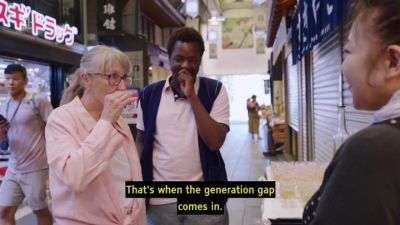 A pair of contenders outside a supermarket.
The duos were sent to Japan, and given instructions to meet up with their partner – by the older person remaining in one scenic location in Tokyo, and their younger companion getting directions to find them. These pairs were arranged by the producers, and were fixed; there was no chopping and changing of partnerships once they'd met.
Our pairs go on tour together: they see sights, they eat together, they doubtless stay in the same hotel, albeit probably not in the same hotel room. Not that we see any footage of the travel, or the hotel – all we see is the pairs on their challenge days. It's a decision not to demonstrate the shinkansen trains, or the city buses, or people making merry. By not showing the mechanics, we're able to concentrate on what the producers do want to show us.
 Each challenge was denoted by this question mark in a circle.
The challenge days, that's what they want to show us. In every city, the pairs take on a task. It's something rooted in the local culture – could be something specific to that city, or something a little more generic and perhaps found in a number of places around Japan. The challenges are the heart of the programme, and we're a game show column, so let's go through episode two in Kyoto.
One team are in a Japanese supermarket, looking for items brought over from the west. Pick the correct five items from a wide variety of hundreds on offer. One attempt at each item, a coin for each right answer.
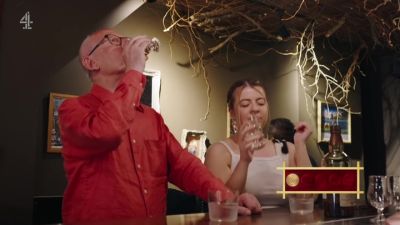 They drink a whisky drink...
Another team go to a whisky bar, and are asked to identify which of a pair of facts is true for the drink in Japan, the distractor is true for whisky in Scotland. Every correct answer earns a coin – and a dram of whisky.
One team go to the geisha district, get dressed up in kimonos, then watch two geishas on the stage. They're asked some semi-open questions. Which of the geisha had the short-sleeved dress? How many flowers were represented in another's fan?
Another duo take on the world of the ninja, and after seeing the various implements in use, they're asked to match five clues to the correct weapon. They've about a dozen to choose from.
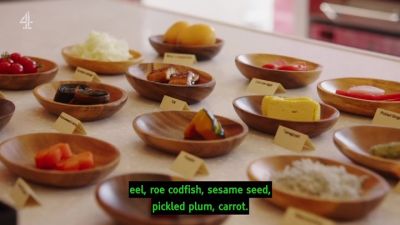 Raw codfish, sesame seed, teasmade, cuddly toy...
One team go to a temple, and learn about the animals of the Japanese zodiac. Then they're asked to recall which zodiac animal has which personality trait – five options from twelve.
The last team, they're in a cookery school, shown dozens of items to remember and learn, and then asked to assemble some combinations of three or four foods in a bento box. Only completely correct boxes are rewarded with a coin.
As we've seen, each challenge yields some coins for the players. And each challenge is done in isolation, away from the fellow competitors. When the couples gather at the end of the episode, the pair with the fewest coins are out of the competition and are going home; whether by accident or design, we never needed to see a tie-break.
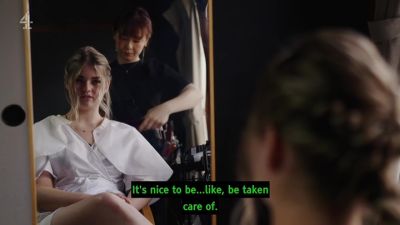 One team went for a pampering session as part of a task.
It can quickly be seen that some of the tasks are easier than the others, and the show is not particularly well balanced; we consider this a mark against the producers. This did result in some lovely people leaving the contest quite early. However, the show is stuffed to the gills with lovely people and it would be rather difficult not to have someone nice leaving at every turn.
All of the tasks bring out something of Japanese culture. The pace is slow enough that we viewers get to understand something, and we can be sure that the five-minute clips we see are ruthlessly edited down from hours of original footage. Worlds Apart is slow and somewhat meditative television, an introduction to the very different culture of Japan. Perhaps it's inspired by the calm and reflective life some people lead over there; of all things, we were reminded of ancient children's show Bod which also hinted at Zen Buddhism.
The producers want us to think that Japan is a metaphor, an introduction to the very different cultures of Young People and Old People. We see what they're doing, and we think they've got it wrong.
 A team look at where they're going next.
The really weak point about Worlds Apart is exposed in the opening narration. "At a time when young and old have never been further apart… in a social experiment to challenge assumptions and prove that age is just a number." The narration is all built on a straw man argument, something that isn't true, and we don't believe that anyone involved with the show honestly reckons it's true.
Of course young and old can recognise their shared humanity, the only people who would argue otherwise are terminally online wonks whose view of the world stretches most of the way to the edge of The Facebook window. By giving real people the space to talk to each other, share their life stories, the pairs are able to find their connection and work out what unites them. The producers didn't intend to prove their thesis, they wanted it to be Betteridge's Law of Television Introductions.
There's a very fine line between emotional and exploitative, and Worlds Apart goes right up to this line, might put a few toes over in some of the pieces to camera, but mostly gets away with it. Life has been hard, we viewers are encouraged to empathise and/or sympathise, but the show never asks us to take pity on the people we see. People are open, people are vulnerable, people are accepted for who they are, people are not criticised for events that have happened to them.
Everyone retains their dignity at all times. Loss, misfortune, the generality of life, it's all treated as completed events. We are where we are, leaving emotional baggage as part of the furniture, something to live around and move on from. And it's very rare to see this on network television: from soap opera to other travel game shows, everything revolves around conflict and judgement and not being your best. A feather in the cap for the producers.
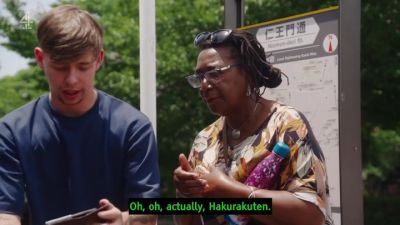 Another team work out where they need to be.
We were somewhat less impressed by the sound design. Voice over from Ralf Little is matey and casual, and we found it a bit prescriptive. There's music played throughout, and that is very much prescriptive, tell us exactly what to think at any moment. Many of the challenges, and some of the other parts of the show, would have benefitted from us hearing ambient sound only.
Six couples taking on challenges can get a bit repetitive, and Worlds Apart only differentiated couples by the challenge they were doing. The styles of presentation, and even the styles of challenge, all flowed into each other. Relaxed and gentle television is fine, though this column found it to be a little featherweight at times, our attention wandered in the ad breaks and took forever to get back on track. The format demands that there is no conflict between the teams, and there was no measurable conflict within the teams, and a drama without conflict is very difficult to make.
Worlds Apart turned out to be a decent enough hit for Channel 4, as in a decent number of people watched it. Perhaps it helps that viewers can naturally put themselves in the shoes of one side of each partnership: young viewers identify with the young, older viewers with the old, and middle-aged viewers might be tempted to take a parental interest, or reflect on relationships with their own parents.
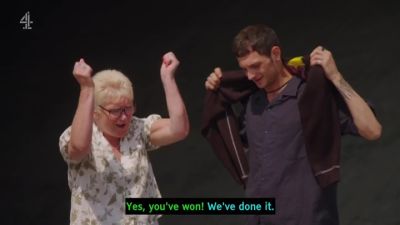 The team to win the cash prize. Can we declare that all competitors were winners, as the real prize is the experience?
Although we haven't watched Race Across the World in some years, we're advised that the general vibe is broadly similar. Except that here, there's no racing. Or travelling. All that's left is the emotional core, and that's rather sweet – perhaps too sweet for some, but very palatable for most. We would not be surprised if there's a second series.
Other news
Claudia might be making more Celebrity Traitors, but don't expect another series of her Channel 4 show One Question: the last series sat on a Channel 4 file-server for over two years, not many people saw it when it did go out, and there appears to be no interest in making even more episodes that nobody will watch.
Nominations are out for the BAFTA Craft Awards, recognising the brilliant people behind the camera who put our favourite progs together. Game shows up for the prizes are:
- Nikki Parsons of Strictly Come Dancing (in Director, Multicamera)
- Stephen Bryce of Tempting Fortune (in Production Design, Non-scripted)
- Mathieu Weekes and Bizibot Productions of The Traitors (in Production Design, Non-scripted)
- David Bishop, Darren Lovell, Tom Young & Matt Lee of Strictly Come Dancing (in Lighting for Multicamera)
- Nigel Catmur, Oliver Lifely, Martin Higgins & Matt Lee of Gladiators (in Lighting for Multicamera)
- Tim Routledge, Morgan Evans & James Scott of Eurovision Song Contest 2025 (in Lighting for Multicamera)
Winners to be announced on 8 December.
Quizzy Mondays
"Annabel Croft: Tomb Raider". Aimee Fuller didn't know much, but brought so much fun to this week's House of Games. Vittorio Angelone and Paddy McGuinness did bring the brains, Paddy at one point managing to collect his Two Points Badge from Duggee. Ria Hebden was rather overshadowed by the even bigger characters around her. Although he was run close, Vittorio entered the House of Games Hall of Fame, winning all five episodes – one more person does that and we can have a Platinum Week of quintochamps.
Various parts of the BBC schedule could have been better this week. Fewer angst-filled vox pops about newsreaders, less handwringing about journalism, just because the Westminster bubble has no sense of perspective doesn't mean the rest of us have to chase after their tail. Oliver Postgate and Peter Firmin made television with soul, small films like Ivor the Engine and The Clangers and Rubovia. Paul Smith remembered those, and many more, winning on Mastermind by a clear margin, and with a general knowledge large enough to suggest he may be a contender for the final.
The Last Chance round on Only Connect began with the 5ks defeating the Showstoppers by six points. Good connections from both sides: 5ks got HTML tags and their effect, Showstoppers the criteria for giving blood. During sequences, Showstoppers got the Inigo Montoya speech from The Princess Bride, 5ks nabbed the song "Young hearts run free". During Missing Vowels, the Showstoppers proved expert on the ACME catalogue. But the game was lost on the walls, where the Showstoppers failed to find a single connection, and the 5ks were perfect, and that's the only difference between the sides.
Sheffield smashed their way into the University Challenge group phase, beating Strathclyde by 290-60. The cry of "plenty of time" came out after just five starters, all of which had been answered by the Steelers. We moved into garbage time shortly after the music interlude, when neither team could identify Chopin's "Revolutionary étude", a miss that leaves us paging our local tomb raider. Buzz of the night was from Abdelrahman Elsisi on the queens of Angola; bonus introduction of the night was "Your bonuses are on prunes in literature".
Sheffield made a 57% bonus rate (following 67% in their heat loss, and 46% in the repêchage win); their overall rate was 62% (after 61% and 49%). The side are still perfect on language questions, strong on biology-chemistry sciences, and hot on geography. Less strong on literature, and there was a lot of lit this week, and even more in later rounds.
The nights are drawing in, and all channels bring out their most popular shows and presenters. For BBC1, that's Celebrity Masterchef (Mon, Tue, Thu). For the ITV network, that's Sorry, I Didn't Know (Sun) with Chizzy Akudolu, and I'm a Celebrity... Get Me Out of Here! (from Sun, also VM1).
Elsewhere, One Person Found This Helpful returns to Radio 4 (Tue), Never Mind the Buzzcocks ends its run on KYTV Maximillian (Tue), and it's the BBC New Comedy Award final (BBC1 and Radio 4, Wed).
To have Weaver's Week emailed to you on publication day, receive our exclusive TV roundup of the game shows in the week ahead, and chat to other ukgameshows.com readers, sign up to our Google Group.