
Weaver's Week 2025-11-30
Last week | Weaver's Week Index | Next week
"My brassicas were in full flower." Er, that makes no sense at all. Neither does this show title.
Actually, it's not that bad. "Game" tells us it's a competition of some sort, and whatever the challenge is, it involves "wool". And that's pretty much what happens.
We could also summarise Game of Wool as "Bake Off, with knitters". (And we'd be wrong, but we'll come to that.)
Tom Daley is our host. If it feels like he's been on television since forever, it's because Tom actually has been on television since forever – twice in the running for Sports Review Young Sports Personality of the Year, a consultant on celebrity diving series Splash!, and all the while training as one of the greatest artistic divers in the world.
It was while training as a diver, and waiting for stuff to happen, that Tom took up knitting. Took his mind off the waiting, gave an outlet for his fierce concentration. If there's one image we remember from the 2020 sports festival in Tokyo, it's of young Tom, sitting alone in the deserted stands, knitting something for his child or husband.
Tom retired from the diving board last year, and has been looking for other challenges. The Traitors bounced him out at an early opportunity, but nobody is going to remove the star and host from this show.
Although Tom is the face of the show, he's not responsible for who wins and who loses. Di Gilpin and Sheila Greenwell are the resident experts. (An early press release suggested there would also be guest judges, but we've not seen any outsiders on the judging panel, though we are writing this review halfway through the series.)
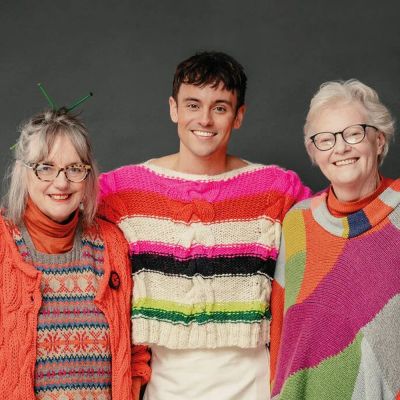 Di Gilpin, Tom Daley, and Sheila Greenwell.
Gilpin and Greenwell – sorry, Di and Sheila – come as a pair. Di is the experienced hand at knitting, Sheila is Di's production manager. They both draw on four decades of experience with couture and ravelry and reflecting their local culture in each garment.
Viewers may reasonably raise a quizzical eyebrow at this arrangement: Di and Sheila are experts in the field, but is there something a bit strange about the judges being in an employment relationship with each other? As we occasionally say, it is not enough for the judges to be fair, they must also be seen to be fair – and it's conceivable that Game of Wool will reflect one narrow definition of good knitting.
This could be the case. We don't have evidence that it is the case, and – as Stephen Fry would put it – the absence of evidence is not to be filled by speculation. Let us work on the assumption that Di and Sheila are giving an honest critique that will not attract any complaints from people who properly know their knitting.
Knit one…
So, what happens on Game of Wool? Well, it all starts with the contenders, who have gathered in a converted barn somewhere in Scotland. The group covers a wide spread of ages – some are in their teens, some are old enough to be their grannies, and they've even managed to find some blokes who knit.
Each show has a gentle theme, and divides neatly into halves. The first half is an individual challenge, where the crafters are given a task to complete on their own. For the first episode, the challenge was to knit a jumper in the Fair Isle style. The model would be Tom Daley himself, and the knitters had twelve hours to complete the garment.
Twelve hours sounds like a long time, but knitting is a very slow process. Every single stitch has to be created by hand: a couple of hundred stitches around each row, many hundreds of rows up the jumper. And then we've to consider the sleeves, and we've to join the sleeves to the body. And then there's things like hems, and we've not even considered the intricacies of the Fair Isle pattern. Twelve hours is no time at all. Tom marks the time by calling hours, and his voiceover explains what the contestants should be doing by now if they're to finish on time.
The construction of the garments takes the bulk of the first part of each show, and about half of the next segment. Then we get the fun bit: how does Tom look in these clothes? Can he squeeze his head through the hole? Is it a punk jumper, held together with safety pins and attitude? Does the jumper come with detachable sleeves? Is there a massive side eye?
We hear a critique from the judges, polite and informed but pulling no punches.
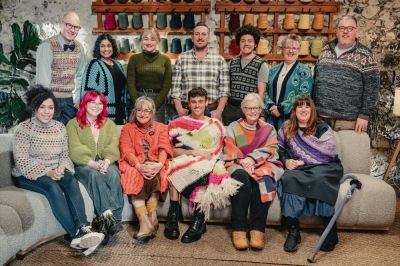 The contenders and judges sit on the show's sofa.
Second half of the programme is a team challenge, the players are split into small groups and given something to do. For the opening episode, it was to knit the cover to a sofa. They had eight hours to plan and complete their work: lots of granny squares, lots of stitching together, some disagreements. Again, construction ends during the final part, then there's a review. Although this element is meant to be judged "blind" – the judges aren't meant to know who knitted what – they seem to know exactly how each piece was put together when they make their final judgement.
And there is a final judgement. Each week, someone is "cast off" and leaves the competition after a big group hug and plenty of good wishes. Someone else is named the "Big Knitter", and wins the week's top prize – a fluffy sheep baaaa-dge.
Purl of wisdom…
Tom Daley is an excellent host. Ten years ago, if you'd asked us to list the celebs we expected to be interested in yarn crafts and gave us ten hours to write down names, Tom would not be on the list. And yet he is now the public face of this work. Tom wears his knowledge lightly, smuggling interesting facts and subtle tips under the cover of bad puns and unorthodox knitwear. (Seriously, some of Tom's shawls and kaftans and togas defy description.) Tom's enthusiasm is infectious, and his energy carries the show.
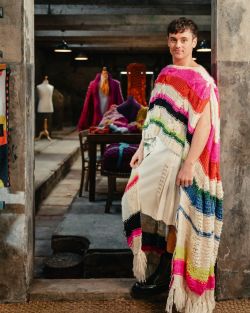 Yoikes, Tom! That shawl's a bit shaggy!
Stereotypically, it's accepted that knitting is usually an excuse for women of a certain age to get together, talk about their lives, drink lots of tea, talk about their children, eat some cake, talk about their holidays, perhaps create something to wear, but mostly talk. Game of Wool is somewhat different, in that contenders are expected to create first. The atmosphere is studious, productive, gently and quietly industrious.
Game of Wool tests skills other than knitting, which is done with a pair of needles. It also tests crochet, which features a needle and a hook. Crocheters and knitters get rather annoyed when anyone confuses the two crafts, and it appears that "yarn crafts" is the common catch-all term. (Crocheters will also get somewhat irked when they're referred to as "hookers", because it makes them sound like something they're not: rugby players.)
Although these basic terms are defined, many others are left hanging. "Knit" and "purl", no clue from the show as to the difference. There's a lot of discussion about "intarsia"; if we've researched correctly, intarsia intermingles various colours or weights of yarn. (And that's another distinction they've elided: all wool is yarn; not all yarn is wool.)
We don't know much about knitting, but we do recognise a judge who knows what they're talking about; they give off a certain confidence, an air of impregnability. Watch Paul Hollywood on Bake Off: he always gives a fair and honest and constructive assessment of a bake, he is precise and informative.
Sadly, Di and Sheila from Game of Wool give critiques that are – well, they're woolly. Comments tend to be vague – "it's good overall", "I like the style" – and seem to lack anything that has not already been pointed out to us. Maybe they should have had guest judges for each show, something to add a little variety to the opinions.
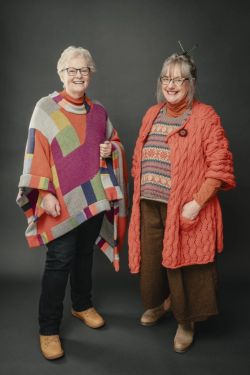 Di Gilpin and Sheila Greenwell: still to find their brilliance as judges.
We're also not sure about the speed element. They only allow a very short time, so the knitters are required to use massive needles and very thick yarn to complete their work. Anyone knitting for 12 hours in a row is going to be tired from the effort: having to use such heavy materials will only add to the burden. It was sad to see one of the contenders have a bit of a moment in the second episode, and does raise questions about whether the producers properly thought about the physical and mental demands they were making.
Game of Wool has a subtitle, "Britain's best knitter". This is almost certainly wrong, and we're not just saying that because of the contestant from Ireland. The contenders have been selected for personality and looking good on television, and for their interesting back stories. They will qualify by working as a team, and individual excellence in crafts other than knitting – someone has suggested lace
Squaring off
And yet, and yet, and yet. We've watched all four episodes of Game of Wool, and we plan to stick around to the finale. The show is light and undemanding viewing, we can leave it to ramble on for a quarter of an hour, and check in for the judging moments.
Game of Wool succeeds in showing yarn craft to a new audience. Heck, when we started watching this show, we'd have put "yarn craft" as things they make in a small North Yorkshire town. The judges show some rigour about the craft, and it is difficult to fault any of the decisions they've made about who to leave.
For the contestants, it shows that the only limit to creativity is imagination, and that people can bond together over a gentle crafting activity. On those grounds, we'll compare Game of Wool most closely to Lego Masters, which was on Channel 4 a few years back: again, slightly nebulous judges didn't get in the way of having fun.
Best thing about the show, however, is Tom Daley. Enthusiastic and brimming with confidence, and he knows what he's talking about. And, being Tom Daley, we know that he knows how to win things, and that joy shows on screen.
Other news
Some major changes to voting at the Eurovision Song Contest. Most notable: the maximum number of votes per phone (or credit card) has been halved from 20 to 10. New checks will be put into place to detect "suspicious or co-ordinated voting activity". There will be new rules to do with song promotion, which would bar third parties from working with performers or broadcasters to influence the vote. Juries will be increased from five to seven people, of whom at least two must be between 18 and 25 years old; the jury vote will also be used to calculate the qualifiers from the semi-final(s).
Martin Green, the EBU's Head of Song Contests, said "We will enforce our rules more consistently to prevent the contest from being used as a political platform or instrument of any kind. The Eurovision Song Contest belongs to all of us, and it must remain a place where music takes centre stage."
This column has been happy to spend a quid or so to support the various songs we liked on the night; we're less happy to find that our considered decisions have been over-ridden by people who didn't watch the show and voted for a particular name without actually hearing the song. Does it help that these people will be limited to ten votes rather than twenty? Not really; what would really help is "a maximum of ten votes in total, and no more than four for one entry", the idea seems to work at Junior Eurovision.
A bar on third parties should eliminate adverts in Times Square saying "Show your loyalty! Vote for us!". It would also eliminate some of the adverts we saw around Liverpool from a well-known streaming company, saying "Green Stream supports Tural Turanx! Here's how to vote!". The fact that absolutely nobody took them up on this offer, and Turanx were out by midnight, shows that Green Stream really don't know good music when they hear it.
These changes probably don't go as far as this column would like. They are changes in the right direction, and they are changes that enjoy broad support amongst the EBU's member broadcasters, and let's applaud people for going in the right direction. More from those members in three weeks, when we look at Junior Eurovision.
Quizzy Mondays
You get a prize! You get a prize! Everybody gets a prize on House of Games this week; Nathan Bryon, Spencer Matthews, Rosie Ramsey, and Ruth Langsford all escaped with some Osman swag. The week was close, and we knew this on Monday when we had a three-way tie – and had the other player not picked up a penalty in Answer Smash, they would have been tied as well. Can we imagine Richard boiling down the entire show to one question between all four of them?
Ross Taylor, a publishing director, won a close game of Mastermind. His specialist topic was Granada's Sherlock Holmes series, and Ross finished just ahead of rivals Julie Aris, Sam Schoen, and Ryan Lewendon. Julie got two of her specialist questions wrong by very narrow margins; had she been correct on both, she would have had the win.
Another draw on Only Connect, between the Sorcerers and the Keyboard Worriers. Foundlings, pairs of people whose names form shops, and the model number of The Terminator, all grist to the mill. A question involving "@" above the number 2 key might be a transfer from the not-yet-commissioned Only Connect Canada, hosted by the lovely Mattea Roach (c'mon, CBC, you know it's a cheap show…) Mattea would know synonyms for the Fresh Prince of Bel Air rap, something which completely foxed our own Victoria Coren Mitchell.
Reversed names proved a stumbling block for both teams on the wall, and when Keyboard Worriers took missing vowels 7-5, we ended up in yet another draw. As we noted last week, Only Connect does not honour draws, and the Sorcerers progress – along with Doctors Matthews – from the bottom section of the draw.
Warwick had another comeback win on University Challenge, recovering from over fifty down to beat Bristol by 180-145. Some great buzzing by both sides: speedy when they knew it, and carefully waiting until Rajan had finally finished before making more speculative buzzes. Warwick picked up a very quick bonus set on video games starring non-anthromorphic animals, Bristol on books with numbers in the title. The difference was on the buzzer, Warwick won the starters 11-8 and the win followed.
Not that it was a tremendous performance by Warwick – 46% overall and on their bonuses (63% and 64% respectively in the heat against Sheffield). Warwick very strong on philosophy and religion, rather weak on history and geography.
This week, Nitro from Gladiators is on Countdown, and we'd be interested in Colin Murray's Epic Pranks, c'mon Channel 4. House of Games (3) is delayed on Friday because of a live event.
If it's 1am in December, it must be time for the Radio Wales Christmas Quiz 2025 (Tue), which we assume is meant for catch-up viewers. A day later, Portrait Artist of the Year concludes (Artsworld, Wed).
Next weekend, Dermot O'Leary returns to The Wheel (BBC1, Sat), it's the Celebrity Catchphrase Mid-Advent Special (ITV, Sun), and the last in the present series of I'm a Celebrity... Get Me Out of Here! (ITV, Sun).
To have Weaver's Week emailed to you on publication day, receive our exclusive TV roundup of the game shows in the week ahead, and chat to other ukgameshows.com readers, sign up to our Google Group.