
Weaver's Week 2026-01-18
Last week | Weaver's Week Index | Next week
This week, it's the only show where they give you £5500 just for turning up!
There's a catch: the money drains at an alarming rate, and your task is to save some of it.
Five contestants play each show. Sara Davies, the host, describes it as "television's quickest quiz", and asks the contestants to describe themselves in just three words. And then, because it's also an ITV daytime quiz, she chats with one or two of them. C'mon, your format point is quick quizzing; don't undermine it already!
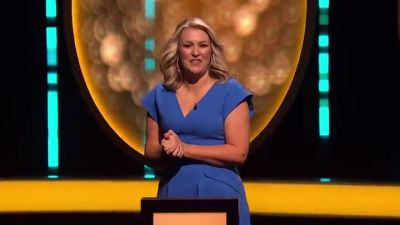 Sara Davies, familiar from Dragons' Den.
Soon enough, we're into the show proper. The first round begins with £1000 in everyone's timer, shown as coins in an hourglass display on the front of the contender's podium. We hear a category of questions described. There's an initial question on the buzzers. Buzz in and give a correct answer, and your timer will be frozen.
Then the category continues, and everyone who hasn't got a question right starts to lose cash from their timer. Sara continues asking questions, and as soon as someone buzzes in with a right answer, their timer freezes. Buzz in with a wrong answer and it'll cost you £50.
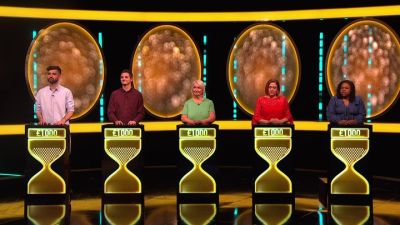 You've got a grand! And you've got a grand!
When your pot is frozen and you buzz in correctly, the drain rate speeds up and other players lose money faster; but buzz in with an error, and your timer starts to drain and you need to give another right answer to stop it. So already we see there's a dilemma: accept that your pot is stopped and you're gaining £300 on the other players, or buzz in with the hope of pushing them further down but the risk of re-starting your own drain.
Each category of questions ends when everyone's pot is frozen, or immediately after ten questions. Play also stops as soon as someone's pot hits zero, because that means they're out of the game. Sara gives a few words of consolation, and the eliminated player strides regretfully past the line of podia - less a Walk of Shame and more a Stroll of Sadness.
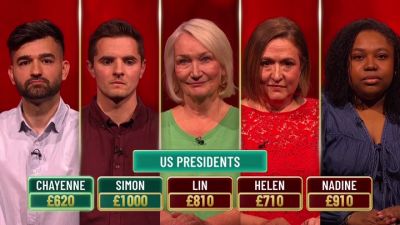 The graphics clearly show who is losing money, and how much they've got left.
Money still in the timers is saved for later. This will be very important for the final, whoever gets there.
The next two rounds follow the same basic formula, with a few differences around the margins. Rounds begin with £1250 and £1500, the drain is a bit faster, and the clues are a little longer each time. Again, whichever player loses the entire contents of their pot first is eliminated from the game. Sara has a little chat with the players between each and every category, someone who did well, or someone who suffered. This game isn't all quiz, though it sometimes feels almost entirely like Sara Davies talking.
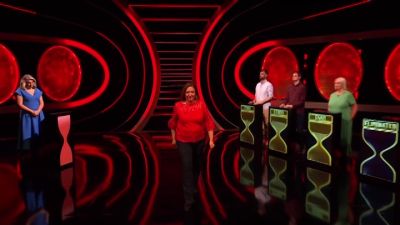 Defeated players take the short walk out of shot.
Because of the way ITV handles its advertisement minutes, there is a short break at the end of round one (or after four categories have been played, if that's later). We then get pretty much the whole of rounds two and three in one ginormous section, often lasts over twenty minutes. And that segment can really drag on, Sara and the same few contestants going round and round without ever seeming to reach a conclusion. Not sure there's anything they can do about that, and it's certainly not something the producers want to happen. The choice to make the game stop and start, that is a production decision.
Eventually, the extended middle bit finally reaches a conclusion. Three contestants have been eliminated, two remain. They start the last competition round with £1750 in both players' pots. A right answer stops your drain and starts your opponent, a wrong answer starts yours and stops the other. Two or more right answers in a row will speed up your opponent's drain; if nobody gets the question right, the drain continues as before. Questions are in categories, a new one after every five questions. Unlike the rounds earlier in the show, this one is continuous quizzing – once the drain starts, they will not both stop until someone reaches zero.
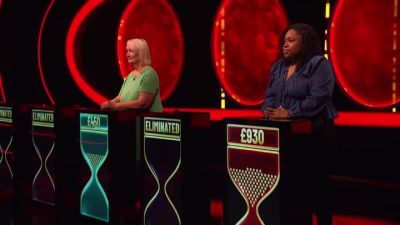 Our two players in the final, one with money draining out.
Our finalist has won in four rounds. And they've saved some money in each of four rounds; each round's savings is put into its own timer. Five questions allow the finalist to top up each timer by £100, but an incorrect answer will freeze the most valuable timer. These are perhaps the easiest questions in the entire show, the producers really want the final to last as long as possible because it is hard.
The finalist nominates the first timer they want to freeze on a correct answer – that's going to be the one with least cash.
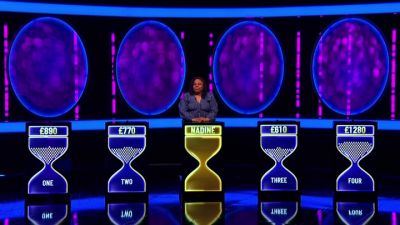 Our player is surrounded by riches - but can she keep any of it?
And then the drain begins. A right answer will freeze the nominated timer, and allow the finalist to name their next timer. But a wrong answer will unfreeze the previously-frozen timer, and the finalist will have to get a question right before nominating that timer again. The drain rate increases every 30 seconds. If any of the timers runs out of money, the game is lost and the contestant leaves with nothing.
We reckon that about half the shows produce a winner; when there is a winner, prizes tend to be around £1500. The mathematics make it very difficult to win less than £500. The nominal maximum prize is £7500, but that cannot be won – we reckon £6500 is the absolute limit with utterly perfect play. There has been one dominant win of over £4600, but we're certain this will be a very exceptional score.
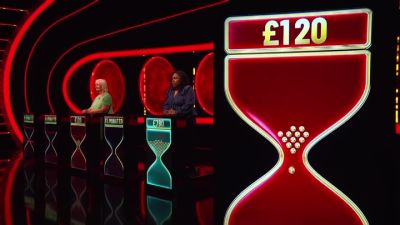 Occasionally, they show this lovely shot with the one active timer repeated on screen.
A few edge cases. Category starters can be answered incorrectly – the player erring will start with their timer draining, and the other players spar for the honour of having their timer stopped. If there's only one player available to take a starter question, and they get it wrong, their timer will start along with everybody else's. We've not seen the case where a whole category is burned on starter questions that nobody answers, and we presume that would be edited out.
More edge cases. We have seen people qualify for the final with £10 in their timer, and if they don't do very well on the top-up questions that would make the final most unspectacular – this is a risk in the format. We've seen someone absolutely boss the head-to-head round and take their timer above £1750 in the final – although the timer display can only accommodate 175 coins, the money can and does go higher.
One edge case we haven't seen. It is theoretically possible for two players to have their timers run out of money at the same time – in this case, we presume that a starter question would be used until someone had been eliminated.
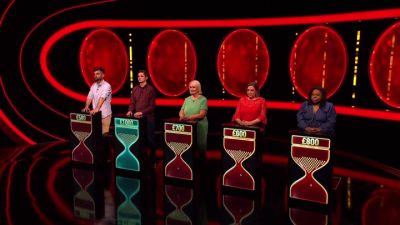 The long shot shows coins on the backdrop behind the players.
Time Is Money gets through a lot of questions – exactly how many depends on how tight the rounds are, and we've not counted precisely, but we reckon they must use around 150 questions per show (that's about 75% as many questions-per-minute as Channel 5's 100%). Some commentators have compared the early questions – prompt and quick response – to 1980s one-series wonder Box Clever.
This column thought about the middle-round questions, pithy descriptions, and found ourselves thinking we could see them on Pointless. "NASA's space programme sending someone to the moon", asked Alexander Armstrong on Tuesday in a round about the stage names of Gladiators stars. "NASA space programme putting a man on the moon", asked Sara Davies on Wednesday in a round about the stage names of Gladiators stars. Yeah, they are channelling something of the spirit of Pointless.
 Apollo, a very popular quiz answer.
So, will Time Is Money be as long-lasting as Pointless, or be as short-lasting as Box Clever? Our money is on the former. Sara is confident and assured, she's able to bring a little sparkle to the chats, and she genuinely encourages the contestants. While the first half is rather stop-start, the continuous quizzing makes the second half of the programme tend to be exciting. The prizes are suitable for daytime television (i.e. not particularly huge, but given away reasonably often). While the show gets through a lot of questions, we're sure that the brilliant question writers will be able to come up with many many other stumpers.
Assuming the viewing public like it, and Sara remains available, we see every reason why Time Is Money can run for a few years yet.
Quizzy Mondays
Mr. Clayton was right. In this column's First Form history class, he told us about the Tudors, and how Henry VII's eldest son Arthur was groomed for the monarchy, and given the hand of Europe's most eligible bride Catharine of Aragon. Then, most inconveniently, Price Arthur died. His younger and more useless brother Henry was thrust into a role he was completely unsuited for, and that he proved to botch in a way that keeps historians busy. But he did inherit the hand of Catharine of Aragon from his brother Arthur. "Remember that fact, you never know when it will come in useful."
Would have come in useful on Only Connect, where the fact Catharine had married Henry was a five-point clue, and the rest were other people who married someone and then their brother. Pitchers won the match, thanks to the knowledge of things taking their name from Horace quotes, and a rearranged scientific equation for c, d, e, and f. But neither side was able to spot things discovered by machine learning, or decode winners of the men's cricket world cup as India in India in '11 and so on.
Absolutely loved the question about the film Tootsie, a part played in a soap by an actress played by an actor played (by breaking the fourth wall) by Dustin Hoffman. Worker Bees were ten adrift going into the walls, and though they achieved perfection, the Pitchers got seven – if only they'd been watching House of Games a couple of years ago and remembered that then-Taoiseach Varadkar anagrams into Aardvark. 27-14 the final score, so the Pitchers go into the final, and the Worker Bees return next week for the All-Important Third Place Playoff.
University Challenge asked the question: what happens when both teams lose their mojo? Last week, we sung the praises of Edinburgh's high bonus rates, and Kai Madgwick's superlative buzzing. Neither was on fire this week: Edinburgh's bonus rate a series-low 42%, Madgwick 5/9 with two penalties. Instead, Johnny Richards' buzzer work proved to be just that fraction faster, with Rayhana Amjad able to work out many of the starters dodged by the other two. Both Richards and Amjad play for Edinburgh, so they got 12 starters to Manchester's 5. A frustrating episode, waiting for either team to show their brilliance, and neither quite did. In the final analysis, Edinburgh won by 195-80.
Edinburgh's path is against next week's winners (UCL or Merton Oxford); we're now less convinced that Edinburgh will win that. Manchester need to beat next week's losers (very possible) and then win a match against the win-lose team from the other side of the draw (we suspect that'll be Sheffield).
Over on House of Games, Adam Buxton saved his marriage by winning the salt and pepper shakers, and indeed everything. Hammed Animashaun was a strong player, but slightly spoiled his own chances with penalties in the Answer Smash round. Hammed also gave us the chortle of the week, confusing heavy metal funsters Guns n' Roses with twee ladband Boyzone. Lorna Watson and Lisa Snowdon both contributed massively, and all would be welcome to a Redemption Week. Adam joins Angela Barnes, Jay Rayner, and Nabil Abdulrashid as quintochamps; that's enough for a Platinum Week.
Other news
Melbourne tennis centre played host to a made-for-television tournament this week. The One Point Slam was a simple elimination tournament, each match was played over one single point. Stars of the men's tour, stars of the women's tour, top amateur players from across Australia, celebrity streamers and their bloke from The Today Programme all came on court, played their point, and then were gone.
Some points were over in a flash – a fault, an ace, an unreturnable serve. Other points were things of beauty, building pressure and running the opponent off the court. After eliminating many of the stars of the game, the final featured Joanna Garland, the (checks notes) (double-checks notes) number 117 on the WTA tour who was only in Melbourne to qualify for the main draw. She lost 1-0 to Jordan Smith, the (checks notes) (double-checks notes) (asks if the note-maker has been reading stories for children) amateur champion who came through regional qualifying in New South Wales.
The event was made for television, 48 matches of tennis (including a play-off between the top two amateurs for an extra prize) and plenty of adverts and sponsor plugs in the three-hour broadcast. Never felt rushed, always had some sort of momentum, and always had something to keep us watching – will Nick Kyrgos meet his match, can McCartney Kessler get some airtime, and then the irresistible fairytales of the finalists. Other television game shows could learn from this production. Highlights at TNT Sports
And there's the chance of a spin-off series. To decide who would serve in the first (and indeed only) point of these matches, players had to do a rock-paper-scissors on court. It emerged that tennis stars are very good at tennis, and not so good at doing rock-paper-scissors. We look forward to Pro-Celebrity Rock-Paper-Scissors, coming soon to a channel near you.
Announced by BBC2: The Big Deal. Steph McGovern with seven couples, hoping to wheel and deal with up-and-coming artists, make connections with buyers, and flog the paintings and sculptures for a profit? £50,000 for the winning pair. Margo McDaid, another artist, will be the resident judge in the six-part series.
Announced by ITV: Chase Around the World, the marriage of quiz and globe-trotting we didn't know we didn't need. Pairs of contestants are given puzzles and tasks to find the locations of the Chasers from ITV's hit show The Chase. Winning pairs get to take on the Chasers to win a "life-changing" prize pot. The full press release is long on corporate puffery and light on details that might matter to viewers.
Amol Rajan has said that he will step down from Radio 4's The Today Show, a frothy blend of consumer affairs, celebrity gossip, bad racing tips, and the occasional bit of news. He will continue to host University Challenge, presumably on the grounds that he's sufficiently good that we risk any replacement being appreciably worse.
Mae Martin, a recent Taskmaster winner, will host this year's Juno music awards. They'll be the first solo host for Canada's top music prizes this decade. The awards will be handed out in the early hours of 30 March, at a ceremony in Hamilton Ontario. On this side of the pond, the BPI Awards will be hosted by Jack Whitehall (from the late A League of Their Own) at a Co-op supermarket in Manchester.
Coming up this week, it's The Traitors final on BBC1. Are we cheering for the Traitors, are we applauding them for a better game play, or hoping for a Faithful win even less likely than (checks notes) Jordan Smith? Somewhat overshadowed, it's also the Junior Bake Off final on Channel 4.
To have Weaver's Week emailed to you on publication day, receive our exclusive TV roundup of the game shows in the week ahead, and chat to other ukgameshows.com readers, sign up to our Google Group.