
Weaver's Week 2026-05-24
Last week | Weaver's Week Index | Next week
- "Bangaranga" finished top of last night's exit poll run by some of the Eurovision podcasts. Spectacular staging and choreography. See you on Saturday … and the winner's reprise on Sunday?
We shared our knowledge with friends on Quizzy Dan's message board. We didn't back our hunch with schillings at the local bookmakers, which explains why this Week comes from UKGS Towers in rainy Birmingham, and not from a pleasant island in the Caribbean.
Senior Eurovision Song Contest 2026
What the bangaranga is going on?
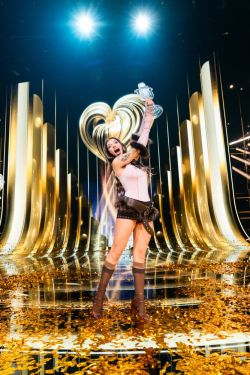 Our new star. EBU/Corinne Cumming
"Bangaranga" won the contest. It was performed by Dara, the representative of BNT (shown on screen as "Bulgaria"). The song had four credited writers: Anne Judith Wik, Cristian Tarcea, Darina Yotova, and Dimitris Kontopoulos. It's an upbeat and very modern song. While the vocals are not as demanding as some in the contest, they're much harder to sing than might appear at first sight.
"Bangaranga" also has the most compelling dance routine of the year. Never mind the writers, we ought to be cheering the stagecraft. The director was Fredrik Rydman, who had previously worked on the memorable "Cha cha cha" and "The code". Dancers in the performance were Iker Cederblom Herrera, Ellinea Siambalis, Lisa Högström, and Mateo Cordova Pomo. They were integral to the spectacle, part of the precise choreography of head-snaps and close chairs. It was like a pop video on the screen, glossy and dangerous and completely unpredictable.
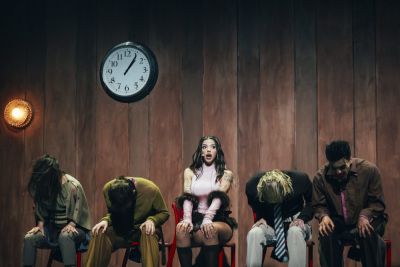 Chair dancing from the winners. EBU/Sarah Louise Bennett
As well as the visual routine, "Bangaranga" also hit the mark as a song. It's minor-key magic, written in D-flat major which is a wailing and depressing key, but the song transcends the musical theory to be uplifting and exhilarating. Another piece of musical theory: "Bangaranga" is the only fast song in the final to change its tempo: the rhythm alters quite often during the verses. That gives us a feeling that the song is a collage of experiences, something emphasised by the semi-chaotic staging.
"Bangaranga", the word, is complete nonsense, a blank slate, it means whatever we might want it to mean. And on that empty space we hear Dara's polished and practised vocals, with the assured confidence of an established star. Dara is an established star: she finished third on The X Factor in 2015 (behind Kristian Kostov, who sung BNT's entry in '17), and has been a consistent hitmaker since. Go back and watch the interview in the middle of the voting sequence: watch Dara demonstrate both her star quality and professionalism, she coolly answers the question and is humble in a moment of triumph, then knows when to stop bigging herself up.
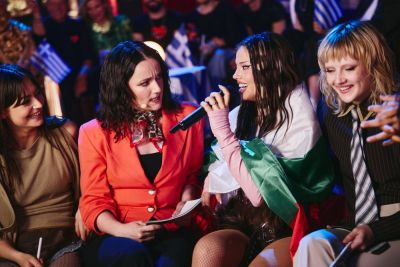 Host Emily Busvine asks a difficult question to Dara, then passes her the mike. EBU/Alma Bengtsson
The combination proved a great hit: ambitious and audacious staging, a performer who knew exactly what they were doing. It was magic on screen; one of our friends said it was as precise and fluid and thoroughly well-drilled as the greatest K-pop bands. It's a club song successfully translated to the television – not just strobe lights and crazy camera angles, it's something to watch and gawp at.
"Bangaranga" turned out to be a consensus winner. It topped the jury poll, albeit with a very low score. And it was the audience poll winner by an absolute mile. The winning margin is the biggest in the history of the current voting system. We loved the spontaneous atmosphere of the winner's reprise – started in the green room, with a "let's do the show right here!" moment on some borrowed chairs, then came down to the arena and finished on the main stage.
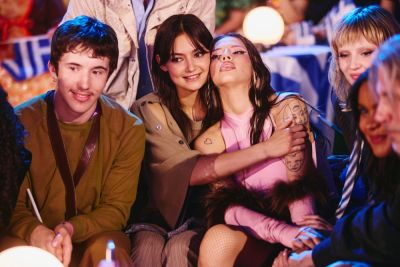 The delegation hold tight for the results. EBU/Alma Bengtsson
We'll be honest, this was exactly the winner Eurovision needed. A complete change from the light opera of the past two years, something accessible and earwormy. The biggest recent hits from the contest – "Tattoo", "Snap", and Måneskin's finest – are receding into the rear mirror. We both hope and fear that "Bangaranga" will be an absolutely inescapable cultural force over the summer.
Is it time for the Uk to withdraw from Eurovision?
A respected television commentator asked this question last Sunday. Betteridge's Law applies: any question in a headline is best answered with "No".
Eurovision – part of the European Broadcasting Union – is, primarily, an exchange of news footage. Not even the BBC can have cameras on every corner of every street in every city of the world. Most of the pictures come from other broadcasters, the journalistic arms of ÖRF and YLE and RTVSLO and a gazillion others. If all the broadcasting organisations round here were to leave, they'd be cutting off the most important supply of pictures to illustrate the news. Would News at Ten be better if it were twenty-five minutes of Mark Austin and a few still photos? (Hint: no.)
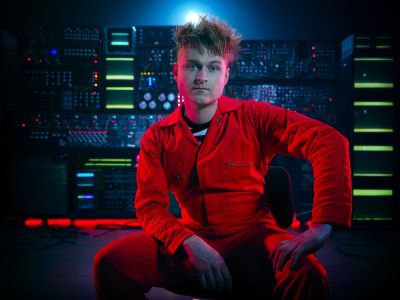 Look Mum No Computer will represent the BBC at the 2026 contest. BBC
Eurovision also negotiates for sports rights, like the football contest next month. It's a clearing house for technology, it allows broadcasters to share what they know, work together on new technologies. The way you can take one DAB+ radio with you across the continent? That, in part, comes from the EBU.
Eurovision is a cultural force, arranging for classical music and documentaries to be screened across the continent – and heard, the EBU works on radio as well. And, to show off its technical abilities and prove it's not just a snoot-fest, Eurovision arranges annual festivals of popular song. It's just one element of the whole EBU membership. To leave the EBU just because this tiny element disappoints would be to throw the baby out with the bathwater.
Should the BBC withdraw from the Song Contest, then? Again, no is our answer. The Eurovision Song Contest is very cheap programming. The Beeb doesn't say how much it spends, but our back-of-the-envelope calculation puts the price of entry somewhere between £700,000 and £1.5 million. For that, the Beeb gets nine hours of primetime television, a show watched live by many more people than would normally tune in to BBC1, and showcases its ability to promote new talent.
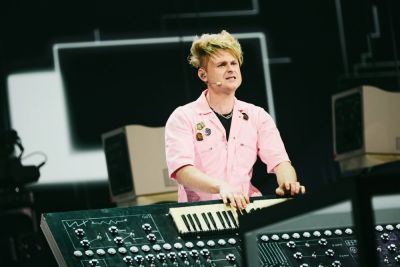 Mr. No Computer on his synthesister. EBU/Alma Bengtsson
Consider the alternative: what if the Beeb did withdraw? We can be sure that ITV would snap up rights to the programme, for exactly the same reasons as the Beeb loves it. Got Talent would morph into Ant and Dec's Search For a Euro Star, and it's almost certain that the song would not win. (How can we be sure? 97% of songs on the Eurovision stage do not win.)
However, it is clear that the BBC entries do not connect with viewers at home. Over the last three years, they've tried a lot of things. Two years ago, something to channel the Song Contest superfans, gay men in a gym, and got nothing. They've sent strong vocalists who were strangled by the EBU's editorial decisions, and got nothing. They've sent a live-action video, and got nothing.
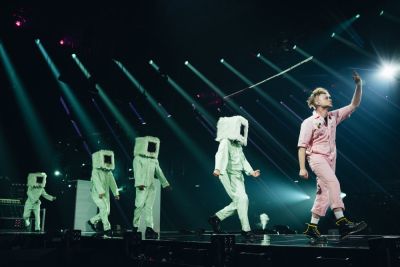 Not time to walk away. EBU/Sarah Louise Bennett
While we were sore with the voters for neglecting "Dizzy" and "What the hell just happened", we fear that "Eins zwei drei" got the drubbing it deserved. The staging was spectacular, with flip-up tables and perpetual motion, but it had to work with Mr. Mum No Computer's weak vocal. Both the song and staging ran out of ideas about two-thirds through. It's underwhelming, and in the current environment, underwhelming is dead.
It's clear that the current approach isn't working, and needs to be reconsidered. But is there a consistent and contemporary hitmaker who would give up four months of their career to enter Eurovision, and then face ridicule because they're in the 97% of entries that do not win?
Songs we heard that we loved
A song about the suffocating feelings from anxiety and self-doubt, "Choke me" (Alexandra Căpitănescu, TVR, "Romania") finished second in the televote. We'll remember the staging: Alexandra chained by bright light-up ropes, arguing with her hooded alter ego, before resolving the conflict in her favour. It's wild, it's vibrant, it's got so much primal energy.
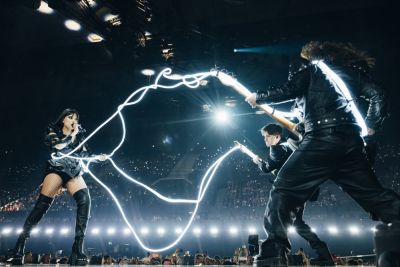 Alexandra is chained by expectations. EBU/Sarah Louise Bennett
The song was like nothing else in the contest. It's dark metal, loud and deep and gothic, reminded this column of Evanescence in their prime. And we don't get enough Evanescence-a-likes in the music world, certainly less than their fans would like to hear. Got a massive amount of love from across the board, and Alexandra will have won some fans for life.
Back in the semi-finals, we saw "Choke me" as a raw and edgy song. "Alice" (Veronica Fusaro, SRG SSR, "Switzerland") had a similar musical position, but was a little bit more mature and polished. It's the one with the web of ropes, for reasons that made sense when one listened to the lyric – the song's a third-person narrative, about a woman who lives under the threat of intimate violence. Should have made the final, and would have made the final if it were either 100% jury or 100% televote - "Alice" was ninth on both rankings, but aggregated to 11th overall.
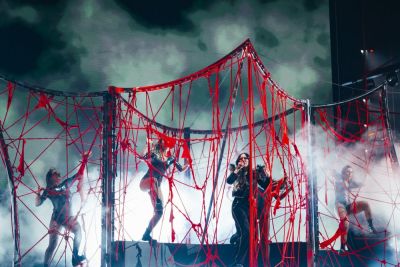 Veronica is trapped in an adventure playground. EBU/Corinne Cumming
We're not to confuse "Alice" with Alis, who sung "Nan" (for RTSH, "Albania"). This was a storytelling ballad about how someone separated from their mother still believes she loves him. "Your mother stays there, standing in the doorway... don't be sad, your mother is waiting for you." It's told in a suitably epic way, Alis walks like a character from Game of Thrones, while portentous chords reverberate on the backdrop.
Twilight truthers were at work when compiling the running order, as they put Alis next to "Bella", Aidan's entry (for PBS, "Malta"). The delegation brought their own gazebo to the hall, mirrors on the inside and video screens on the outside. We were observers peering into the mirror world Aidan inhabited, a universe of pining and yearning for a lost love. Catnip for the juries, rejected by the televote.
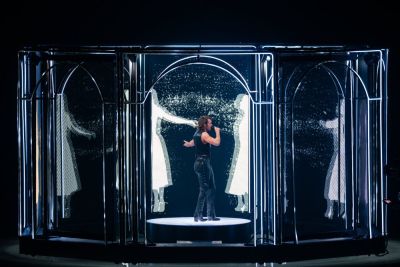 Aidan had the most remarkable video effect. EBU/Corinne Cumming
There was more Twilight significance as "Eclipse" was a song (performed by Delta Goodrem for SBS "Australia"); it's the classic orchestral pop love song, Delta performed it with all her experience, and we were not surprised to find it joint second in the jury vote.
"Før vi går hjem" was the other joint runner-up in the jury, performed by Søren Torpegaard Lund for DR ("Denmark"). The lyric talks about finding someone who is completely wrong for you, but the exhilaration of being with them feels just so right. It's the staging with The Cube, Søren joins a group of dancers inside a rectangular cuboid and they strip him of his inhibitions and his jacket. Nerfed by the producers, they put it as the Saturday show opener.
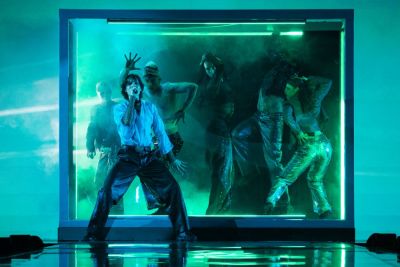 For ten thousand votes, can Søren win Eurovision... in the cube? EBU/Corinne Cumming
First song we saw in the semis was "Viva, Moldova!", performed by Satoshi for the broadcaster TVM (shown on screen as "Moldova"). Welcome to Moldova! We drink, we dine, we dance. We have the camera going everywhere, wobbling like the operator took lessons from The Big Breakfast while completely drunk. It's a big-hearted song, joyously selling the merits of – oh, wherever it is they come from.
There's a fine line between a song that's nationalistic (being proud, perhaps too proud, of one's country) and a song that is patriotic (showing love for a country, both its faults and its merits). "Andromeda" certainly fell on the patriotic side of the divide (performed by Lelek for HRT "Croatia").
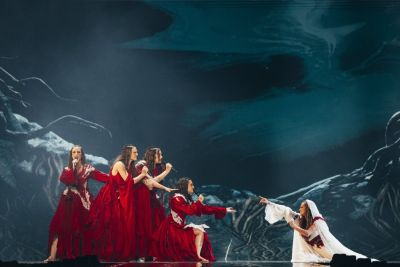 A cultural story, resonating through the continent. EBU/Sarah Louise Bennett
Back in the days of the Ottoman empire, ethnic Croat women often faced persecution; in an effort to stave off this unwanted attention, they wore sicanje – tattoo patterns. Women wore these patterns on stage, and demonstrated the effort to rescue one woman from an unseen menace. If you didn't know the history, the performance still worked, still got the artistic message across. If you somehow understood this was a folk-inspired anti-war ballad, deeply steeped in local history, there's a tremendous extra level. By telling a national story that is important to Croatia culture, one could argue that there is a nugget of politics involved; by telling the story in a clearly artful manner, only those people who choose to take offence would be offended.
Pre-contest favourite was "Liekinheiten" (Linda Lampenius & Pete Parkkonen, YLE, "Finland"), the experienced concert violinist is able to tempt Pete into the fire of lust. It's a memorable song, anything involving that much fire is memorable, but we didn't really connect with the story or the performers. It'll be remembered as another instrument played live on the Eurovision stage, special dispensation was granted for Linda to play her violin live while miked up.
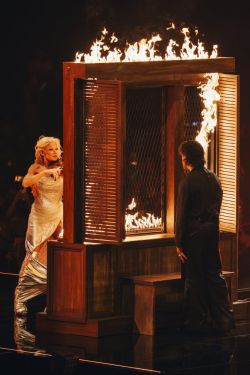 Stoking the flames of desire, or something. EBU/Sarah Louise Bennett
"Too epic to be true" brought Vanilla Ninja (EER "Estonia") back to the arena, twenty-one years after they'd made the top ten; sadly their soft rock still sounded like 2005, and the group were left in the semis. Alicja was due to represent TVP ("Poland") in 2020, but circumstances intervened; this year's "Pray" showed her growth as a singer, and was rewarded with strong jury marks. SMRTV ("San Marino") bought in the talents of Boy George to croak a few lines on "Superstar", but we'd rather they hadn't and he – and Senhit – were also left behind on Tuesday.
The Marcel Besançon Awards are given at the contest. The media vote on Best Song, and that went to "Eclipse". Songwriters name the best composition, "Før vi går hjem" took that award. And the commentators vote on the artistic staging award, claimed by "Bangaranga".
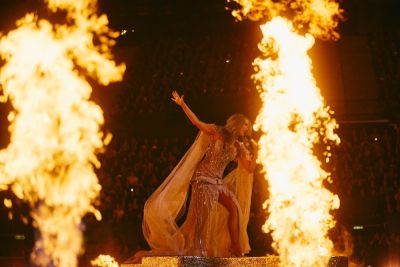 Delta's on fire! EBU/Alma Bengtsson
Te deum
Most of the online chatter about Eurovision has revolved around the KAN entry, "Michelle". It was about 3% of the show, we'll give it about 3% of the write-up. This column found the song anodyne, performed adequately, with a predictable staging, and completely immemorable. Given the relative weakness of the Tuesday semi-final, we couldn't honestly say it did not deserve a place in the final, but could not understand its success with the jury or the televote.
In order to address perceived bias, the EBU made changes to the televote system. Each line was limited to ten votes (halved from 20 last year), and there was a quarter-hearted effort to ask voters to "share the love" and vote for lots of songs. Many proposals have been made to further address this perceived problem: limit callers to one vote per song, or to impose a stricter "one SIM, one vote" method.
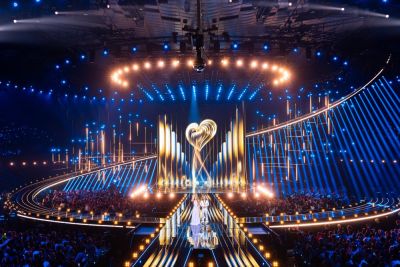 This year's arena. EBU/Corinne Cumming
But in order to make radical change, it's necessary to demonstrate that radical change is required. And we cannot – yet – rule out the null hypothesis: that the televote for "Michelle" was a genuine expression of viewer appreciation.
There is a way to find out the truth. The EBU has all the information from the televote: how many votes were placed for each song, and how many individual voters showed appreciation for each song. The EBU could publish this information. If it turns out that 60% of "Michelle"'s vote came from people voting ten times, and only 5% of "Bangaranga"'s vote was from maximalists, then there would be a clear case for further change. However, if it turned out that both songs received 140 votes from every 100 voters, the case for change would be much less strong.
Facts will save us, transparency is the EBU's friend. If they want support, the EBU needs to communicate with the viewers, and we've noted before that the EBU has been atrocious at talking to ordinary people when their entire job is to talk to ordinary people.
There is no immutable law that currently popular shows must remain popular. This column chooses to believe that the Eurovision Song Contest is a valuable cultural exchange, and should be treated as such. The EBU appears incapable of identifying the root cause of its problem, and incapable of taking a fearless measure of itself. This tetchiness feeds through the fans and into the broadcast. Opinions of shows can go down as well as up, and it is easy to squander years of good work
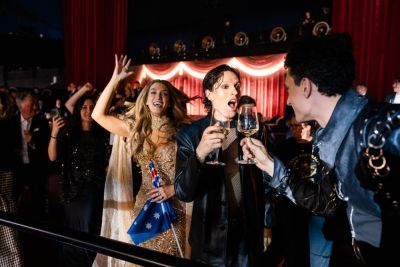 Let's get back to something cheery, with Delta and Søren and others. EBU/Corinne Cumming
Production problems
Bad camerawork and wonky shots during "Crossroads"? It's like we're back in the 1970s, when Crossroads was a cheap 'n' cheerful soap opera on ITV. The spirit of Benny Hawkins, Kath Fellowes, and The Wobbly Wall came back to haunt this year's contest.
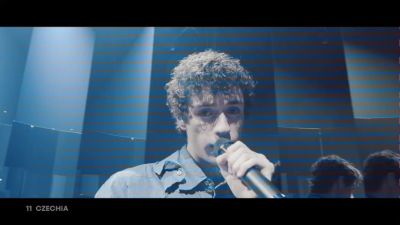 This wonky picture froze for some seconds, and the lines remained for an age. EBU
"Crossroads" (Daniel Zizka for CT, "Czechia") suffered from a major camera failure. There was a meant to be a 40-second long shot of the singer, a tracking shot following him round the mirror maze. But the camera stuttered, lost its connection, and had lines all across the picture. This wasn't deliberate, it didn't happen in the semi-final or the jury final.
Enough for a re-sing? We thought so, but the scrutineers thought otherwise. The camera problem was dismissed as a "minor technical issue" by the people who are meant to prevent this sort of thing from happening. While it didn't materially affect the result (CT failed to trouble the televote, and even a resing would only have lifted this by a few marks), it leaves a sour taste in the mouth.
The glitch was symptomatic of what was, generally, a poor show. Best part of the programme was Emily Busvine, who was warm and witty and sassy and savvy and quite clearly brilliant. We want to see a lot more of this talent!
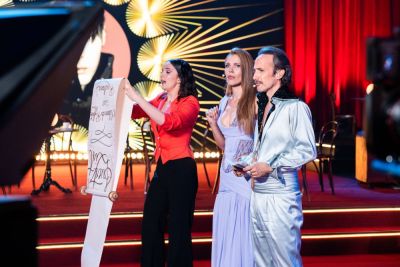 Emily Busvine reads off a list of hosts they tried to book. Victoria and Michael look on worried. EBU/Corinne Cumming
Most irritatingly, Emily was confined to the green room, and delegated the bulk of the hosting to Victoria Svarowski and Michael Ostrowski. One of them is the heir to the Svarowski crystal fortune, and the other has been taking fashion and style tips from their favourite contestant on The Traitors.
The programme was stodgy, with some not-very-funny conversations filling 30 seconds while they reset the stage – the moments when Mel Giedroyc would lead a conga around the arena, fun and dynamic and unpredictable. Ad breaks were covered by "Professor Eurovision", three-minute lectures about the history of the EBU's contest; one of the lectures seemed to be in such questionable taste that the BBC declined to show it, and we think they made the right call.
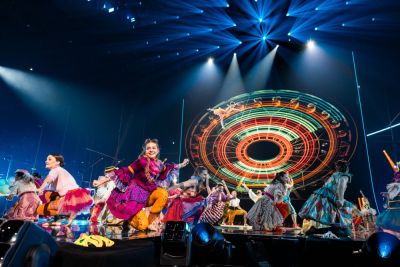 The circus interval was quite the highlight. EBU/Corinne Cumming
Interval acts were a mixed bag. Loved the circus skills on Tuesday night, and the medley of classic Eurovision tunes on Saturday. It led us to wonder, who did "Save your kisses for me" better: Brotherhood of Man, Lordi, Kenickie on A Song for Eurotrash, or Alis on stage for RTSH?
While it is the 70th anniversary of the Song Contest, and a reasonable excuse to look back, they could have done it differently. Ten years ago, "Love love peace peace" took the first six decades, filleted them for memories, presented them back to us, and said, "right, there's your history, let's go off and make something better!" ÖRF's contribution was nostalgic in the sense of looking backwards.
Slipping previous winning song titles into casual conversation is funny if you're doing it and your audience doesn't; might be fun at the start, but the idea lacks wings, quickly goes click-clack-dull, and rather than look like a superhero, j'imagine that your audience will make you go bzz.
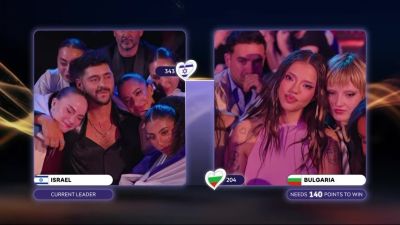 They indicated the winner by raising the bar, like an inverse Pointless. EBU
Graphics were bland and unobtrusive, and reasonably legible at all sizes of screen; that's absolutely fine. Staging was a decent circular blob, with a very long and surprisingly narrow catwalk towards the Green Room. The back wall met the stage in a curve, no sharp angles to be seen.
The Model (and it's looking good)
Our friends at ESC Insight tried something new this year: predict the contest before it happened. James Stephenson came up with "The Model". This piece of statistical wizardry starts with various mechanical facts about the songs (tempo, speed, key, how happy, how danceable it is). Then it adds in the historical facts about the broadcaster (although all entries start at zero points, the BBC's zero is smaller than the zero of SVT from Sweden). And then the fan reaction, bookmakers' odds, draw order, and eventually the exit poll all factor into a final prediction.
All of which explains why The Model predicted a win for "Liekinheiten" (YLE, Finland). Going into the final, The Model ranked "Bangaranga" fifth.
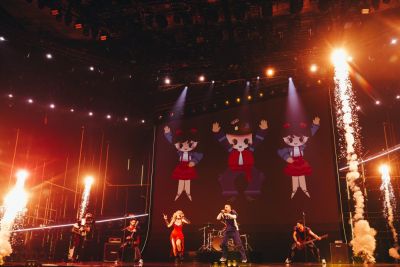 "Viva, Moldova" was always seen as a televote fave. EBU/Sarah Louise Bennett
A failure? Not a bit of it! Stephenson's work was brilliant when asked to spot which songs would get most of their points from juries, and which from the televote. Songs that The Model predicted would do well in the televote consistently did well; songs it said would fail to attract televotes did not get televotes.
"Regarde!" (FT, France) was projected to flop in the televote, it flopped. "Choke me" (TVR, Romania) was going to get most of its points from viewers, and that's what happened. Yes, it's true that The Model particularly over-estimated viewer support for "Leikinheitin" (YLE, Finland) and "Ridnym" (UA:PBC, Ukraine), under-estimated the response to "Andromeda" (HRT, Croatia) and "Bangaranga". But even back on its first projection, The Model had been broadly right about the jury-televote balance for almost all songs receiving a decent number of points.
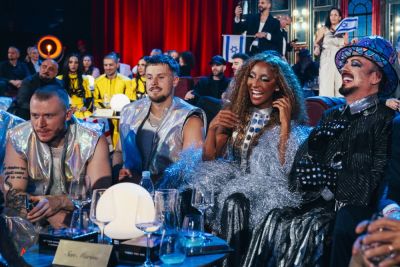 Senhit and Boy George's song was briefly tipped as a qualifier. EBU/Sarah Louise Bennett
The Model was less good with the numbers on jury projections, which is understandable: this year's juries were larger and younger, and that may well have brought a different atmosphere to the jury rooms. Juries are a bit of a random number generator at the best of times. It underestimated jury support for "Michelle", and over-guessed "Viva Moldova!" (TVM, Moldova).
As a guide to the Eurovision weather, The Model proved to be decently accurate. Did the BBC need to take an umbrella? Yes, from the very start.
We do have a slight concern that weekly updates may have been a bit too often, there was a risk that hearing the same projections over and over would create a narrative that "Leikinheitin" had this in the bag, and if it wasn't them it would be "Eclipse" (SBS, Australia). And this wasn't true.
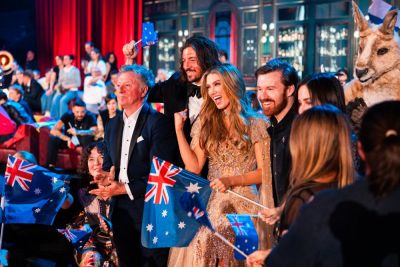 Runner-up in the contest, according to The Model. EBU/Corinne Cumming
Psychologists call this the "repetition-induced truth effect"; if we hear something often enough, and it feels reasonable, then we'll start to believe it. While every piece about The Model's work contained a disclaimer – this is the projected Eurovision Song Contest result if it were held today – nobody is going to remember the disclaimer as much as we remember the message.
Did this repetition feed back into the fan reaction, into the bookies' odds? Was The Model basing its current predictions on its past predictions? We hope it did not, but from discussions we saw and other commentaries we heard, we fear it might have done. In retrospect, would we have chosen to hear from The Model about once a month, rather than every week? Perhaps less would have been more.
If James Stephenson and ESC Insight repeat this exercise next year, we'll be very pleased to hear it. And this column will take an extra effort to remember: it is only a projection, and to trust the televote scores more than anything else.
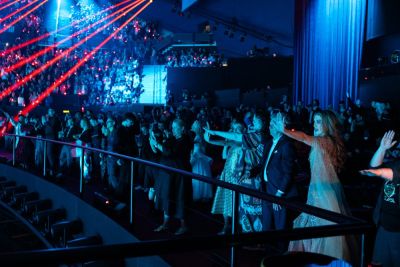 The Green Room joins in with one of the interval acts' simple choreography. EBU/Corinne Cumming
Next year, in Sofia?
So, we have the first win from south-east Europe in a couple of decades. Not since "Molitva" in 2007 led to Belgrade 2008 has the Senior Song Contest been held in the general Balkans area. Even the Junior contest hasn't been in the region since BNT hosted in 2015. We expect and hope that the contest will feel rather different next year, it's a rare chance for BNT and the Bulgarian people to show their soft power.
Given the location, it seems likely that MKRTV, the cash-strapped broadcaster in North Macedonia, might be able to afford an entry, and they would be welcome with open arms. We also hope that MTV can return, now that there's been a polite and orderly regime change in Hungary.
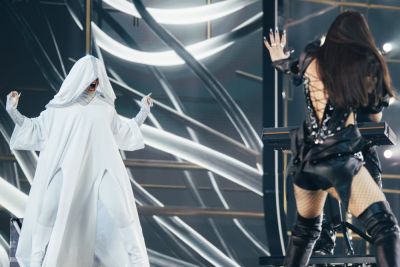 Begone, demons, be driven away. Or banished. EBU/Sarah Louise Bennett
The loss of four very western broadcasters (TVE, RTÉ, NOS/AVROTROS, and RÚV), and western-looking RTVSLO, has shifted the balance of the contest. It's no longer an approximately equal balance of west and east, but one where the former Iron Curtain has a slight preponderance. This may give more strength to culturally important entries from the area, like this year's "Andromeda". And it might give extra impetus to invite Canada's public service broadcaster CBC/SRC, to help balance the numbers.
Eurovision is expanding as a contest, we saw a brief advert for Eurovision Asia. Dare we suggest that the winning broadcaster in Asia gets to send a new song to the European contest? Might the 2027 Eurovision winner be from Bhutan?
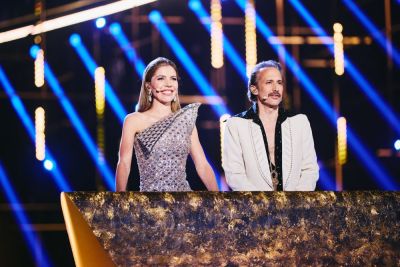 This year's hosts, Victoria and Michael. EBU/Alma Bengtsson
But before any of that, there need to be viewers. And there weren't as many viewers this year than in previous years. NRK reported its lowest overnight figures in two decades, SVT and the BBC their lowest scores since 2010. So much of the pre-contest discussion concentrated on the political rights and wrongs of one particular entry, without regard to its musical merits, and without any regard to the thirty-four other performances.
We mentioned the "repetition-induced truth effect" earlier. And the drip-drip-drip of negativity, from people pushing their political agenda more than their connection to the contest, wears down even the most supportive viewer. The EBU's continued failure to sincerely address and engage with these questions hasn't helped. We really hope that Eurovision can become more of a break from the rest of the world, a night when we might celebrate the brilliance of fine talents.
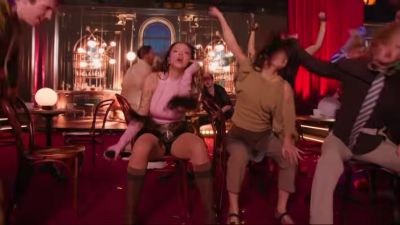 Let's do the show right here! EBU
Closing reprise
Ultimately, the 70th edition has given the contest a kick up the backside. A really modern song has won. For only the second time in a decade, the winner sounds like the sort of thing they'd play on the radio, or put on the Today's Hit Energy playlist.
The door is open to fresh sounds. K-pop, like the defending champion of the Americanovision Song Contest. Hyperpop, like SBS's entry from five years ago. Afrobeats, amapiano, whatever wonderfulness is coming out of South America. Just when Eurovision was starting to become predictable, something has come along and shaken up our preconceptions.
Where do we go from here? We go further! Junior Eurovision is at the end of October, and is already scheduled for the Week of 1 November.
Other news
Judith Chalmers has died, aged 90. She'll be remembered as the host of Wish You Were Here..?, the annual travel show on ITV. She also turned up to add glamour and wit to many panel shows; we were impressed when we caught a repeat of Give Us a Clue lately. Her family includes Mark Durden-Smith; we wish them well at this time.
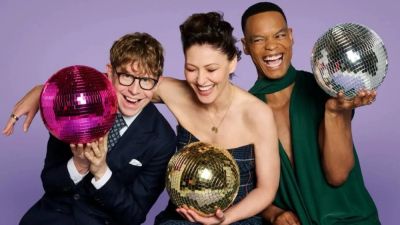 Your new Strictly hosts! BBC
Throuple of the week Can any pair of presenters succeed Tess Daly and Claudia Winkleman on Strictly Come Dancing? Turns out that "no" is the answer, so they've had to put three people in charge of the programme. Emma Willis is the skilled television presenter. Johannes Radebe is the dance expert. Josh Widdicombe is the comic relief. We hope they all have a brilliant autumn, and while Strictly might feel a bit different to start with, we're certain that the trio will be a comfortably familiar presence by Hallowe'en.
About the Week For about twenty years, this column has published on Sundays, a routine for our readers and for the writer. Because we're going to be out and about quite a bit this summer, publishing on Sundays will become a little bit difficult, and would affect the quality of the column. To avoid this, we're going to publish on Thursdays. The next edition will come out on Thursday 4 June, and we'll have a new column on Thursdays until at least the end of September. If you're interested in the TV guide, from the start of June that'll emerge on Wednesdays.
By the time we meet again, Nobody's Fool will have finished; ITV are burning it over two weekends. Bake Off The Professionals starts a new series (C4, Tue). New Tipping Point brightens the week (ITV, from Tue). Round the Islands Quiz reaches the final (R4, Sun); next week's Radio 4 quiz is Bookmarks with Clare Balding. The Way Out continues on the Dave channel (Tue); we'll review the show next time.
Soccer Aid season on ITV gives us Deal or No Deal Celebrity (Sun), The 1% Club Kids' Special (Sun), Tipping Point (Mon), Celebrity Lingo (Wed), The Chase (Fri); the big match is next Sunday. Got Talent has its final next Saturday (VM1 and ITV). As the calendar flicks over to June, Love Island kicks off (VM2 and ITV2, Mon 1 June). Masterchef finishes on Fri 5 June.
To have Weaver's Week emailed to you on publication day, receive our exclusive TV roundup of the game shows in the week ahead, and chat to other ukgameshows.com readers, sign up to our Google Group.