
Weaver's Week 2026-06-07
Last week | Weaver's Week Index | Next week
Exit through the gift shop.
Do you remember Britain's Brightest with Clare Balding? Of course you don't, not even the host remembers it. It's a 2013 one-series wonder with Konnect spelling, dodgy sequences, and an escape room. Yes, a couple of contestants got to follow a trail of clues and break out of a small Perspex cell to deliver a message to Clare Balding.
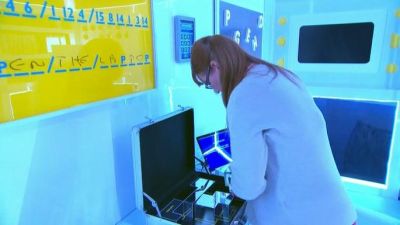 The message, written by researcher Tara Dys, was "Do not get in an alliance with Jonathan Ross".
It wasn't the first time we'd seen this type of puzzle on the telly. The Crystal Maze had a "murder room" almost every year: start with the message in the dead man's hand, and that would lead you to the jars on the shelves, which would point you towards something in the parrot's claw, and so on until you found the crystal / ran out of time / got laughed at by Richard O'Brien.
Elsewhere, Japan had invented "The Real Escape Game", a commercial timed get-out-of-the-cell event; by 2013 it had been run in Singapore and San Francisco. Hungary had a burgeoning scene, and a couple of the "escape rooms" opened in London at the start of the year. By the end of 2013, there were escape rooms in many major towns, and the phenomenon has spread in the years since.
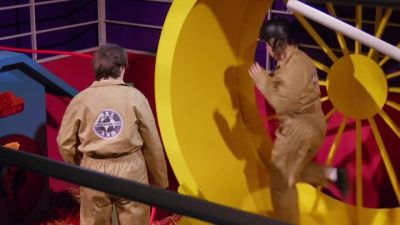 Lou Sanders runs in a giant hamster wheel. Let us explain...
But it's proven surprisingly difficult to make an escape room work on network television. The best example is Code van Coppens, which took to television screens in Flanders towards the end of 2019. Two pairs of famous Belgians compete to get out of a themed escape room as quickly as possible. There are lots of riddles to solve, and occasionally a bit of science to know. The hosts, brothers Mathias and Staff Coppens, watch from a control room and give hints / sarcastic applause / gentle abuse where warranted.
Code van Coppens has been running since 2019, and has notched up six series for production house Roses Are Blue. It must be doing something right. And, with about eleventy billion escape rooms on the streets of Britain, it's high time this popular pastime was represented on television. Domestic production company Tuesday's Child worked with Curious Cat to make it happen.
 One team was Chloe Petts, the comedian Ed Gamble, and Lou Sanders.
The Way Out is shown on the Dave channel, part of BBC Studios' UKTV arm. The channel positions itself as "the home of witty banter", and tends to give a lot of time to stand-up comedians and other professional smartie-pants. Host for the series is Mel Giedroyc, comedian and raconteur who you might remember from Letterbox, Pictionary, and Draw It!. She's a solid choice, familiar and dependable.
Unlike the Belgian original, The Way Out keeps the same teams throughout a series. The comedian Ed Gamble is joined by Chloe Petts and Lou Sanders. Nish Kumar enlists the help of David O'Doherty and Amy Annette. Would this be a way to save money by only flying six celebs over? Perhaps. They are able to make a virtue out of a budget-saving decision, and turn the challenge into a proper series, build up running themes (such as Gamble being "snippy") and find an overall winning team.
 David O'Doherty, Nish Kumar, and Amy Annette.
Ah, three people on a team, but we said these rooms are for teams of two. How does that square? The third wheel goes in the commentary booth with Mel Giedroyc; the team-mate is able to watch what's going on, talk to Mel, and give encouragement / abuse / help to the actual players. Both of the spare wheels are shown with Mel, and between them they pretty much replicate what the Coppens brothers do. Except our peanut gallery actually has some skin in the game, working to help their own team, and heckle the other side.
Each of the escape rooms are two chambers and a transition space. We suspect – but cannot prove – that one team does the entire course, then the other team do the entire course, and footage from both teams is edited together for the television show. Whether this is true or not, we don't lose much from the challenge: the rooms are completed in about 45 minutes, and there's about 35 minutes of competition on the prog.
 "Hello, is that Dial-a-Clue?"
The rooms are decorated with great detail, they look impressive. We saw four rooms in the series, "Visserij" and "Brandweer" from the 2022 Belgian run, "Bankoveral" from 2025's series, and what we think was "Het einde van de wereld" from 2025. (That's "Fishery", "Firefighter", "Bank robbery", and "The end of the world".)
"Fishery" featured a room made to look like real fishing boat, with real salt water flying around, and the real stench of real fish. "The end of the world" was a child's bedroom, including a real hamster; as the story progressed, our players miniaturised themselves and eventually ran around in the hamster's cage. (They didn't show the players becoming un-miniaturised, which is a minor continuity error.) "Firefighter" was rather a loose theme, as there was no real fire-fighting until the closing act.
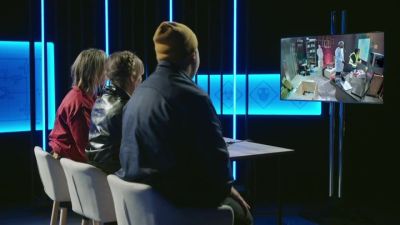 Mel and her guests watch everything on a big monitor.
The Way Out had to work as an entertainment programme, and by gum it worked as an entertainment programme! Each of the puzzles was translated from the original Flemish into English. And we use the word "translated" in the same way that Anthea Bell "translated" the Asterix albums; where a joke doesn't make sense in literal translation, the writers replaced it with something similar and funny in English. Kudos to James Donkin and the other localisation elves for a job well done.
Each room also challenged contestants in lots of different ways. Let's take "Bank robbery" as an example; the contestants start by being chained up in an artist's studio, and there's an excuse to shoot paintballs at the comedian Ed Gamble. But before we get to re-enacting a fabled Byker Grove scene, our players first have to aim the paintball thingie – and when they're just off target, they start seeing numbers appear on the canvas behind Ed.
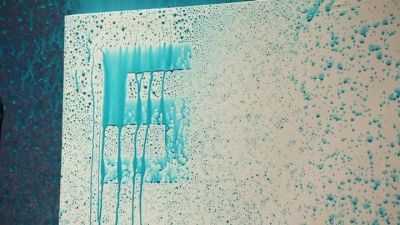 Water-repellant paint sticks to the shape of a 5.
How do they do that? Oh, it's a nanospray, it repels water and they're using a mostly water-based paintball. From time to time, The Way Out smuggles in a little bit of actual science. More science in a moment, as bleach clears the paint from a painting and reveals a lock code. Good grief, it's entertainment with a little bit of education in it; Lord Reith would be rolling in his grave.
Numbers on the canvas turn into symbols using a decoder above the shooter's head, and twingo bingo they're free. And that allows them to unlock the person they've been shooting at, so they can explore the rest of the room. A box of Important Tools, and filled with albino Wotsits? Expected. A box that actually goes beneath the floor? Blimey, that's unexpected. That box contains jump cables to connect a battery to a 3d printer, and that completes a screwdriver to remove the ventilation shaft.
 Of course they're going to unscrew a vent.
A task from The Adventure Game next: while one player gives directions, the other crawls in the dark tunnel to power up a ventilation fan – and to do that, they've got to get past some "rats" (the role of the rats is played by some stuffed socks, no small nibblers were harmed in the making of this programme). And slapped wrists to the writers for inflicting gratuitous electric shocks on their players; a later episode asked them to make an electrical connection in a plug, which is somewhat more dangerous than we're comfortable with.
After starting the fan, a message appears on the fan "look behind fan"; on the security camera behind the fan, "behind Munch", for a key that will unlock the lift. Inevitably, the lift stops halfway down, and there's a challenge to connect coloured wires to coloured sockets. Simple, except, the emergency light has come on, and everything is as red as a Taylor Swift album. An announcement from the emergency service gives a code to reveal a torch, which allows them to see the colours and open the door and drop out of the lift.
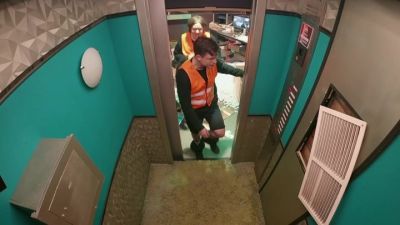 The lift: small space, large puzzle.
Then there's a battery powered by the acid in a banana (something Johnny Ball showed every few years on his shows). That shreds a Pranksy, which opens a locker, and in the locker is a printer gun. A whatty what? A printer gun: an inkjet printer about the size of a hairdryer. Swipe it across the canvas to show how to crack the safe. Follow those (and translate some numbers and directions) to reveal the laser maze.
Then it's a very simple task to get to a pair of buttons without breaking the laser beams, otherwise the security system will trip and the players will have to go back to the start. Yes, Ed Gamble, things would be so much easier if you stop having an arse. Soon enough, the task is complete, the Moaning Liza is stolen, and the clock is stopped.
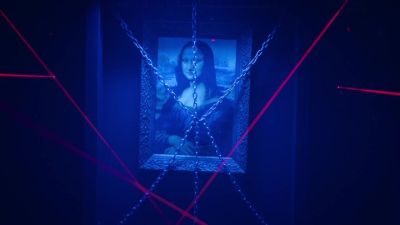 The prize painting is behind chains and laser beams.
It's a decision to keep the action flowing, and only cut to player confessionals on the way in and out of an ad break. We approve, keep the action flowing and the events happening. It's an immersive experience, so let's immerse!
By re-using an existing studio, and mostly re-using the existing plot, The Way Out is able to make more television for less money. If they'd had to construct everything from scratch, maybe The Way Out would only have been three episodes.
We enjoyed The Way Out, it treats the frivolous business of escape rooms with all the playfulness it deserves. In a world with so many drab and serious documentaries, it's grand to have some puckish frolics on our screens. By keeping the same teams throughout, we viewers become a little more invested in the teams' works: whether we cheer for David O'Doherty or against Ed Gamble, the result is the same.
 A small prize, and big bragging rights.
Another series? We'd be up to watch that!
Other news
We'd normally put in some details of obituaries, or new commissions, or anything else happening in the world of game shows. There are no obits, which pleases us. No commissions have passed our desk, which saddens us. Got Talent was won by Simon Cowell, which does not surprise us.
This weekend has the annual 24 Hour Game Show Marathon weekend (https://gameshowmarathon.com/ , Sat-Sun). They raise money for charity by making fan re-creations of great television and radio shows (and, for some unaccountable reason, Channel 5's Heads or Tails).
Elsewhere, Mock the Week kicks off a new run (TLC, Sun). I'm Sorry I Haven't a Clue returns to Radio 4 (Mon). The Great Australian Bake Off lands on E4 (Sun).
Wales' Home of the Year finds somewhere nice (BBC1 Wales, Thu), and the Interior Design Masters of the year is named (BBC1, Tue). The semi-annual Taskmaster final (C4, Thu) takes place.
We'll be back next Thursday (yes, editions this summer publish on Thursdays), and we'll review ITV's recent quiz-reality show Nobody's Fool. Did Danny Dyer ask any quiz questions? What was the importance of the fox? Was it inevitable that cards on the table present a problem? And is there ever a time when that is an answer?
To have Weaver's Week emailed to you on publication day, receive our exclusive TV roundup of the game shows in the week ahead, and chat to other ukgameshows.com readers, sign up to our Google Group.