
Weaver's Week 2026-08-30
Last week | Weaver's Week Index | Next week
This week, we're going on a mystery tour around Europe with some of our favourite people.
Do you remember Destination X? BBC1's big hit of last summer, it's the one where a bunch of people go on a coach trip around Europe, and are periodically asked to work out where they were. The one where Rob Brydon was rather wasted, the one where there was so much bad feeling on the bus that it rather ruined the programme.
ITV wanted something a bit similar, but improving on the bits that needed work. The result is The Chase Around the World; the familiar faces of The Chase, but taken out of the studio and put in various cities of Europe.
Let's cut to the chasers.
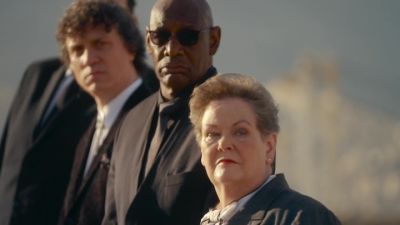
Ahem. Let's, er, show our conclusions. The Chase Around the World was a great programme to show off some famous bits of Europe. It asked the teams to test unusual skills, like map-reading and orienteering. The show barely used The Chasers, and could have worked without any involvement from The Chasers. Bringing in the familiar faces gave ITV's viewers a clear reason to watch, and a familiar conclusion. And the contestant selection worked brilliantly.
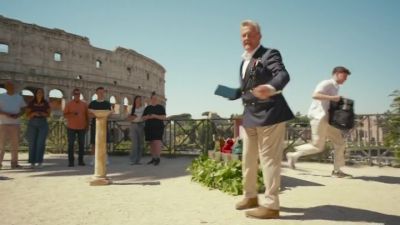 They're going already!
We'll start with the contestants, because they worked in pairs. Straight away, we've got some excuse for people to verbalise their thoughts: when Bill tells Ben what she's thinking, it's so that Bill can communicate with Ben. We viewers are able to overhear a natural and unforced conversation, perhaps enhanced by some pieces to camera recorded on the street.
How could they have done things differently? They could have used a diary room chair, in the style of Big Brother, in the style of The Traitors and Nobody's Fool, in the style of Destination X. But that would have been a waste. We much much prefer a chat in the real world, we were allowed to stay in the moment with the players. Yes, The Chase Around the World did have the occasional "diary room" entry, allowing a contestant to tell their story at slightly greater length; but this was very much the exception to the rule, and was made special by its rarity.
 A pair of contestants talk from a hotel room.
So, pairs of players gather. Six teams, to be precise. Six is about the right number of teams to introduce at once: not enough to overwhelm us, but enough to ensure that we'll never stay with one couple for too long. Our players will be allowed to leave once they get some general knowledge questions correct. Many of the questions have some link – however tenuous – to the city or country where our players find themselves.
To fully explain the format, let's chase after teams on their journey around Barcelona. A city known for its architecture, its museums, sandy beaches, seafood, and one of the biggest football teams on the planet – yeah, European champions if we remember correctly.
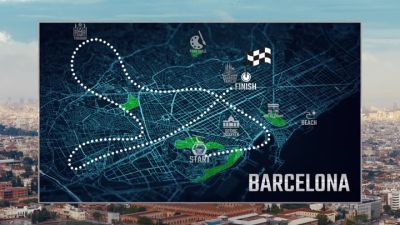 Small mercies: Bradley Walsh will not sing the city's theme song.
Last episode, sisters Amy and Katy won the chase around Rome, so they get the winner's bonus. They don't need to answer a question to start the race, and get to choose the order that other couples answer their starter questions. It's a small advantage, perhaps more psychological than practical.
Our players need to take cable cars to the beach – and there's only one car every nine minutes. One question, one right answer, and off our players go. But give a wrong answer and they've got to wait for all the others to face a question before their next one comes round.
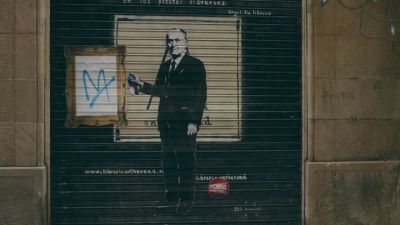 Can our players win in the miromaze?
What's next? A hunt for some artwork. Our players are asked which of three artists was born in Barcelona. They're then given the approximate location of three murals inspired by each of the artists. Find the mural relating to the artist you think is the correct answer, scan it in to your tablet computer, and pass through the round.
Part of the problem is working out which artist is the right answer. Part of the problem is locating the artwork, and not walking past it. This is where they test orienteering, map-reading, being able to work out where you are from clues like street names. Other episodes will test the teams' ability (or otherwise) to navigate the Paris Métro, where failure could mean withdrawal of your carte d'huïtre.
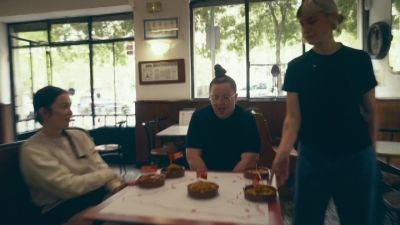 Move your tapas back.
There's a choice for the next round. Three of the teams will be asked questions on popular culture, the other teams will take a geography test. Whoever unlocks the artwork first gets first choice of subject; the last team is going to have to take what they're given.
The geography test? Go to a tapas bar. Five tapas dishes are going to be served, each labelled with its city of origin. The task is to place each dish on its spot on the map. They'll be told which answers are right, but if they get anything wrong there's a five minute wait until they can play again.
The pop culture test? Go to a shop selling figurines. Four pop stars are going to be shown: put them in order to move on, and there are two sets of figures to order.
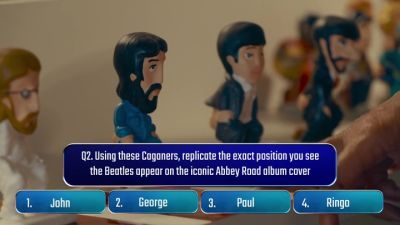 Put the Beatles in order from the "Abbey Road" cover.
One of the teams is having great trouble with the artist question from earlier, while everyone else is about two rounds ahead. The route makes its way to the Tibidado amusement park, a place that can only be reached by funicular railway. And there's only one railway departure every 15 minutes, so teams can bunch up and advantages get lost – or stretched. The Chase Around the World does this sort of thing on most episodes, a bottleneck on the journey adds some randomness to the result.
Is it fair? No. Is it just? Yes; the rules were written without knowledge of who would be in what place. Does it mean that the winning team have got to be lucky as well as clever? Yes, and The Chase requires a bit of luck: a healthy cashbuilder, a question you know and your Chaser does not, a quick pass – little things can make the difference between success and failure.
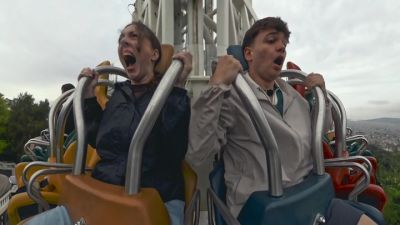 The players plummet like a lemming.
The next round is on the huge drop, taking contestants 50 metres due up, so they can get a better view of the city. Or our players can ride the carousel, less chance of being re-introduced to their lunch but there's an extra time penalty. Players can get an extra clue, but it'll cost them another run on their ride.
After the amusement park, the leading teams make their way to a taxi, which will take them to the stadium where Robbie Williams played last year. Was it at the Camp Nou, home to Barcelona men's football team; or the RCDE Stadium, where Espanyol lose their games?
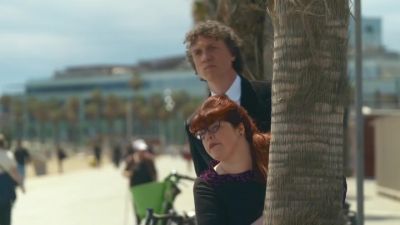 Darragh and Jenny are on the lookout for players.
In the dressing room, there's a bunch of questions, with answers displayed on the back of football shirts. The digit on the back of the shirt is the one they need to put in a phone number and dial. Get all four digits right, and they'll be connected to The Vixen's personal hotline; get any wrong, and they'll be told which answers need to change.
Then it's back in the taxis, and off to the Sagrada Familia. Somewhere around the square will be a red clue. "In Barcelona for one night only, The Vixen & The Menace, at the Sercotel Rosellón, followed by the place's address." All our teams have got to do is find the teeny-tiny clue in the huge huge square, then scamper to the hotel. On the roof, Bradley Walsh is waiting, and happy to greet the teams as they arrive.
 Bradley changed his pocket square to the national flag colours of this week's city.
Who's first? They'll get the advantage next week. Who's last? They'll face a Final Chase with the Chasers. Our players are asked questions until they've got eight right, buzzing in to answer. The Chasers then face questions alternately, and hope to get ten correct answers faster than the players got eight. If the Chasers win, the players are eliminated and leave the contest.
The Chase Around the World had one persistent problem: it always told us about time gaps, never showed us reliable evidence. In the Barcelona episode, we're told that the last couple made up a lot of ground by racing to the right football stadium, but we rather have to take the producers' word for it. Only when it's necessary to show teams in the same shot did we get any scale of how close things were – or weren't.
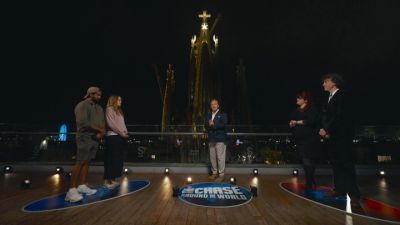 The players are ready for the final Chase.
What was their route? The Chase Around the World started in Rome (where Destination X finished) and passed through Paris (where DX ended its first episode). The route also visited Barcelona, Lisbon, Zurich, and finished in Athens – by allowing themselves to travel by plane, The Chase Around the World could reach the parts Rob Brydon's coach would not. One might quibble and call it "across southern Europe" – these familiar and accessible destinations, are markedly less exotic or ambitious than Channel 4's The Search from two decades back. Ah, but The Search probably had more budget.
Last year, this column criticised Destination X on a number of grounds. It had a confusing opening, but The Chase Around the World kept it as simple and uncluttered as possible. DX changed its format every time; Chase was predictable in format, the entertainment came from the challenges and landmarks. Chase had challenges – they were all trivia quizzes, but dressed up in unusual and inventive ways; DX was memory tests and not a lot else. One thing is common to both programmes: the £100,000 prize was going to be given away to someone, no way to increase or reduce it.
To be honest, The Chase Around the World is not a world-shatteringly great programme. And that's fine: it is something to go out in the middle of summer, a way for ITV to while away six evenings when there isn't much to watch. The show had limited horizons, and was a perfectly pleasant – if undemanding – way to spend some evenings.
Quizzy Mondays
Mastermind was won by Hugh Nicholl, who notched up 11 on Lyndon B Johnson and finished on a total of 19. Good general knowledge from Paula Lawford (Virgil's Aeneid) took her to second place, ahead of Akin Ajayi (men's Tour de France since 2000) on passes, with Mary Obodo (George Harrison) in fourth.
Only Connect went to Meat and Two Veg, who beat Six Sevens 19-14. Again, the match was won in Connections, where Veg succeeded on pictures of animals who are opposites in sayings, and rhyming synonyms differing by L and R. Renton's speech from Trainspotting felt quite hard for an opening heat's sequence, though Only Connect aficionados from BBC4 will welcome the footnote punctuation. Narnia and Oz on the walls, and Veg had slightly the better of Missing Vowels.
A reminder that next week's Only Connect introduces the last two teams: from here, it's familiar faces all the way to the end of the series.
Hard going for a lot of University Challenge, where Pembroke College beat St Andrews by 180-90. Very much a game of two halves: 60-55 to Pembroke before the music bonuses were resolved, 120-25 afterwards. St Andrews had the buzzes – first out of the blocks on exactly half the starters, but three penalties and just five bonuses arose.
Pembroke were very strong on the bonuses, 74% right, only one set fell to less than two correct. Their overall rate is 59%, somewhat better than average for the series. Strength in Literature and Social Sciences bodes well for later rounds; we wouldn't be too surprised to see Pembroke in the quarter-finals.
Sorry to hear that Dolly Parton died this week. We were scrabbling around for a game show connection: someone took Dolly as the specialist subject on Mastermind a few years ago, and achieved a rare Perfect Round. Dolly lived a life and was celebrated by all.
Next week, Taskmaster is back (C4, Thu), and so is RuPaul's Drag Race (BBC3, Thu). Siobhán McSweeney's fan club will be pleased as The Traitors Ireland returns (RTÉ1, from Sun). Daytime telly brings us new episodes of Pointless (BBC1) and Millionaire Hot Seat (ITV network). Radio 4 has new words in Unspeakable (Mon) and The News Quiz (Fri).
To have Weaver's Week emailed to you on publication day, receive our exclusive TV roundup of the game shows in the week ahead, and chat to other ukgameshows.com readers, sign up to our Google Group.