
Weaver's Week 2026-09-27
Last week | Weaver's Week Index | Next week
A bunch of MPs said this week they were going to hold an enquiry into an important aspect of media. Good. Here are some questions we'd like them to ask:
- How come every entertainment programme on ITV flops without trace.
- The subsidies dished out to "streaming" services, who freeload on the telecoms network while regular broadcasters have to pay for their transmission.
- Whether OFCOM is genuinely upholding standards held by society as a whole, or if it has been captured by the broadcasters and telecoms operators it is supposed to regulate.
- The terms of reference for a Citizens' Assembly which will be given a free hand to determine a funding model for the BBC.
- Corporate social media is rotting society from within and needs much tighter regulation; you can start by coming off it.
But no, these are difficult questions that might raise some troublesome actions. Goodness, the MPs might actually have to do something!
Instead, they're going to investigate… why the BBC hasn't done well at the Eurovision Song Contests lately. (Let's cover the recent history. 2021: rubbish song. 2022: won the jury vote, won the televote. 2023: host's curse, did very well. 2024: gamble that somehow didn't pay off. 2025: completely nerfed by the EBU's anti-booing "tech". 2026: gamble that more predictably didn't pay off.)
C'mon, you have bigger questions to ask. Such as, how come the BBC has cancelled two of its queerest shows?
Beneath a blue sky, two people walk along a path in front of a well-maintained building. They stop, look into each others' eyes, and kiss. A deep, long kiss. With tongues.
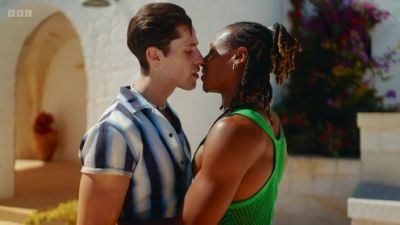
"Hello, what's your name?"
Snog first, then ask questions. Welcome to I Kissed…, an unusual dating show.
TwoFour, who made the I Kissed series for BBC3, insist that it's not a game show. There are no prizes at the end of the series: nobody walks away with a brand new car, or a sterling silver dinner service, or a shared cheque for £50,000. Nobody goes onto I Kissed to become famous, or boost their brand; at best, competitors might find some new friends. All this is true.
However, this column believes that "game show" goes beyond whether there's a prize at the end. We'll demonstrate that I Kissed has many of the elements shown on actual competition programmes, including what we can reasonably call "a way to lose". For those reasons, we say that I Kissed is a game show, or something recognisable as a version of it.
And if TwoFour want to say I Kissed is the antidote to dating shows, in the same way I'm Sorry I Haven't a Clue is the antidote to panel games, we'll support their call.
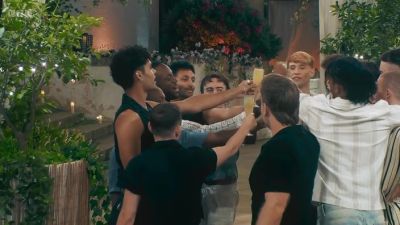 Raise a glass to us!
The key difference between I Kissed and other dating shows: it's unashamedly, openly, joyfully queer. Gay. Homosexual. 2SLGBTQIA+. Men who love men in I Kissed a Boy (which ran in '23 and '25); women who love women in I Kissed a Girl (shown in '24 and '26). We're going to refer to the show as "queer", which includes all of the terms above and any others you might think of; we'll specify particular details as we reach them.
We're discussing a queer dating show. It's not the first, there have been [riffles through the UKGS Encyclopaedia] … er … [consults footnotes] … um … [looks into our scrappy notebooks] .. ah … [puts on the head-torch and goes into the archive for scrolls dating back to mediaeval times when Radio Luxembourg was the Grand Duke standing on top of a tall hill and shouting at the top of his voice]… oh.
Turns out that I Kissed really is the first queer dating series to be made for these islands. Sure, there have been one-off specials, and successful imported series, but never before has there been a domestic series to foreground non-hetero couples.
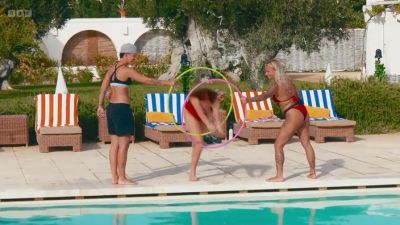 Producers, like contributors, jump through hoops.
Behind the scenes, I Kissed is a programme by queer people, for queer people. The people we see are almost entirely gay twentysomethings, and the people behind the camera are primarily gay twentysomethings. Sure, some of them are in their fourth decade of being a twentysomething, and a few of them are actually straight, but the general point holds. The producers deliberately chose to employ a crew who were broadly similar to the contributors, it helps them to feel at home and to be open and honest.
So, having established the programme's queer credentials, how does I Kissed pass muster as a game show? We're going to bring in three pieces of evidence: the chemistry tests, the kiss offs, and the contestant count.
Why I Kissed is a game show
As we've said, I Kissed takes its name from the opening kiss. In theory, these couples have been put together as the most compatible pairs they could make. But how accurate have the producers been? Most episodes feature a "chemistry test", which are meant to see how well the couples fit together – or cast doubt if they don't. Turned out that most of these tests were gossipy and scurrilous, trying to stir up discontent where it already existed, and perhaps sow doubt where discontent was not already found.
For instance, a test called "I begin to wonder…", where the players – er, er, the cast – spin a wheel of misfortune to get a sentence. "I begin to wonder if there's a red flag when…" Now, is there a way to complete that sentence in a way that does not suggest another competitor is a bit dodgy? Good luck finding one.
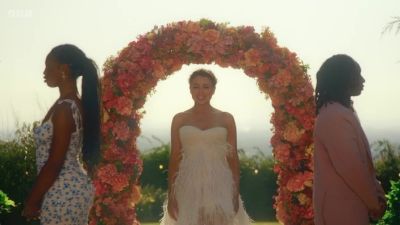 Will this couple choose to stay together?
From time to time, there was a "kiss off". This was the point at which couples determined if they were going to stay together, or split. Established couples stand back-to-back, and if they want to stay together, they turn round and kiss. Both turn around, great, true love wins, at least for tonight! But if either wants out, they stay as they are, and then state who they'd rather kiss instead.
The whole thing is done with the maximum amount of fuss and drama: it's mostly done at night when bright spotlights contrast with the dark sky. There are countdowns and cues to turn, and we're certain to have a cliffhanger at some point in each kiss-off sequence. Anyone who isn't kissed – anyone without a match – is off the show.
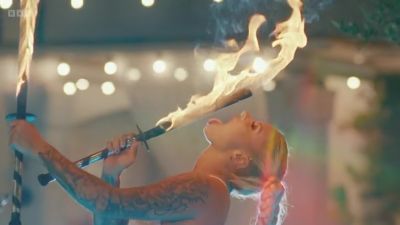 Some episodes featured party tricks.
Each of the kiss-off ceremonies features an odd number of contestants – er, er, potential kissers. The format also insists that each person nominates one and only one other person, and they only stay if their affection is reciprocated. And the format will only accept monogamy. So if Joe wants to kiss Pip, then they only stay in if Pip wants to kiss Joe. What if Joe wants to kiss Pip, and Pip wants to kiss Alex, and Alex wants to kiss Joe? That's no good, throuples and cycles are too much for I Kissed to handle.
So there is a way to leave the experience early. While I Kissed doesn't really have winners, it sure as anything has losers, and is certain to find at least one loser in each "kiss off".
Finally, we'll quickly cover the contestant count. Ten people enter in the first episode, coupled up into pairs. Others come in through the series, entries and exits are designed to ensure that there are always roughly ten people until the final episode.
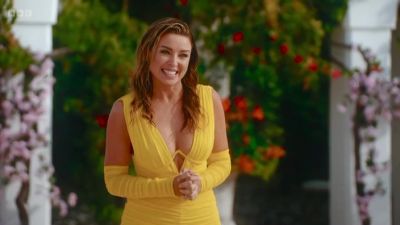 Dannii Minogue, host and contributing producer.
The host is Dannii Minogue, the actor and singer. She's been showing up for queer people since the 1980s, she's literally old enough and wise enough to be a parent to the I Kissed cast. Dannii has been a particular favourite amongst gay men since the last century, and does an awful lot of work for queer causes. We can believe that Dannii is honestly and whole-heartedly and vocally in favour of queer people being accepted for themselves.
It's clear that I Kissed is influenced by the straight dating shows, most notably Love Island. There are lots of shots of a sun-drenched masseria – a fortified farmhouse in Puglia; it looks to be about the size of a modest stately home. There are plenty of nooks and crannies for private chats, and outdoor space for intimacy of emotional and physical types. The voiceover (from Layton Williams or Charley Marlow) is sharp and leading, the soundtrack fizzes with queer energy. Comparisons to a villa in Ibiza, and the show set there, are plainly invited.
But there are many differences between Love Island and I Kissed. For starters, I Kissed is entirely pre-recorded, the results are set in stone many months before the show goes to air; Love Island is shown no more than a day after it's recorded. There's no suggestion of "showmance" or playing for the cameras. While Love Island makes it clear that its contestants are banging away like rabbits on a drumkit, I Kissed is much more discreet and barely hints at anything more risqué than a kiss on the mouth.
The outcome on Love Island are dictated by the viewing public; relationships on I Kissed stand and fall on their own merits. Closest they get to a "public vote" is in the closing episode, when friends and family from home meet the couple, and offer advice on whether to leave it as a holiday romance or stick together at home.
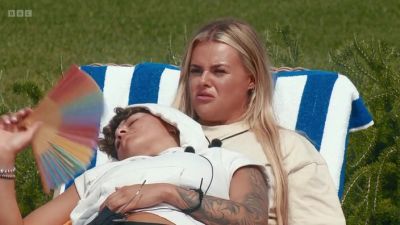 Great for right now, but will they last? The couple — and nobody else — will decide.
What's more, Love Island has a habit of being quite nasty to its contestants. Couples are split up, shown each others' faults and flaws, and almost encouraged to split up. We don't see any such editorial drive on I Kissed; for prolonged periods, it's an observational documentary with no particular game show elements.
For this column, the best bits of I Kissed were these quiet and reflective moments. Sure, there's lots of discussion of people's "types", as if one wants to narrow the dating space too much. But there's also room for gentle and honest discussion of being bullied, of how women are ignored in sport, of what it means to be non-binary or a trans guy. Relatable people talk of coming out, of being Black or Muslim, of their life with HIV, of growing up gay in Northern Ireland, of why the most common abbreviation is "LGBT" in that order. With a relatively small cast, there's a danger of reducing people to broad stereotypes, and I Kissed takes care to show us how the participants are more than just tokens but are real humans.
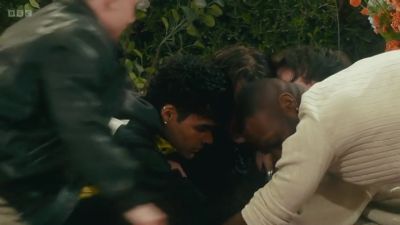 After one particularly emotional revelation, a spontaneous cuddle pile formed.
And, surely, that is the most important thing I Kissed – or any programme – can do. Strip away the gloss, remove the loose competition elements, and we have public service broadcasting in its purest form. This programme allows people to tell their stories in a natural and unforced and relatable way. We don't just hear that there's a trans guy on the show, we see him attempt to form a relationship, we can feel emotions for him. Good television is an empathy machine, and I Kissed allowed its viewers to empathise with all the people on set.
Perfect public service broadcasting? Allowing people to give an honest account of themselves on network television? Reaching young and alienated audiences? Treading ground that the commercial channels have refused to cover in seventy years? Of course this is something the BBC ought to be doing, a show close to the corporation's core purpose.
Which explains why the BBC has chosen to cancel I Kissed after four years.
A brief diversion into RuPaul's Drag Race
For over a decade, the Beeb has shown editions of Drag Race from around the world. They've made their own competitions, too, with the eighth series going out on BBC3 at the moment. It features drag queens – performers who dress up as an exaggerated caricature of gender in order to entertain. Drag Race takes after the titular RuPaul, and tends to feature camp gay men who are flamboyant and sharp-tongued and bitchy.
There are challenges, including fashion design and modelling and singing and improvisation. A big chunk of the show happens backstage, where contestants prepare for the challenge, and encourage each other. Sometimes they're able to touch on deeper matters. Each episode features a Gratuitous Runway Fashion Show, often for no other reason that it's what they do on Drag Race. After the competition, Queen of the Week is declared, and the worst performers compete in a lip sync battle to avoid elimination.
We've given a brief and superficial overview of the show for the very simple reason that we might have seen two episodes some years ago. This column finds that we dislike RuPaul as a character, and it is impossible to watch Drag Race without seeing an awful lot of RuPaul. We found the initial competition format to be uncomfortably Americanised, as if RuPaul's vision of drag was the only viable one, and it particularly neglected the British tradition of pantomime dames. We are given to understand that this has been addressed and mostly reversed in subsequent series.
Frankly, we don't believe we can give Drag Race a fair review on its actual merits; we consider this no flaw in the programme, and a negative commentary on us. We also know that there are a lot of other commentators on Drag Race, and an awful lot of fans, and this column would be pouring a lot of yuk on many people's yum. And we'd rather talk positively about a good programme – or just stay schtum – than criticise something from our faults.
You cannot be what you cannot see
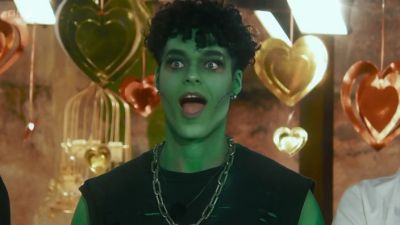 Some nights featured fancy dress, a come as you aren't party.
But the current series of Drag Race is to be the last on the BBC. The corporation has decided to close production; as with I Kissed, the cited reason is an ongoing budget shortfall. Drag Race will continue on RuPaul's own World of Wonder website, but it appears that I Kissed is unlikely to be picked up in the foreseeable future. We're heartened that TwoFour are shopping the format around, and we hope that there's a place for I Kissed, somewhere on the other channels (looks at E4 in a slightly stern manner). It's just a shame that the BBC have chosen to do less for young queer people.
These aren't the only programmes to be taken off air. Many beloved shows have also reached their off-air cue – from Football Focus to Celebrity Mastermind, from Lynn Bowles to Winterwatch, sports news and presented weather forecasts, all gone or coming to an end very soon. We expect to hear next week about further programmes – and maybe entire channels – to be sliced from the EPG.
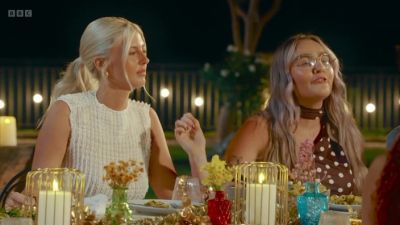 The dinner party was an excuse for bitchiness.
In recent months, the corporation has been running a promotional campaign, asking "What has the BBC ever done for me?" Entertainment, drama, entertaining drama, Traitors, faithfuls, adulterers, politicians, dancers, drummers, musicians, Duggee, hospitals, and Romesh Ranganathan.
And not a single drag act.
Queer people in general, and trans people in particular, feel under attack from other forces in society. Amongst queer people, it is an orthodox belief that the media in general has over-represented and encouraged the attacks on the community. It's also an orthodox belief that the BBC has not acted with great journalistic integrity when it reports on, and fails to challenge, the attacks on queer people. Shows like I Kissed and Drag Race have been a quiet and subtle resistance, telling the humble truths of queer people, and exposing the lies spouted by haters.
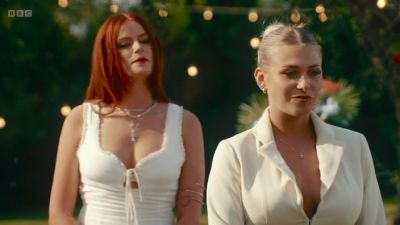 The ultimate heartbreak: when one wants to commit, and the other does not.
When a community is under attack, it will choose to interpret any action in the worst possible light. We have heard suggestions that these shows ending is a direct attack on queer people. This column hears the claim, and we cannot refute it. We hope it is wrong, we expect that it is a bunch of commissioners making individual decisions, but when we add them all up the cumulative effect is plain for all to see. And we remember that the BBC has plenty of outlets for capitalists and "businesspeople" to push their news, but hasn't commissioned a regular queer news programme since the turn of the century.
As Romesh says, the BBC has done a lot of things for a lot of people. It would be great if it continued representing everyone on screen.
In other news
Congratulations to Freya Skye, the Junior Eurovision Song Contest alum released her new single "Bad taste", and this week it's the best-selling single in the land. We are sure that the MPs will pay close attention to the BBC's great success in the contest, and encourage a return.
Remember Rise and Fall? One of the many expensive shows Channel 4 made, didn't quite know what to do with, and cancelled after a single series. Three years later, the show has been picked up for viewers in India. A group of celebrities and reality stars take part in the challenges. We understand the Indian version is somewhat more mainstream entertainment than we got, concentrating more on the personalities than the power struggles. The series is on Amazon Prime, and might be viewable over here.
Matter of Stats has an update on which Chasers we'd prefer not to face. All of them, quite frankly, though especially Jenny who is solid, and Darragh who offers very few pushbacks. For our money, a key finding is in the contestant count: increase from two to three in the Final Chase and your team's target increases by over two answers – and pushback rate increases almost 10%. Is this advantage worth a negative offer: guarantee your place in the final, and massively improve everyone's chances of winning something, at a cost of a few grand? Full article's worth a read.
Quizzy Mondays
A rare high-scoring edition of Mastermind, where everyone did commendably well on their specialist subjects. Alex Spacey won the programme, notching up 11 on his specialist Round the Horne, and extending to 24 after general knowledge. Freddie Mitchell (Paris commune of 1871) scored 11 on general knowledge, and tied with Beth Goodliff (novels of Jeanette Winterson) who notched up five passes. Finally, Lotte Verheijen (films of Nicole Kidman) may have been scuppered by a lot of very British questions for (we think) a Dutch-speaking contender.
Accrual World made it through to the next round on Only Connect, translating the police forces of various languages, John McEnroe's rant, and dogs with no noses. They beat Double Features by 25-17; the DFs were unlucky to get tennis questions from when their parents were children, but came into their own with a spectacularly solid wall solve. Thanks this week to Victoria for spoiling the ending to Goncharov, and the choruses of "Brad Pitt".
"It seems completely wrong that anyone should lose, especially by a margin of 5 points." It's a rare match where the side giving the most correct answers loses, 28-31. Southampton were the winners, by a margin of 200-195; Queen's University Belfast take the first place in the repêchage next month. After a fairly even first section, Southampton did very well and opened up a 40-point lead, only for Queen's to briefly retake the lead. Southampton moved ahead again, but Queen's remained in touch, and eventually the game came down to a one-question shootout. The combined total of 112 opportunities to answer is a record for this series, which has averaged 94.5 so far. 59 correct answers ties the series record set by Bristol and Imperial in the opening game.
Southampton won it on the buzzers. Eleven starters, most of them successful interruptions. The side was a little unfortunate to get just 47% of their bonuses right, many near misses. The side were thin on Art and Language questions, which perhaps doesn't bode well for an extended run in the contest. On the upside, everyone buzzed in with at least two starters.
Queen's Belfast lost it on the buzzers: two penalties for incorrect interruptions, compared with none for Southampton. The side rode their luck on the bonuses – with three folk from the United States on the team, they got flags of the States. But they also knocked off three questions on decolonisation in no time at all, only to confuse Petula Clark with Barbra Streisand. Belfast ended with 70% of their bonuses right, and 57% overall – Southampton only made 48%. Queen's were very strong on Geography and Language, and look useful on History.
A note to our readers in Northern Ireland: the BBC2 transmissions of Quizzy Mondays will be delayed for the next two weeks, owing to live events.
Our periods of waiting are almost over. Strictly Come Dancing started its performance shows last night (BBC1), and It Takes Two returns with new host Ellie Taylor (BBC2, from Mon). And it's paired with Richard Osman's House of Games (3), back with favourite contestants (BBC2, from Mon).
Later in the week, The Celebrity Traitors begins (BBC1, Thu, Fri). Have I Got News for You continues to prop up the Gyles Brandreth jumper industry (BBC1, Fri).
To have Weaver's Week emailed to you on publication day, receive our exclusive TV roundup of the game shows in the week ahead, and chat to other ukgameshows.com readers, sign up to our Google Group.
Last week | Weaver's Week Index | Next week