
Weaver's Week 2026-10-25
Last week | Weaver's Week Index | Next week
Ah, wuff.
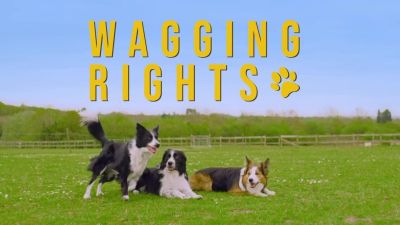
Take five dogs. Invite along their famous owners. And get them to do new tricks. Sure, the dogs are going to end up doing all of the stunts, but the humans are going to have to learn how to persuade their pet to move or fetch or stay still or whatever.
It is a competition show, they do have a winner at the end, but Wagging Rights is mostly about the training and the journey. The judges are Kay Attwood and Nigel Reed; Kay is a dog trainer and behaviourist, Nigel is an author and behaviourist. They both know what they're talking about, and offer sage advice that contestants should heed. For the viewers, Liza Tarbuck does the narration, she's always the voice of a wise owl.
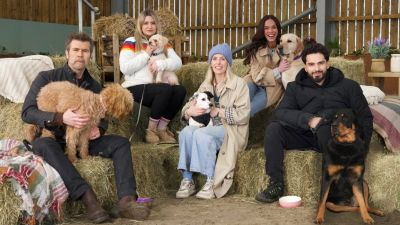 The contestants, and their humans.
The players were:
- Rhod Gilbert from Jest a Minute, with the moderately-sized Picsen
- Harriet Kemsley from all the panel games, with teeny-tiny Sonny
- Sara Pascoe from Out of Her Mind with her dog Mouse, who is actually larger than a mouse
- Vicky Pattison from It's Not Me, It's You and big silly Milo
- Kae Kurd, performance poet, and the big scary Riot
Each episode followed a similar, and very familiar, form. After setting the challenge in a short meeting, the bulk of the show cut between each of the human-and-dog pairs training for the events. How would the big dogs cope with agility work? Would the small ones be able to pick up a ball that's almost as big as their head?
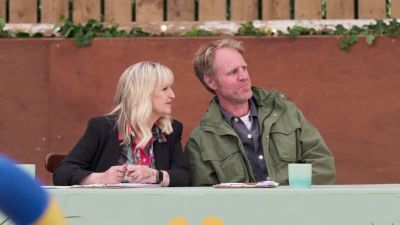 Kay and Nigel, the expert trainers and judges.
In turn, the celeb-and-dog pairs would be visited by Nigel or Kay, the expert trainers. They assessed the progress that the humans had made, and the tricks the dogs could do. And they offered advice to improve the dogs' performance. The experts chose not to talk directly to the dogs but addressed their remarks solely to the other human in the pair. While this made the trainers' job harder than it perhaps needed to be, the show was better television as a result: viewers, like celebrities, do not speak fluent dog.
Soon enough, it came time to gather back in the Wagging Rights shed, and see how each of the canines would perform. The tests – of obedience, agility, scentwork, freestyle performance, and retrieval – were judged by Kay and Nigel from behind a little table. It looked cheap and familiar, perhaps a small village fair where some of the familiar faces are parading their pets' abilities. Points were handed out – ten for the winner, down to six for the last-placed team – and a leaderboard took shape.
 Rhod and Harriet share a joke.
Wagging Rights was a very light and fluffy programme; if this show were any lighter it would float off into the wide blue yonder. The stakes were deliberately kept low, the prizes were comically small – a rosette for the weekly winner, a small trophy for the series champ – and it quickly became clear that the contest was a framing device to provide each episode with a climax.
The real story of Wagging Rights was the bond between the human and their dog. Harriet and Sonny may not have been much good at any of the tasks, but they clearly had so much fun doing them. Vicky had a bad week when one of her other dogs fell ill, and it was clear that the health of the hounds was more important than any competition. This message was emphasised the following week, when Riot was withdrawn on medical grounds, leaving Kae out from the series.
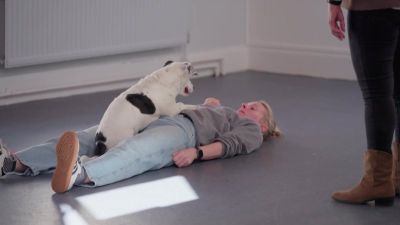 Sara had some unorthodox training methods.
Boldprint Studios made the programme, for BBC Studios' commercial UKTV network. In a very unusual move, UKTV decided to air the programme at the same time on two of their channels – Dave (home of smartiepants shows like QI and Have I Got News for You) and W (lifestyle channel where it followed Pete Wicks For Dog's Sake). It's an obvious fit for the W channel, not at all clear what the attraction is for Dave, other than most of the humans are familiar to the channel's viewers.
In the grand history of game shows, Wagging Rights will be a footnote. In tone, we found it to be sweet, a people show (albeit one where half of the people are canine). In structure, it brought to mind the classic Scrapheap Challenge: here is an improbable task, we'll give you time to prepare for it, we'll give you advice and help to do it, and you'll perform for us at the end.
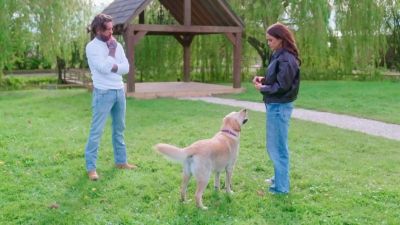 The dog pays attention to Vicky, not the expert.
Do we regret watching it? No, it was a quiet and relaxing way to end our Sunday evenings. Do we recommend it to others? Perhaps: if you're interested in the various human competitors as people, or you've a mania for dogs, this will be right up your alley; otherwise, maybe not. Watch on "U", the UKTV player
In other news
Pop star Olivia Rodrigo released a new video clip last week. The short film, promoting her new single "Expectations", contains many homages to American game shows. Our friends at Buzzerblog explain all the references.
How BBC Sport grew its online audience by using quizzes. Former editorial develop Iain Hepburn explains that harder quizzes had better long-term engagement, how the sweet spot for an online entertainment is about five minutes, and other evidence-based insights.
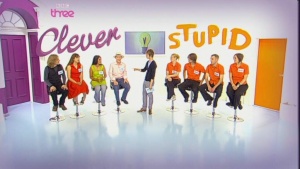 The BBC board of governors this week.
Oh no not again The BBC intends to take BBC3 off telly sets. It will also close BBC Scotland as a standalone channel, and stop the cycle of repeats that is radio channel BBC7. BBC3's best bit was Liquid News and – more recently – I Kissed…. BBC Scotland had some interesting little game shows when it was new, and we still think Wonderball deserves a commission for the network. Radio 4 Extra (as they're calling BBC7 this week) was almost entirely repeats, another chance to hear Counterpoint from ten years ago, Many a Slip from fifty years ago, and Just a Minute from when Nicholas Parsons was in short trousers.
We reckon this is a set of errors. The BBC top brass are obsessed with the latest fashion, streaming and seeing things over the internet, each viewer curates their own evening's viewing. But the BBC top brass also want to serve a balanced diet, and the best way to do that is a curated linear channel. A clear editorial voice is needed, a place that every viewer and listener can switch on as a default. By closing BBC3 on telly, and BBC7 on radio, they're removing two linear channels with very clear curation, two of the channels that should be the strongest arguments for the corporation.
But we do not blame the current BBC management. Not when the prime error is of George Osbourne, the finance minister who single-handedly torpedoed the previous funding arrangement for the price of a few beans. Osbourne knew the cost of everything but didn't care for the price we're still paying.
Quizzy Mondays
BBC Brain reached its semi-finals, and we start to give quick recaps. And we note the series' new "Spotlight" round: each contestant has nominated a really niche subject, and will receive questions on that topic. It's a familiar idea, like the Mastermind specialist subject, but functions more like the expert topics on Tom Gleeson's Hard Quiz, as an error can be picked up by the other players. This week's subjects included the Nuremburg trials, and fighting video games.
Round two went straight into the history books. Claire Reynolds begins with a Five In A Row (And A Bonus Mark). Michael McPartland comes close to a Five In A Row of his own, but cannot quite place the Golden Triangle of Central America, and that's a bonus to Claire. Paddy Moore secures Five In A Row (And A Bonus Mark) on his spotlight subject, the films of Billy Wilder. And, not to be outdone, Shaun Drury gets his own Five In A Row (And A Bonus Mark). The maximum twenty questions correctly answered across that second round, awarding no less than twenty-three points! We have never ever heard that before!
We learn that there is such a thing as a "turducken": a chicken, containing a duck, containing a turkey: we raise a stick in memory of Bob Johnson. And that Watership Down is a real place, with a real book about it. Later in the show, Claire will secure another Five In A Row Etc on her spotlight round, the mathematician Emmy Nöther. With a slight sense of inevitability, Claire Reynolds is the week's winner, finishing a full round ahead of the others. She'll be back for the final on 15 November.
House of Games (3) featured Cheryl Baker from Bucks Fizz, Rick Edwards from !mpossible, Toby Olubi who's Phantom from Gladiators, and Lou Sanders from Unforgivable. We all know that Rick is a bit of a quiz legend, and he proved it here, winning all five days without particular competition. Good to see that he was generous with his prizes, though if Rick goes on Gladiators he'll get no favours.
Have the contenders on Mastermind been watching the 1977 repeats? Back in the day, they passed liberally and freely; this week's show featured contenders passing liberally and freely. After all the points and passes had been counted, Matt Malin emerged the winner. He picked up a few points from guesses, not least a call of "Banana!" after time; Matt had taken Peep Show as his specialist. One point back, we found Tony Barnes (The Lake District) and Maria Nagle (Joni Mitchell), just four off the win was Emily Freeman (the poet Aemilia Lanyer).
It is, perhaps, worth noting that Matt won this week's show with 16 correct answers. He would have finished last in the previous show, and eight points off the tie-break we saw. Yes, it's true that the show's rules are known and are clear; they don't always give the most just results.
"Is that Keith Richards? No, it's the other one." Colonial Geese and Knitwits met on Only Connect. One of the sides had not seen Balamory, the other side fired up the Five Point Klaxon on the clue "Helsinki (French end)"; the bit in brackets is Fin, add Land to make Finland with the capital Helsinki. The Geese completed a tricky sequence on "Bananas", split.
But this was the Knitwits' show, scoring on all but one of their own questions, picking up three bonuses, and the Knitwits won by 39-15. Knitwits make the quarter-finals, Meat and Two Veg lie in wait for the Colonial Geese
University Challenge moved into the repêchage phase, the first of ten consecutive matches where the losers are out of the contest. St John's Cambridge played LSE. "Your bonuses are cakes and pastries in Victorian novels", lovely, especially with a round on cocktails following soon after. An incorrect suggestion that "Paul Merton" is an economist; they were thinking of Robert Merton. A round on the Gilmore Girls soundtrack: brilliant, forgotten that Sonic Youth appeared. Aaagh, no, don't let the host sing, it'll rain for a week afterwards!
In the contest proper, St John's took a lead in the second quarter, and proceeded at their own slow and secure pace. LSE buzzed early and often, got surprisingly few bonuses (just 38% in the end), picked up four penalties, and go out: St John's Cambridge win by 220-100. St John's were right on 58% of their questions, and 58% of their bonuses, both slightly above average in the series so far. The side remains strong in Art, and all Science questions; they're perhaps weaker on Languages.
And a distinct raspberry for the host, whose quotes included: "I don't think I'd have forgiven you if you got that wrong." "We enjoyed watching you struggle." "You gave us such entertainment in the bonuses, having these wonderful, feverish discussions and then getting it wrong." "Maybe avoid letting your mum watch this particular episode." Grow up.
It's a big week for winners. The Celebrity Traitors works out who's won (BBC1, Thu and Fri). ITV has a pair of finals on Saturday, The Voice and Win Win hand out their big prizes.
Celebrity Race Across the World returns (BBC1, Wed). Daytime is brightened by new Dickinson's Real Deal and Lingo (ITV network, from Mon), and by Maddie From The Traitors who appears in Radio 4's afternoon play on Thursday. We'll be back next weekend with a look at the Junior Eurovision Song Contest.
To have Weaver's Week emailed to you on publication day, receive our exclusive TV roundup of the game shows in the week ahead, and chat to other ukgameshows.com readers, sign up to our Google Group.