
Weaver's Week 2026-11-01
Last week | Weaver's Week Index | Next week
Did somebody mention… boo?
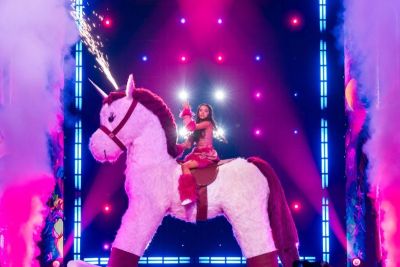 My lovely unicorn.
"Nobody ever wins Eurovision when they're seen with a horse." A piece of received wisdom amongst fans for the past little while, following the atrocious performances of just about every act ever seen with an equine animal. From Lesley Roy to The Two Fathers, nobody with a horse in their video ever gets to the final of Senior Eurovision, they always fall at the first hurdle, or cannot clear Beacher's Corner.
"Boo!" proved the exception to the rule. Performed by Naré, with music by Lilit Navasardyan, lyric by Grigor Kyokchyan, it represented AMPTV at last Saturday's final. The song (shown as "Armenia" on screen) featured Naré and four backing singer-dancers on a very pink and very fluffy stage. Seriously, this is what happens when you let Elle Woods design your staging. The visuals remained on point, the dancers held up little fluffy ghost glove puppets; later, the steps rotated, and were replaced by this giant pink rocking unicorn.
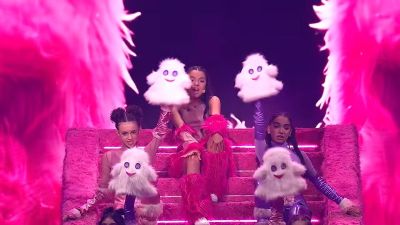 Adorable little ghost puppets.
As a song, "Boo!" is absolutely spot on. It's done at a fast walking pace, in a yearning minor key. Naré sings in a staccato rhythm, about when a group of friends get together on a dark and stormy night, tell each other scary stories, and dance to keep the nightmares away. The sound is contemporary: the energy of the best K-pop, matched with notes that are just that little bit more discordant than normal. It's a scare, but it's a safe scare – just like the ghosts popping up on your friends' hands.
How did "Boo!" get the win? From the televote, where it was selected by almost a third of the votes cast, far in excess of any other song. As ever at Junior Eurovision, no song wins without being validated by the juries, and there "Boo!" finished in third place, 11 points off the lead. It's the third time AMPTV have won the contest, five years after "Qami qami" began a jaw-dropping run of success for the little broadcaster with big songs.
The other medallists
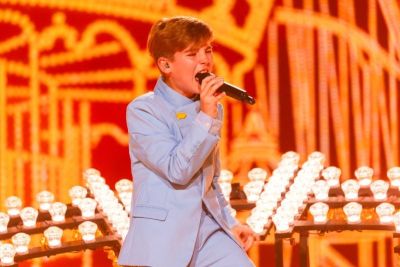 Lucas Paulano is going places.
"Cuore bello (te quiero, te quiero)" finished second, for Lucas Paulano. He represented another of the perpetual JESC powerhouses TVE ("Spain"), who are always going to be there or thereabouts. It's a nostalgia-laden song, about a moment when the young singer felt truly happy and cared for. The staging saw Lucas trapped in the rings of a circular clock, perhaps a clever framing device to ensure he didn't dance or run out of breath.
Although this column didn't see tremendous merit in the song, it's clear that juries did, putting it second in the voting. Televoters gave it third place, easily enough for second overall. Perhaps it helped that there's a lot of support for Eurovision in Spain, and no other outlet this year for those fans to express their love of the contest.
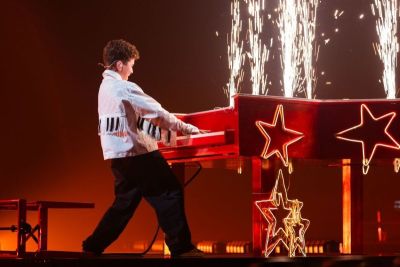 Burning grand piano, check.
"Comment tu vas?", Alec placed third. He represented another JESC powerhouse, France Télévisions ("France"), for whom third place is something of an underachievement – they've won the contest four times in the past six years. This was one of a few compositions that began with a young man at a piano, and unlike most of the other ones ended with him at the piano. Sure, it burst into flames a few times, and had neon stars on the side, but that's just absolutely normal and completely unremarkable at Junior Eurovision.
Top of the jury votes, which we could completely understand, because this is a polished song, sensitive and with a powerful climax. The surprise came in the televote, where it finished squarely in the middle of the pack, dropping 48 points to the winner – evidently this had not connected with the casual viewers at home.
What is San Marino like at this time of year?
"Ruota panoramica" came fourth, that was sung by Violamarie. She represented another JESC powerhouse, The Mighty Mighty SMRTV ("San Marino"). This is a glorious song, a sensitive rendition of life's ups and downs, the bad times and the good. The moments when you're flailing on the floor, the moments when you're standing tall, the moments when life hands you a lamp and a place in the turret of The Traitor San Marino.
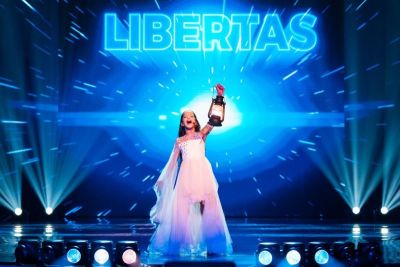 Violamarie, better at this Traitor lark than some people we could mention.
Eighth with the jury was no mean achievement, though on this night there was no particular consensus amongst the jurors. The surprise came with the televote, where "Ruota panoramica" came second (second!), leading to the remarkable sight of "San Marino" appearing at the top of a Eurovision scoreboard. More of this, please!
It's the second year in a row that SMRTV have placed into the top half of Junior Eurovision, and the second year in a row that the microstate's broadcaster has beaten the entry from RAI Gulp. Quite clearly, they're doing something very right, perhaps it's sending really good songs that are joyful and staged well.
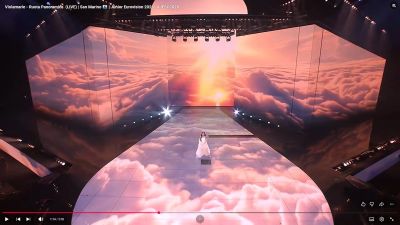 There's a hole in my floor.
There were persistent rumours that SMRTV wanted to host this year's contest. Maybe they would have done better than the technical glitches: there was a massive pause of about four minutes before the second performance, while technicians attempted to repair a major fault in the LED floor beneath the competitors' feet. Host Keane Cutajar was given a massive hole to fill with generic facts and canned cheering, and eventually they had to cut to a backup video package because he was looking awfully like a rabbit in the headlights.
The other hosts were Gaia Cauchi and Destiny, singers who won for PBS in 2013 and 2015, bringing the contest to Malta the following years. Both hosted with sass and verve, and performed with a little more pizazz that one might dare to expect.
Other competitors
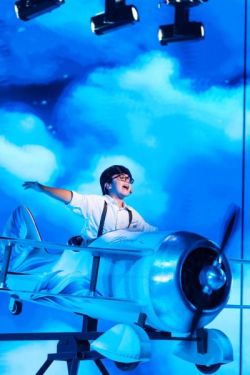 Beppe's full-sized plane prop was a wow.
There are four powerhouses in Junior Eurovision this decade, and the last of them came fifth. "Sun on the rooftops" was performed by David Lomidze, representing GPB ("Georgia"). An upbeat song, with a bit of a music hall vibe, it ended with the singer climbing on a giant ship. If 3-2-1 were still a thing, they'd have signed David up before he could say "Dusty Bin".
"Blue bird" had another tremendous staging, in support of Beppe representing home broadcaster PBS ("Malta"). Little slices of everyday magic from this song in waltz time and a yearning minor key. And made all the sweeter by a CGI bluebird flying around the arena.
A quick shout-out to two other pieces of stagecraft. "Che cos'è l'amore?" (Matteo Trullu for RAI Gulp ("Italy")) began with the lad at a piano, but he stepped up and grabbed a guitar during the first verse. His companion went on to perform a ballet behind, while the singer played punk rock chords. Thanks to the choreographer, A Lavigne of Ontario.
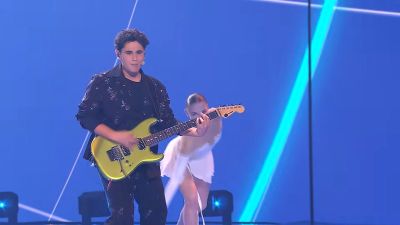 What more can we say?
"Not a lullaby" (Erika Kolesnichenko for UA:PBC ("Ukraine")) was a slow-slow-dance-dance song, rather forgettable in the contest. It did, however, feature four backing dancers in lurid hairy green costumes. Let us say, very quietly, they looked like dancing bogies.
"Nios iáidre" finished towards the bottom, performed by Caleb Kirwan and Naomi Gribben. It was the entry for TG4 ("Ireland"). The Irish-language broadcaster continues on its mission to spread the Irish language around the world. Their medium this year was two very talented performers, both trained dancers who have performed on various national and international stages, and this expertise shone through during the performance. Sadly, the song wasn't as good as the performers, being a bit too much like "Laika party" from a recent senior contest. Didn't finish bottom, didn't get much higher.
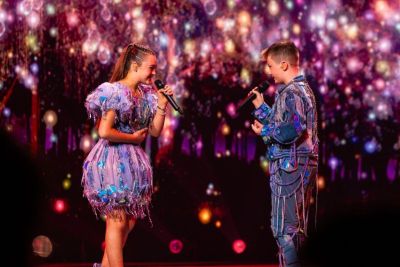 Naomi and Caleb performed well.
...and the rest
Every Eurovision event has a big opening number, and a slightly artsy performance in the middle when most of the broadcasters are off on an advert break. There was a common song for all the competitors, which was an excellent moment to go off and get a second mug of orange squash.
During the active voting window, two performances of note. One we're calling "We're obsessed with Junior Eurovision" melded various parts of Maltese history at both Senior (hello, Miriam Kante) and Junior (Eliza Borg, and hosts Gaia and Destiny). It's similar in spirit to SVT's "We just love Eurovision too much" from a couple of years back.
The other great performance was the Rehearsed Winners' Reprise: Lou Deleuze got to perform "Ce monde" as the top tier of a cake made from dancers. This eased effortlessly into "Bangaranga", Dara and her dancers on their chairs in the middle of the stage. The sweetest moment of the night came when Lou and Dara were interviewed on stage, champions together.
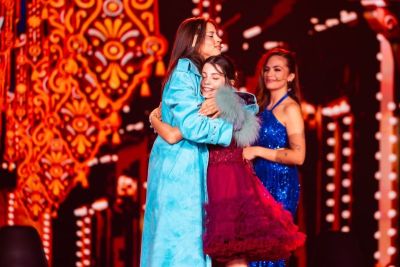 Dara and Lou Deleuze share a warm embrace, as host Gaia Cauchi looks on.
Staging was big this year: a very wide arena, with massive LED backdrops, and a mostly-functioning LED floor. In the middle of the stage was a screen that parted to reveal a giant staircase, used by the hosts and interval performances. The art was of a "festa", a typical Maltese street party full of colour and vibrancy, the sort of place where glitter squirts out at you.
If there's one complaint from this year's show, it's the mostly-functioning LED floor. To be fair, in two decades of Eurovision contests using LED floors, we've never seen one break as badly as that, and we cannot fault the producers for attempting to repair it mid-show. Stuff happens.
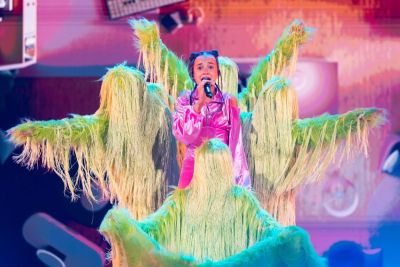 Erika and her bogies.
A second complaint is the late start time. Junior Eurovision has generally been a 3pm Sunday event, allowing the show to go out on semi-mainstream channels like RAI2 and BBC2; the last couple of years began around 5pm on Saturday and that felt about as reasonable. This year, 8pm our time on Saturday evening, which meant the winner's reprise didn't begin until 10.30, and that's late, and the reprise really suffered.
But 8pm in Birmingham is 9pm in Paris and Malta, 10pm in Nicosea, and midnight in Yerevan. How many children in Armenia were still up at 2.30 in the morning to see their entry win? One advantage of holding the contest in the east next year is that they'll show it at a more sociable time.
We assume, therefore, it'll be off to Yerevan next year. Good. AMPTV don't get many chances to shine on the bigger stage, and we can be sure they'll take every opportunity they can get.
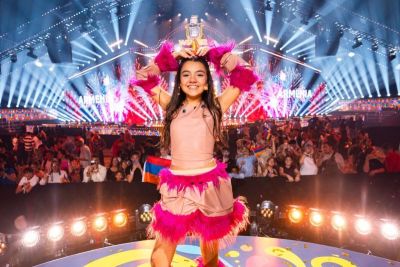 Naré has a teeny-tiny new hat.
Junior Eurovision remains a beacon of hope for the future. The young talent is given a space to shine, to show their love of music, to make new friends and discover things about themselves. While only one act wins the trophy, everyone comes away with memories to treasure.
In other news
A maximum game on Countdown! Hazel from the Isle of Man racked up perfection on all the letters games – we thought TOLUENE was a difficult spot, but found that and TAIHOAED – and she was perfect on some tricksy numbers games, and capped it with the conundrum. The good people at The Countdown Wiki say this was only the 17th perfect game in almost 9000 daytime editions.
Hazel continued to rack up the points, game after game after game. She retired undefeated after eight wins, and became only the sixth player to total 1000 points across those heats. Hazel will return for Finals Week in December, and we'd be amazed if she's not the top seed.
Quizzy Mondays
"What drew you into the world of Egyptian hieroglyphics?" "I was a huge Only Connect fan." Somewhere in deepest darkest Cathays, the letter Zeta orders another exploding milk from the bartender, and thinks wistfully about what could've been.
Yes, it's another semi-final on BBC Brain, the quiz with the best pictures. This week, we learned about "Wednesday's child is full of woe", which gave an idea to The Addams Family creators, which in turn inspired Jenna Ortega's breakout role. Virago Press grew out of Spare Rib publications, which took its name from a story at the start of the Bible.
Frankie Fanko has a slim lead after the first couple of rounds, but then the video game Assassin's Creed helps Anthony Smith go on a bit of a run. Chris Ducklin takes Lee Miller as his spotlight round, and scores Five In A Row (And A Bonus Mark) on the author-photographer-journalist, recently the subject of an exhibition in Tate Britain.
Anthony Smith and Ewan McAuley are close to the leaders, but the questions don't quite fall for either player. Chris comes into the final round one point behind, hits three of his own and adds a bonus, but Frankie Fanko has already scored a bonus; she gets floored by people who collected the tax discs they used to put on a car. Chris Ducklin emerges the winner by a single point, and will come back in the final.
House of Games (3) featured Les Dennis, Jenny Éclair, Lauren Patel, and Owain Wyn Evans. The quizzing wasn't done to a particularly high standard – none of these players will be regretting their lost Mastermind Celebrity trophy – but it was done in tremendous spirit. Lauren won a couple of days but found the toolbox was just a toolbox, Jenny won something, Les warmed the cockles of our heart, and Owain is always good value. (Not putting him in our dream Celebrity Traitors list, mind, but more of that when we review the show in a couple of weeks.)
Mastermind was won by Lewis Sinclair, who took the Waterloo campaign of Napoleon and Wellington (not the one of Benny and Björn). In a week when none of the contenders excelled on their specialist subjects, Lewis had the greatest general knowledge round. Naomi Liddle (The X-Files) was second, with Martin Whitelegge (Gene Tierney) and Gordon Rogers (Creation Records) completing the quartet.
Only Connect went to the Creepy Crawlies, who beat Meat and Two Veg by 27-16. The Crawlies remembered what's on various websites' 404 pages, identified Angelina Jolie films and orangutans, and knew their netball. Meat and Two Veg knew their kings and queens, 808 State, and parts of woodwind instruments. Neither side remembered the Andrew Lloyd Webber casting shows from the other year, which means they're both winners. Creepy Crawlies return in the quarter finals, Meat and Two Veg in a month.
University Challenge was won by Bristol, 205-135. Worst possible start for Queen's, they take a penalty then see the opposition get a full set of bonuses, and the side never really recovered. Bristol were right on 57% of the questions they faced, and 61% of the bonuses, both above average for the series. The side is strong on Fine Art, Language, Literature, and Leisure; their weakness on Social Sciences might come back to haunt them.
Yes, we are aware of a report from Leicester about their recent University Challenge match. We're still considering the questions it raises, and intend to discuss it further next week.
Next week
A busy week next week. Masterchef The Professionals (BBC1, Tue) and QI (BBC2, Tue) start their new series. Help Me Tiny Big Brain combines clever kids and comedians (Dave, Mon), we're rather looking forward to that. Deal or No Deal has new episodes (ITV, weekdays).
Other shows reach their conclusion. Taskmaster (C4, Thu) declares its winner. So does Big Brother (ITV2, Thu). RuPaul's Drag Race takes its leave from network television (BBC3, Thu). The Young Musician of the Year is named (BBC2 and Radio 3, Sun).
And there's more! Mas Fhior returns (BBC Alba, Mon), so does Aldi Colon The Next Big Seller (C4, Thu). Bradley Walsh's Million Pound Shot says it's a game show (C4, Sun), we're not sure we believe them. Next Saturday sees something worth watching on BBC1, The Famous Finish Line with Roman and Sarah and famous faces – including Roman's own sister.
Most photos: EBU/PBS/Corinne Cumming, used under general media release
To have Weaver's Week emailed to you on publication day, receive our exclusive TV roundup of the game shows in the week ahead, and chat to other ukgameshows.com readers, sign up to our Google Group.