
Weaver's Week 2026-11-22
Last week | Weaver's Week Index | Next week
It's illegal to show people having more fun after drinking alcohol in ads. No such prohibition exists for ads promoting gambling.
The grand final of Radio 4's general knowledge quiz took place this weekend. Working through the auditions, heats, and semi-finals, are our finalists:
- Ailsa Watson, a university admissions co-ordinator from Paisley
- Ben Spicer, an energy salesman from Bridgnorth
- Chris Ducklin, a civil engineer from Frustall in Tunbridge Wells
- Claire Reynolds, an actuary from Stratford-upon-Avon
One slight change to the rules: no Spotlight rounds in the grand final, it's general knowledge all the way.
"Helen of Troy's breasts were used as moulds to make goblets." One of the facts in Ailsa's first round, which concludes with Five In a Row (And A Bonus Point). Nothing for Ben until he picks up Claire's bonus, but Chris has a good guess on badminton before ceding a bonus to Ailsa. She's on 7 points after hearing 5 questions, which is markedly good.
Would people celebrate a particular festival under a new moon or a full one? Ailsa zigs with "new moon", and it helps her to another Five In a Row (etc). Which company makes Nutella? The Fererro company, another blank for Ben and a bonus for Claire. She's also right that Twickenham is known as "the cabbage patch", as part of the ground was acquired from a market garden; we thought it was a reference to the players' ears at the end of the game. Ailsa's now on 14 points after hearing 10 questions, which is a level of brilliance we've never heard before.
Melbourne's many Aussie Rules teams pop up in Ailsa's round, which ends after three correct answers and a bonus to Ben. The comeback starts here!... and stops here, as Ben doesn't remember JD Vance's birth name. Ailsa has now established a lead of ten points, and surely cannot lose from here.
Maybe she can: Ailsa doesn't remember the time Jay-Z headlined at Glastonbury, much to the disgust of Noel Gallagher. It's never Tchaikovsky, as Chris finds out in his music question. Three bonuses for Ben in this round lifts him ahead of Chris into third place.
Would people remember the first woman at the North Pole, or the first on Antarctica? Ailsa zags with the latter, ending her run early. But nobody is able to get a good run going, and Ailsa's lead is up to twelve points.
Are we sure that players in Splatoon don't fire custard pies? Ah, that was the Ant and Dec version, not the subsequent video game. Peppa Pig's new baby sister Evie gets a mention.
Final scores are in: Ben Spicer 7, Chris Ducklin 9, Claire Reynolds 11, Ailsa Watson 25 (TWENTY-FIVE).
Ailsa's trophy is in the shape of the island of Britain, with places connected by nodes of the brain. It's presented by Paul Bajoria, the former producer of the show.
Bradley Walsh's Million Pound Shot
Channel 4 surprised us on Sunday 1 November, with the "pilot episode" of a brand new high-stakes game show at 9pm. Bradley Walsh would host it.
Very little was said about the programme beforehand; even the audience were ordered to sign non-disclosure agreements. Was it going to be a Derren Brown-style stunt, the "shot" would be a literal bullet, the contestant would have to shoot their loved ones? Were we going to see a surreal scripted drama, a ghost story for the night after Hallowe'en, in the style of Ghostwatch? Was it, in fact, a pilot programme for a show they expected to take to series?
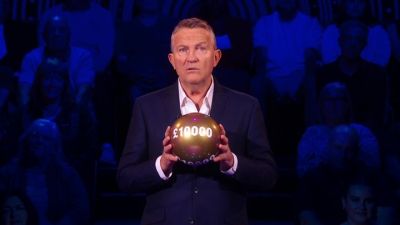 Bradley Walsh caught a gold ball with £10,000 written on it.
None of the above. Million Pound Shot was a polemic about gambling; the programme used many of the tricks from actual gambling organisations, even some of Bradley Walsh's lines were straight lifts from adverts. We'll briefly address the moral case at the end of the review; our main point is to describe the format. What works, what didn't work, and could we ever see these ideas turn into a real competition format?
"Players will be risking their own hard-earned money," says Bradley at the top of the show. So, what's to stop someone already rich from spamming the game with big bets and effectively freezing everyone out? Didn't something like that already happen on Millionaire?
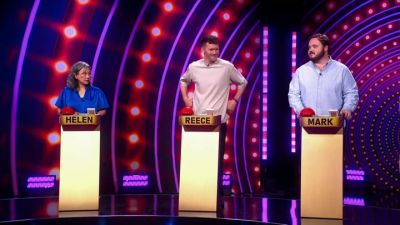 The players stand behind game show podia, in a game show studio, filmed with (er) slightly smeary lenses.
Three players walk onto the set, and see four possible answers, then a question to go with it. Nice simple question: which American president was born in Hawai'i? Our players have just five seconds to lock in a bid for the question, and the highest bid plays first. But before we hear the bids, there's a quick chat with the players.
Whoever bids the most has to pay for the privilege of answering the question: get your card out, put it in the terminal, enter the PIN. "Did you leave a tip for me?" asks Bradley. "Never tie your shoelace in a revolving door," the answer nobody gave.
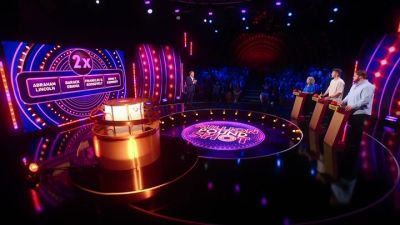 The game show set, complete with a massive golden contraption.
Our player has a "bet ball", a CGI ball rolling on the graphic for the four answers. He's to press the button on his podium to stop the ball by the answer he thinks is right. Of course he's right, "Barack Obama" the answer. The £500 he'd staked turns into £1000. But the other two players are out of the game, and go back for a second round later in the show.
There's a short video package of the contestant at home. Two more questions, two more "bet balls": a correct answer will multiply the stakes by ×3 and ×4. Then comes a question with six options they don't have to play: a question with three correct answers will be rewarded by ×3; the one correct answer gets ×10.
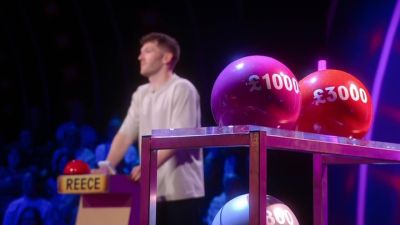 A real* contestant, and some real balls...
Having got some of the questions right, and some wrong, our player moves into the endgame. Put some real balls into a real gizmo, made to look good and feel tactile. And then it's all in the hands of the computer deities; if the CGI ball stops on a win zone, it'll increase in value from ×2 to the jackpot of £1,000,000. But if the ball stops on a loss zone, it is lost.
The remainder of the game show segment follows the contestant, who gets a win with his first ball, then loses each subsequent roll. The show was developed and produced for KEO Films by Jacob Greenhalgh, with James Smales the Games Development Producer, and featured the usual high-quality soundtrack from Paul Farrer.
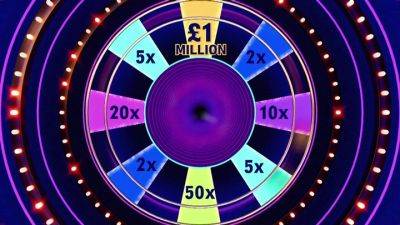 ...but a CGI finish to the game.
So, how could this work in an actual quiz environment? We reckon it's the second and third stages of a show with a bonus round. First phase, the bit before we join the contest: a quiz, or other activity. Do some things, answer some questions, complete some tasks, win some points.
Second phase: you're required to divide all those points up between some more questions, with multipliers in effect; what the setters reckon is an easy question might be ×2, up to a galaxy-brain difficulty of ×10. Correct answers return the rack of "balls".
Third phase: you can cash out those "balls" and take the points home. Or you can risk on a wheel; while a real-life version of the one on the show would have had about a 1% chance of a spin landing on a win, a more interesting game would have a win rate around 30% to 40% - less than half the spins would be wins, but we'd be most unlucky to have no wins in five spins.
It's the sort of idea we can see being knocked about by some of the lovely Twitch streamers we know. And, frankly, probably knocked down for being too darned complicated. Some of the formats from our fave game designers Flush and Ash are perhaps a bit tricky to follow if you're not playing, but Million Pound Shot is designed to be colossally abtruse to everyone especially the player. Million Pound Shot deliberately and purposely distances the player from how much money they've spent, and how much they've lost.
So, no, we don't think this is a particularly viable or interesting format.
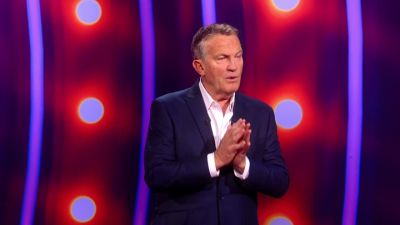 Brad prays that this column isn't about to preach. Sorry, Bradley.
More generally, this column believes that gambling is an attempt to predict the future, and is messing with fate, and that doesn't sit well with us. We will indulge in a local lucky dip or raffle, where we can be sure that the money is going to a good cause and any prize will be a bonus. We play for the enjoyment and amusement, never for the prize.
This column actively despises all of the adverts for gambling. And there are so many adverts for gambling, some students from Bristol found there's a gambling advert every two seconds in televised men's football games. The football companies welcome the money, something's got to pay the over-inflated salaries. The television companies welcome the money from these adverts, right now television companies welcome any money from anyone.
But the product is corrosive, it ruins people's lives. This column reckons gambling adverts sap the integrity from any programme associated with them. (Yes, we're looking at you, The Summit and Nobody's Fool.) Channel 4 would be a better station if they'd stopped taking adverts from these gambling companies, but that would require them to do the moral thing and the station needs the money.
Ultimately, Million Pound Shot was a rug pull, a not particularly subtle piece that stood up against the torrent of betting. As a game, we think it's an interesting idea, though nowhere near ready for primetime, and probably not worthy for prime Twitch.
In other news
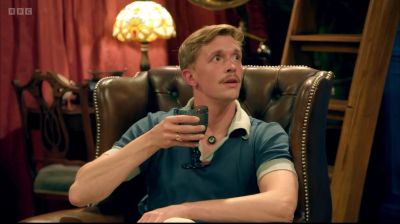 Winner!
The BAFTA Scotland awards took place. Congratulations to Stephen Libby From The Traitors, who won the public vote for Personality of the Year. Congratulations also to Saturday Mash-Up, the children's show is the best Entertainment programme made in Scotland.
Nominations for the RTS Craft and Design are out. Game shows and people are:
- Director Multicamera: Nikki Parsons, Strictly Come Dancing
- Editing Nonscripted: Squid Game: The Challenge
- Lighting Multicamera: David Bishop and team, Strictly Come Dancing
- Production Design Nonscripted: James Dillon, Taskmaster
- Production Design Nonscripted: Stuart Frossell & Matthieu Weekes, The Celebrity Traitors (the 2025 series)
Winners will be named in a ceremony at London's Park Lane on 7 December.
 Claudia's ready to turn the heat up.
Hell's Kitchen is to return to ITV. Gordon Ramsay will still be the chef who shouts at moderately famous people desperate for a sniff of sympathy. Claudia Winkleman's remains as host, she also fronted the last series in 2009 while bunking off school. Two weeks of this at some point next year.
House of Games was somewhat tighter than last week, in the sense that more than one player came within a sniff of victory. We'll remember Sue Cleaver, Rav Wilding, Rachel Parris, and Jake Bhardwaj as pleasantly chaotic. In one round, Sue was asked to say one word, offered "Peach Melba", only for Jake to forget what he had literally just been told. In another round, where they blank out words in a question, teams managed to talk themselves out of correct answers and got left with errors.
This week, the final of Bake Off (C4, Tue). New series of the Black community's answer to QI, Sorry, I Didn't Know (ITV, Sun) and a new run of jolly maths quiz Your Number's Up (Radio 4, Sun). Good news for the Jack Dee fan club, I'm Sorry I Haven't a Clue returns (Radio 4, Mon), and his Help Me Tiny Big Brain has its final (Dave, Mon); we expect to review it next week.
To have Weaver's Week emailed to you on publication day, receive our exclusive TV roundup of the game shows in the week ahead, and chat to other ukgameshows.com readers, sign up to our Google Group.