
Weaver's Week 2025-07-20
Last week | Weaver's Week Index | Next week
We heard recently that the Westminster current government want to set up a "register of traditions", an "inventory of living heritage". Cultural things you can't visit, can't steal for a museum the other side of the continent, but can experience.
And that reminded us of a Week we half-wrote late last decade.
Listed Game Shows
Take the concept of "listed buildings" – constructions of great architectural and cultural impact that shouldn't be changed without care – and apply them to other parts of the culture. Edith Bowman and Robbie Collin came up with a list of "listed films", starting with Jaws and The Little Mermaid. (The rest of their list is in the Wittertainment podcast archives from summer 2019.) In this column, we consider shows of great technological and cultural impact, important steps on the development of the genre.
Building on Collin and Edith's idea, we've taken seven shows, first shown between 1955 and 2010. We could have chosen many other programmes, this is not a definitive list, offered more to spark discussion. We didn't consider anything since 2010, because it's difficult to gauge cultural impact until some years have passed.
The most popular new show of the 2010s, and still one of the few programmes that can stop other channels' schedules.
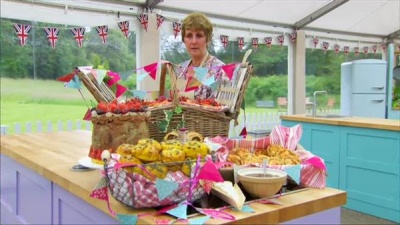 A picnic basket even Ranger Smith would steal. (Love Productions)
The Mel and Sue and Mary and Paul phenomenon made baking cool again. It's pleasant to watch, Bake Off is nice television. Everyone wants everyone to do their best, there is a tremendous camaraderie in the tent. Never mind the manufactured drama of other shows, Bake Off is a laugh because it knows it's a laugh. And it's all shot in a tent – not a sterile old studio, but in a proper gazebo plonked in a country garden.
Bake Off is inspirational. Across the series, contestants are expected to improve their own skills, to do better week on week. The episode stages – signature, technical, and showstopper – have become a shorthand way of referring to tasks. A similar idea has been applied to many other skills – pottery, haberdashery, hair styling, make up, sausages, Lego bricks – often to great popular success.
 Nadiya Hussein receives congratulations from Paul Hollywood and Mary Berry. (Love Productions)
Bake Off has sold around the world. It is a strong demonstration of soft power, of taking a particular idea tied to one culture and making sure everyone around the world knows about it.
The crunch for any show is what happens when it's threatened. Bake Off left the BBC in 2016, and the entire country went beserk. Even this column may have somewhat over-reacted. "It'll be somewhat less successful than Masterchef Goes Large," we said. All predictions wrong or your money back! But the point remains, millions of people cared about a television show moving channels, and that's got to be a huge sign that it's important to the culture.
Not every show has to sell across the world. To the best of our knowledge, nobody has ever thought about exporting Only Connect to another country. Which is a surprise: it's consistently the biggest programme on BBC2, often the biggest non-soap of the night, and people who get Only Connect absolutely love it.
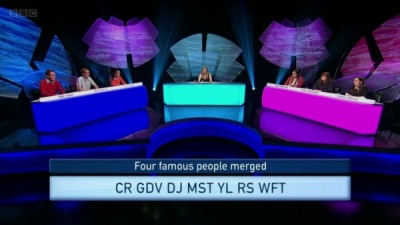 Can't help but to play along. (Parasol)
After some years in development (at one point we understand it was a pairs quiz based on sport), Only Connect emerged onto our screens in autumn 2008. It was tailor-made for BBC4, the corporation's self-consciously highbrow and artsy channel. The format is as constant as the weather: what's the link, what's next, sort out these tangled groups, and add in some vowels.
Like a charity appeal's totaliser, Only Connect slowly ticked up the audience figures: a respectable 75,000 for the launch, 250,000 when it was on almost every week of 2010, breaking a million soon afterwards. The show loosened up a little, replacing the "patronising and elitist" Greek letters with something much more accessible.
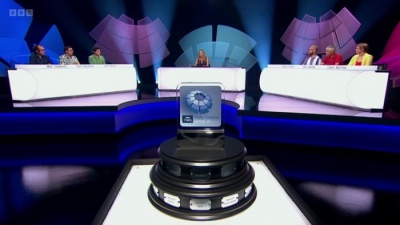 The high-stakes high-value prize. (RDF)
Always played for the smallest possible prize, Only Connect takes witty and well-researched questions and has louche fun with them. Knowledge and lateral thinking are rigorously tested; only the excellent make the show, only the greatest win it, knowing answers such as Craig David James Taylor Swift. Victoria Coren Mitchell hosts with a dry wit, there are self-referential questions, and Christmas specials allow us to greet old friends once again.
Only Connect sparked a small revival of parlour games played for love not money. Richard Osman's House of Games on the same channel could be a GCSE-level version of the same idea, played by celebrities for publicity and wheeled suitcases. And it came at the same time as The Chase and Pointless, successful teatime quizzes about collective effort and thinking outside the box.
When The Weakest Link sprang onto our screens in summer 2000, it had attitude. Weakest Link was feisty. Aggressive. Nasty.
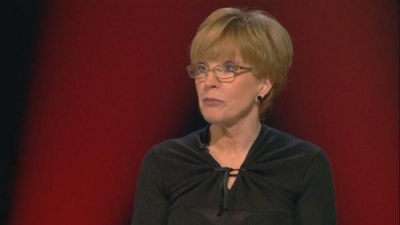 Goodbye. (BBC)
We'd often thought, "how can you not know the capital of France / winner of Wimbledon last year / which hand of the Mona Lisa we see" and found the contestant didn't know it was Berlin / Monica Seles / the left, and thought, "Blimey, what an idiot". And suddenly, Anne Robinson is giving voice to all those uncharitable opinions! "You thought the capital of France was Lyons, have you never been out of Lee-on-Sea?" Such a refreshing change.
The only trouble is that after a short period, Robinson's schtick stops being amusing, and starts dragging the programme down. Some of the lines were rancorous abuse; after a few years everyone knew she had toned down the personal attacks.
But The Weakest Link had merit beyond its contender-bashing. Questions came thick and fast, and while the absolute best player would rarely be allowed to win, the format ensured that the winner would be a decent quizzer. Paul Farrer's soundtrack built the suspense through the rounds, with just the right stabs and motifs throughout. Episodes promised much – a potential £10,000 jackpot on daytime telly – but usually delivered about a fifth of that.
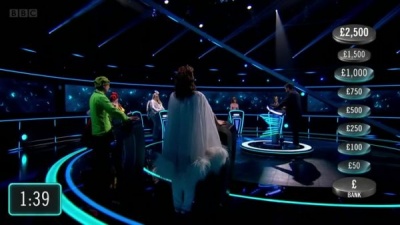 Look who's back. (BBC)
Weakest Link had its cultural moment in the autumn of 2000, in ten weeks it went from a name on the schedule to the must-emulate Hallowe'en costume. The show sold overseas, and then it stopped selling overseas. When it went off air in 2012, very few tears were shed.
We put this on the original list in 2019, and seriously considered dropping it for something else from the era. Then we remembered Romesh Ranganathan's revival: keeps the quiz and the paraphernalia, but gets rid of the nastiness, and proves The Weakest Link is a strong quiz format. And that – not the contestant-baiting – is why we recommend it as a cultural touchstone.
The late 1980s were a time of tremendous technical innovation. Cameras got smaller, audio devices got smaller, video editing got easier. Suddenly it became possible to go out on location and film very close to your subject. The top example of this techno-wizardry is Network 7, a youth magazine show with all sorts of weird camera angles, and captions that might have added something to your understanding of the story; it looked like nothing else on telly, and inspired everything on youth telly for absolute decades.
 Get a move on, Mikey! (Chatsworth)
Chatsworth were also working at the cutting edge of technology. They'd imported Treasure Hunt, where Anneka Rice flies round the countryside and runs up church steps with a cameraman in hot pursuit. They'd go on to make The Crystal Maze, how many yuppies does it take to change a light bulb. In between, Chatsworth made one series of Interceptor for ITV. The technology was right, the show looked great. One press preview said,
- "This is like a computer game brought to life. Two contestants, each with a back pack, one of which contains £1000, have to find their way from separate points across country to meet up. The Interceptor of the title is a macho chap (Sean O'Kane) in a black leather coat who is out to zap their back packs with his laser, thereby permanently locking them, from a helicopter, horse, or whatever vehicle happens to be at hand. Annabel Croft is in charge and in permanent radio contact with the contestants to guide them back."
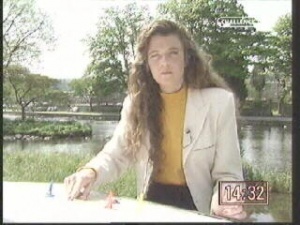 Annabel Croft, last seen on Centre Court. (Chatsworth)
Underwhelming press notices, Annabel's diffident presentation, and a slight feeling that we want to root for the Interceptor and against the shrieking and smarming yuppies, meant there was never a second series. Interceptor remains one of those shows people get very nostalgic about, if only for that incident in Derbyshire involving a tractor and a very bad accent.
If there's one television show we expect to feature on any list of living heritage, it's Monty Python's Flying Circus. A world ruled by its own logic, where strange and bizarre things happen for whatever reason. Jigsaw is like Monty Python, but for children and with six-letter words.
 Jigg, and a space for a Jigword. (BBC)
Clive Doig's brain came up with all sorts of bizarre and unexpected ideas. A talking pterosaur. A non-talking human host. A character so large we only ever saw his feet. Remarkable contraptions, odd inventions, film and animation and sound effects.
Jigsaw served to make television faster, it proved that viewers (well, young viewers) could cope with ideas and stimuli coming at great speed. Down this path lies MTV, and the fast editing of Network 7.
Yet there was a serious attempt to tell stories and bring viewers back week after week. Characters had quests: Pterry wanted to learn to fly, Hector to become a lorry driver, Cyd Sleuth to catch his criminal, and these provided a loose framework for each series to progress and advance its characters. The talking jigsaw piece hosted the show, with Janet Ellis providing a very human response to all this buffoonery.
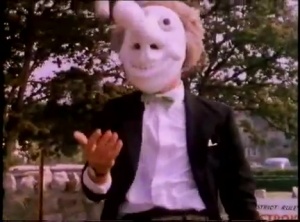 And, for some reason, a man with a very silly mask. (BBC)
Tell a compelling story, and we will ride to the end of the universe with you. It's a lesson absorbed by Russell T Davies, shows up in everything he has ever done, from Why Don't You..? to Doctor Who and Queer as Folk and Dark Season.
The Golden Shot and Dotto
We finish our list of Listed Game Shows with two imports from the black-and-white era. Dotto was easy to understand – it's a join-the-dots picture, like you'll find in comics aimed at the very young. The Golden Shot was a simple idea – fire a crossbow more accurately than the next person – put to air in the most complicated way possible.
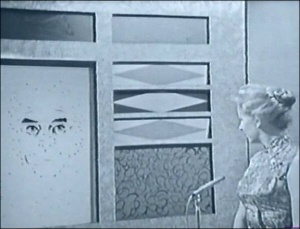 Which famous face is that? (ATV)
Both of these shows pushed the limits of television game shows. Dotto pushed the limits by being visual. Until it began, every television game show had essentially been a radio format – talent show Opportunity Knocks began on the wireless, Double Your Money was a lot of chat and not much picture. But if you tried to play Dotto on the radio, it completely wouldn't work, you need to see the game to appreciate it.
The Golden Shot was another visual show, literally asking the viewer at home to control a crossbow by calling instructions. "Up, up, left, stop, right, stop, down a bit, stop, fire." The host was helped (or hindered) by assistants who feigned a complete inability to count beyond three. Many people watched The Golden Shot from behind the sofa, expecting it to fall to pieces at any moment. Others watched it because Bob Monkhouse hosted, wisecracks and painted-on smiles concealed a sharp mind and television's swiftest wits.
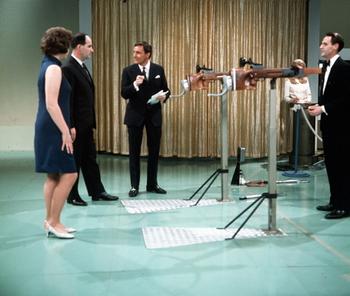 Bob Monkhouse takes aim. (ATV)
Those, then, are the game shows we'd choose to enter in a "registry of traditions". Wonder what we'll say if we come back and revisit this list in another six years.
In other news
After almost two years, super-champion Émilien has finally been dethroned from Les 12 coups du midi. The contestant made his first appearance in September 2023, and turned up every single day – a total of 646 wins – until losing on 6 July. Les 12 coups airs each lunchtime on TF1 in France, and features four contestants answering general knowledge questions with the winner coming back to face new contestants the next day. We took a look back in 2022.
"I never expected to have the chance to stay for such a long time. It's amazing everything that has happened. It's hard to understand," said the history student and professional game show contestant. Émilien won more than 2.5 million euro in cash and other prizes, and a total of 23 cars. TF1 said that made him the biggest winner in French game show history.
 Emilien, le plus grand champion. (Formidooble)
Speaking of super-champions, The 1% Club is set to host a Rollover Week. Everyone who makes it to the final 1% question comes back on the next night's show. And if the jackpot isn't won, it comes back as well. Supersmart Susan could win £100,000 on all five days of the week, or the jackpot could roll right through and Cleverclogs Chloe could scoop half a million. Rollover Week is scheduled for this autumn, we guess as a spoiler for Celebrity Traitors.
Masterchef Goes Large will have to continue without Gregg Wallace, who has been fired from the cookery show. Wallace has continued to prittle on, completely unwilling to accept the harm he has caused or that sometimes silence is the best policy.
To lose one host might be a misfortune; to lose two... Masterchef will also have to continue without John Torode, after it emerged he had used some racist language some years ago and his contract wasn't renewed. They've made a civilian series with both hosts, and a celebrity series with Torode; it's not immediately clear if these series will be broadcast or uploaded anywhere.
 Buzzin'. (Green Inc and Saltbeef)
What are the Hive Minds champions doing now? In the case of John Payne, winning on Countdown, and discussing the words-in-a-honeycomb quiz to people who never saw it first time round but will surely be able to catch the new series on BBC Buzzfax.
Although ITV brought Who Wants to be a Millionaire to an end when Chris Tarrant left in 2014, the show continues to shamble on. Another primetime run has been ordered, and they'll also make Millionaire Hotseat – a long-running show in Australia, and a short-lived experiment in a number of other markets.
The Hotseat rules: Fifteen timed questions, six contestants, each has the ability to pass once in the show and give up the chair to the next player in line. Wrong answers eliminate the player and remove the top prize from the game. Whoever answers the final question correctly wins whatever prize is left. ITV's version will be hosted by the same bad-tempered boor as they've got on the main show.
Quizzy Mondays came back on reduced power. Lorna Frankl won Mastermind with a strong specialist round on the Women's Institute, and a carefully-considered general knowledge round to reach 24 points. Randall Alleyne came second, had a bit of a problem in his specialist round on Carl Lewis, but a strong general knowledge round means he could be a strong contender in a few years.
For the second University Challenge in a row, Warwick answered more questions correctly than their opponents. Last year's defeated finalists are back with a new team, who beat Sheffield 32-27 on answers, and 210-170 on the scoreboard. Very much a match of two halves, Sheffield led 155-40 with about eight minutes to play, but were blown away by a great team performance. Jacob Price of Sheffield top scored with 85 points, Warwick's Lucy Dennett had the most significant buzzes, getting a quote about Desdemona and "sprite" as lightning.
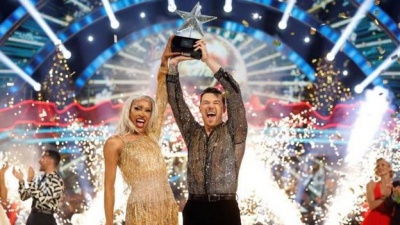 Who will follow last Christmas's winners Tayce and Kai? (BBC)
With the schools breaking up across England, we have to clear our ears because The Strictly Come Dancing Klaxon will sound soon. Who will appear on the guest list this year? Our guesses: Popstar whose career needs a bit of a lift, unexpectedly available presenter, Radio 1 deejay, someone from The Traitors, politician thrown out last year, and lovable buffoon who will be kept in by the public and finally leave in late November.
The writers have emerged blinking into the light from Ikea, and Only Connect (2) starts a new run (Mon, BBC2). We've a new series of Game On, Grandparents! (CBBC, weekdays) Lego Masters Down Under arrives on E4 (Sun), and 8 Out of 10 Cats Does Countdown is back (C4, Fri).
To have Weaver's Week emailed to you on publication day, receive our exclusive TV roundup of the game shows in the week ahead, and chat to other ukgameshows.com readers, sign up to our Google Group.