
Weaver's Week 2025-12-14
Last week | Weaver's Week Index | Next week
Buffalo buffalo Buffalo buffalo buffalo buffalo Buffalo buffalo. More on this story later.
From a perfectly unintelligble sentence in English to some perfectly intelligible sentences in Welsh. Y Deis is the latest S4C primetime quiz, where players can win some thousands of pounds.
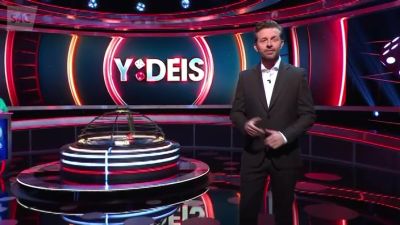 Host James Williams, in the studio with an LED board and dice tumbler.
Three pairs of contestants come to the studios in Cardiff to play this game. The studio is dark, lit with thin spotlights and reflective metal bars, and a giant LED screen. At its centre is a small round metal cage, containing a couple of small cubes. The studio looks modern, futuristic, sleek – and it looks a bit bare. This is S4C, a channel with very little budget for its shows, and the set design is going to be functional.
Y Deis is a game show, and it needs contestants. It's inevitable that the host James Williams spends a few moments talking to each person, introduce us to them and perhaps bring out a little of their personality. But it's only a half-hour show, and soon we're into the game.
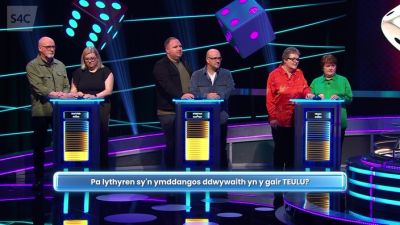 The first round in progress: a right answer will solidify the part-lit gold bars, but there's a lot to take in.
The first round proper looks like it's been borrowed from Going for Gold. Each team is given a stack of bars, and the instruction to turn them all gold. The value of the question is determined by a roll of the dice in the metal cage: anything from 2 to 12 points. Questions are quickfire and on the buzzer, and an incorrect answer will be opened to the other teams, there's no wallying in this round. Whichever two teams reach 18 points first progress to the next round, the third team goes home. It's a very quick elimination, bit of a wasted journey.
We really need to discuss the dice cage in some detail, because it holds the title stars of the show. The cage is tall and imposing, mounted on a plinth in the middle of the studio. It comes to the same height as the presenter's podium, and the players' stands, and that's great design. The cage is capped by an arch, four metal bars rise up to a point at the centre of the circle, with many concentric circles supporting it. Reminds us of the dome at the Reichstag building in Berlin.
 Contestants look on as the dice do their tumbling.
Inside the dome are two large dice, one white and one red. They're agitated by a plate with little ridges on top, and it spins at a great speed. The dice bounce up, bounce down, bounce around the dome. Careful design ensures there's no danger of the dice bouncing out of the dome, this is an S4C game show and they can't really afford to stop the tape unnecessarily. And it's always accompanied by a whirring noise, courtesy of top composer Paul Farrer – it's a loud and boisterous soundtrack, suitable for a loud and boisterous show.
Soon enough, we're into round two, where each team is given £120, and face the grid of values. Every individual combination of dice rolls is on the grid, and each has been assigned a value. £40 for anything that adds up to 7, £60 for the 6s and 8s, right up to £200 for the 2 and 12. The team to get into the round first decides whether they want to play first or second, and then the team in control rolls the dice.
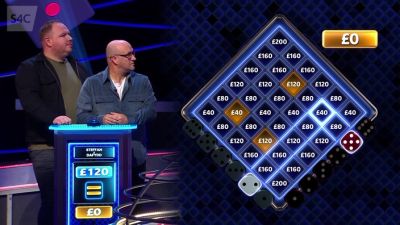 The players have rolled white 2 red 5, which is a £40 question.
Where they land determines the value of the question. White 5 and red 2, so that's a £40 question. All questions in this round are multiple choice, pick the right one of four answers. Questions don't seem to be more difficult if they're worth more; questions do seem to become more difficult the further into the turn you go.
A wrong answer ends your turn and wipes out any money you've accumulated in the turn. A right answer gives a dilemma: stop now and bank the money, or play on knowing that a wrong answer will wipe you out. There's also the possibility of landing on a space that's been used before, another white 5 red 2 will be treated as a wrong answer and wipe you out.
To add to the decisions, three of the squares are "steal" squares; instead of taking a question, the team can elect to steal half of the money in their opponents' bank, add anything at stake from earlier answers, and end their turn. There's a surprisingly large amount of strategy to be had here: when to stop, whether to steal, and even whether to go first or second (the trailing team know what they have to do, but have more holes in the board to avoid).
 The studio is dark, with plenty of little lights.
Just two turns for each team in the second round, it feels like they ought to have three turns and they might have chopped one out for timing reasons. (Or because it too often ended as an anti-climax: in the first three episodes, there's been an average of one scoring move per show in this round.) Ties are broken Popmaster style, ask questions alternately until one pair is right and the other wrong. Whichever pair loses goes home with the consolation prize, a pair of fluffy Y Deis dice.
The winning team keep whatever money they've got so far. The players each get to press their button and control when the dice stop. They're bringing £100 per pip into the bonus round, and if either throw is a double, that money is doubled. But that is the last we see of the dice, for the remaining time, they stay in their cage and do not move.
To win that jackpot – usually around £1400, potentially as much as £4800 – the players must each answer six this-or-that questions correctly. Errors count against any right answers each player has given, though a player's own score cannot fall below zero. Once one player has reached six, they must keep answering correctly while their playing partner builds their score. Questions go alternately to each player, and there's three minutes for both players to reach their target. Realistically, they'll be lucky to get ten questions each, though the posers seem to become a bit easier as the round nears a climax.
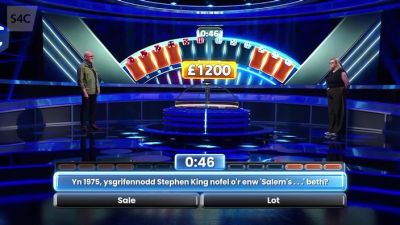 46 seconds to play, and Right needs to answer another question to match Left's 6.
We're glad that Y Deis exists, and that it's already been sold to TG4 for viewers on Ireland. It's been made with love and care – questions are written by familiar and quality names, the computer system is by the quality KPX company, and production house Slam Media are always associated with good telly.
And yet we fear that the show doesn't quite make enough of its own stars: the format crams most of the dice rolls into the start of the show, and they're missing throughout the final round. Compare with Tipping Point, which integrates its end-of-the-pier gimmick throughout the programme; on Y Deis, we have barely any spinning action after the commercial break. If they can address that, Y Deis could run for absolutely ages.
To S4C's children's strand Stwnsh for this science show. Heledd Roberts and Aled Bidder are the hosts, and they keep control of two groups of children. The kids are here for bragging rights, to prove they know more about science than their friends. And they're here to avoid being gunged, because whichever team doesn't win will be covered in S4C's greenest and gloopiest gunc. (See, we know some Welsh!)
The introductions are brisk, tell us who the players are and how team Boom knows team Bang. There's a teensy-weensy bit of trash talk, though it's less trash and more detritus. All of the contestants wear white lab coats, because science.
 Bang - the yellows - burst through a paper wall.
Soon enough, we're into round one. This is a task to test reactions, done in the studio. Best of these we've seen is a game similar to – but distinct from – the party game Operation. You know, the one where you use tweezers to remove the funny bone from the ill person's body, without setting off the alarm. It's played as a relay, from one player to the next down the line. Here, the tweezers are much larger so they can be seen on telly, and there's a five-second penalty if the tweezers touch the side of the patient's body. Actually quite difficult, they've got rubber bands in the legs and that's quite difficult to remove.
Winner of this round gets some points on the board. Except they don't bother with anything so boring as points or a scoreboard here. No, Boom! Bang! rewards performances by pouring water into the team's measuring cylinder. Whoever has the more water at the end of the show will be the winner. It's novel, it's different, and it's a bit sciencey.
 Aled and Heledd come dressed for the occasion.
Winners of the opening round also get to pick their presenter in the next challenge. Yes, Aled and Heledd are going to earn their crust on this show, In our sample episode, the children are to scrabble around in a ball pit and retrieve some eggs. The presenters will then light a taper of paper so it burns from one end, drop the lit paper into a glass bottle, and put the egg just over the top. The burning paper will start to consume the oxygen in the bottle, this will lower the air pressure, and suck the egg into the bottle. Absolute magic when it happens.
Anyway, the teams get their adults to help, and whoever gets the more eggs in the bottle is the winner of the round. They get a lot of water. To keep the game flowing, there might be some consolation water given to the losers of the round from time to time, this equalises itself over the course of the show. What never equalises over the course of the show is Aled's jokes, which start off as abysmal and never rise above groansome.
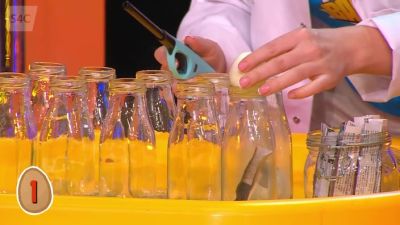 Light paper, put into bottle, put egg on top.
Round three is the filmed challenge: presenters Zach Mutyambizi and Peri Vaughan Jones are in the car park where they hold the meeting for all the fans of Aled's jokes, so it's completely empty. There, Zach and Peri have done some big scale experiments. In one episode, they exploded some dustbins filled with plastic balls. In another episode, they tried to work out which would bounce higher: a tennis ball, a basketball, or a ten-pin bowling ball.
(The answer surprised us: it's the bowling ball. Both the tennis and basketballs are made of rubber, which loses some energy when it deforms; the bowling ball is able to keep its shape, and translate all that energy into a higher bounce. It was possible that the energy of the fall would have made the bowling ball shatter, and that's why we do experiments.)
Water for anyone who gives the right answer. Next, a set of quickfire questions. Answer by shouting out your team's name, Boom! Bang! doesn't go in for anything as high-tech as buzzers, perhaps that's another £50 off the show's budget. And it's clear that S4C doesn't have a huge budget for this show: it doesn't use anything you couldn't get fairly easily, so if you want to replicate the pop bottle – vinegar – baking soda – balloon challenge, get a responsible adult to help.
 The final physical game raises the tempo for the final minutes.
The final round is another physical challenge. This one tests the teams' ability to work together, co-operate. A sample challenge is to follow the path of food through the human digestion system, in through the mouth, past the stomach, push through the intestines, then out as excreta. Um, this show goes out at 5.40, exactly the time when S4C viewers might have their dinner. Puts us right off our food, it does.
Boom! Bang! has plenty of spectacle, and is rollocking good fun. It's also a bit educational, we're learning through some good play.
Oh, and we know it's a children's show by the way the winning team don't get a prize, but the losing team get gunged. And if the game ends up in a draw, neither team has won, so both get gunged.
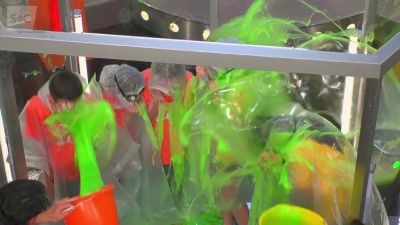 Result!
Other news
RTS Craft and Design awards were given out on Monday night. Hearty congratulations to the Gladiators lighting crew, named best in the business for multicamera lighting.
Results were announced at the TV Times awards, voted by the readers of the listings magazine. Ant and Dec won the Favourite Presenter title, and I'm a Celebrity was the top entertainment programme. The duo came third in TV Icon Of Today, a title won by David Attenborough.
Quizzy Mondays
Something of a surprise in the World Cup draw last weekend. Strictly Come Dancing was popped into the same group as sportsball quiz Golassa Brazilia, crossword puzzler Slam, and Total Wipeout. Things are even more bizarre elsewhere in the draw: House of Games will meet the winners of the third-place playoff from Jeopardy!, the Village People, and Kazakhstan.
Mastermind is a contest of general knowledge and specialist subject revision. Two of this week's contestants put forward excellent specialist rounds, two of them left a lot of points hanging. The best general knowledge round of the week came from William Tams, one of the players quite badly out of the running; we're sure he'll be back. Emma Reeves had been superb on the songs of Dory Previn (that's Andrew Preview's wife), but general knowledge was lacking. Alan Hotchkiss was decent at both phases of the game, and the total combination was enough to secure a win.
Only Connect began its quarter-finals with the ultra-rare Five Point Klaxon: 5ks knew the Braille representations of letters D to A, and ended with a dot top right.
That was the difference in another tight match. Very little between the sides in Connections, before Oh No They Didn't managed to wangle two correct sequences – plural animals ending in "o", and somehow guessing the answer to a question about the men's rugby union world cup. Neither team got a question about the Chief Rabbis; in a nod to last year's winners, it was captioned "Four Opinions".
This week's other team, 5ks, stretched a slim lead after going slightly better on the walls – it's the ones with half-a-dozen Friends and Simpsons characters. In the end, 5ks extended further in Missing Vowels, and beat Oh No They Didn't 23-15.
So, what's the deal with all the buffalo? The key is that "buffalo" can have three different meanings: the city of Buffalo, the animal, and a verb meaning "to bully". So the sentence breaks down as
[Buffalo buffalo] (animals from the city...)
[Buffalo buffalo buffalo] (who are bullied by other animals from the city...)
[buffalo Buffalo buffalo] (themselves bully a third group of animals from the city)
We could cast it as "Buffalo bison, Buffalo bison bullied, bully Buffalo bison", but that's very much how they'd do it on The Link.
University Challenge had one of those nip-and-tuck matches that could go either way, and at many points did. At the gong, Edinburgh beat Trinity Cambridge by 180-150. Ultimately, the match was won and lost on the bonuses, Edinburgh returning 74% (up from a disappointing 50% in the heat), Trinity 46% (from 67%). Some great buzzing from both sides: Piers Marchant of Trinity captured seven starters, and colleague Alessandro D'Attanasio came in with a very good easy buzz on "acid base". Johnny Richards took six for Edinburgh.
Edinburgh were correct on 59% of the questions they faced in this round (63% in their heat win over Newcastle). Amongst the quarter-finalists, they're strongest in Geography and Literature, and are doing well on Philosophy. They are rather weak on all shades of Science, and comparatively weak on high culture.
And for those of you wondering where Alice Leonard's sweater comes from, it's this pattern
Celebrity editions of The Finish Line (BBC1, from Mon). The annual outing for Stephen Mulhern's The Big Quiz (2), this year actually with Stephen Mulhern (ITV, Mon). World's Strongest Man begins (C5, Fri). Breaking the News marks its tenth anniversary (Radio Scotland and BBC Scotland, Fri).
Festive specials include Scotland's Christmas Home of the Year (BBC1 Scotland, Mon) and Christmas Blankety Blank (BBC1, Sat).
Finals this week: A League of Their Own (KYTV, Wed), Countdown (C4, Fri), Celebrity Masterchef Goes Large 2024 (BBC1, Fri), Strictly Come Dancing (BBC1, Sat).
To have Weaver's Week emailed to you on publication day, receive our exclusive TV roundup of the game shows in the week ahead, and chat to other ukgameshows.com readers, sign up to our Google Group.