
Weaver's Week 2026-01-04
Last week | Weaver's Week Index | Next week
Poll of the Year 2025 has begun! Your favourite and least fave new show, your favourite broadcast and online shows, the best bits from the world of game shows, and any other business. Bother's Bar are hosting once more, and your votes will count.
Another year ends, and let's have a look to see what the UKGameshows website says.
"hello"
We'd been battling for about a year with AI bots overwhelming the site and making it go up and down like a yo-yo. Over the August bank holiday weekend, a spectacularly hugemungous bot attack took us completely offline.
The website is just about back, and with a fresh look, though with further work to be done. There will be a complete archive of Weeks (and some pictures you've not seen) when everything does return.
From our lowlight of the year, to the absolute highlight.
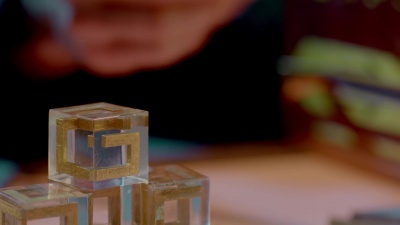 The garnet, the year's most desirable game show geegaw.
It's over ten years since Brig Bother and his bar patrons started to cheer for this show from Korea. Korea, of all places! The Genius was a challenge of intellectual smarts, in that there were missions to complete and win. And it was a challenge of social smarts, in that the same players were competing against each other throughout with one of them emerging the winner. And it was a challenge of elimination, the worst performer would select their opponent for a match that would see one of them lose all claim to the prize.
Was a broadcaster over here going to show it? Many appeared interested, there were sizzle reels and pitches, but nothing came close to our screens. A revival on Dutch telly came and went, and then we learned that ITV still had the rights, and were going to take it to a full series.
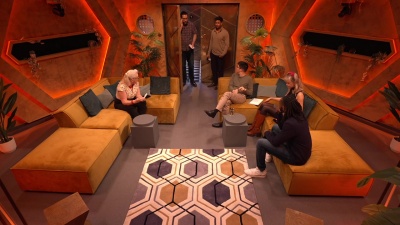 The cast plot exactly how they're going to get rid of the person they don't like.
The first episode showed the cast's priorities: alpha male Paul spent most of the episode in prison, and was bounced out at the first opportunity, quickly followed by the young challenger Scott. Things settled into a groove after that: challenges where people could show off their intellectual brilliance (Alison's demolition in one of the Death Matches), their social power (India proving that beauty and eye make-up could charm as Ben's bossiness scared), and their ability to understand the tiniest nuances of rules (Ken's ability to cause chaos).
Two things somewhat undermined Genius Game. One was ITV's insistence that it was a David Tennant show: the Broadchurch and Doctor Who star was on screen for about ten minutes through the entire series, but all the press revolved around him. In retrospect, maybe they should have had someone from production set the games. And two, having made this expensive programme, ITV didn't know what to do with it, sat on it for almost a year, and eventually burned it off against Race Across the World. Viewers stuck with what they knew, and Genius Game was saddled with the tag of "Flop".
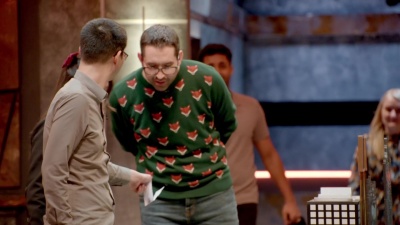 See, a proper cheque, filled out properly. Nothing can go wrong!
Viewers missed a treat. Genius Game was television made with heart and brain. It had to be: the contestants were going to be tested on these same aspects. It brought us many memorable moments, and by the time we got to week three, we were cheering for everyone to win. The show was modern, and it was steampunk, and it was futuristic, and it was subtle, and it was demonstrative. Like the finest port, Genius Game took time to become its best. We viewers had to stick with it, and too few people did.
One more thing they'll never take away: the Dealer's Room podcast, from which other people could learn a lot. Alex McMillan from the production team has a polite and informed and lovely chat with the eliminated contestants, processing the events we've just seen. Think of it less an interview, more an after-care podcast.
A lot of shows have caused us to think, "that looks like fun, can we apply for the next series?" Most of the time, we rule ourselves out quickly: this column knows enough people in the industry to make most quizzes off limits, we're not particularly sporty. While our cooking doesn't always burn down the kitchen, our ability with needles can be written on the back of a postage stamp.
99 to Beat had a terribly simple concept: here are some quick and easy tasks, and your mission is to complete each task before at least one other player.
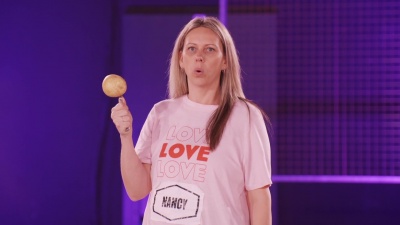 Potato!
Sure, there were some major problems with the execution on ITV, most notably far too many team games where lots of people were eliminated (a regrettable consequence of only ordering eight episodes for 100 people). "Comedy" payoffs for departing players were not funny, and clearly made less snarky later in the series. They also managed to get well through the contest without speaking to lots of the remaining players, and we didn't hear from the winner until the penultimate week.
But the variety of challenges was brilliant. Curling with vacuum cleaners. Peel a long length of potato. Curl a slinkie onto your forehead. Guess the weight of a llama. Count peas in a bottle. Pop balloons with a cactus tied to your head.
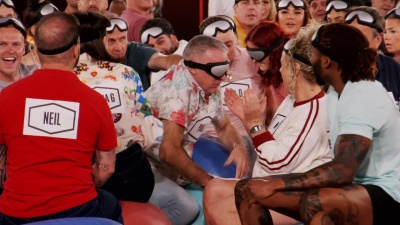 Friends forever.
Over the course of the episode, the filming weeks, it was clear that lifelong friendships were made. The hosts, Adam and Ryan Thomas, commentate from in the arena, join in the cheering and the bonhomie – unlike Total Wipeout a decade earlier, the commentator's snark can be heard by the players. 99 to Beat turned out to be a people show, brought together by the bizarre and unpredictable challenges. Made us care about the competitors, gave us interest to join them.
But this column is not going to darken your telly: ITV has decided not to renew 99 to Beat.
The Traitors and all its copycats
Received wisdom had been that people don't gather round the television set like they used to in the good old days of 2005. Received wisdom is absolute cobblers: if the television is good enough, people will all watch it at the same time. That so little television is good enough is the fault of the television industry, and how it's spreading six channels' quality across six hundred channels.
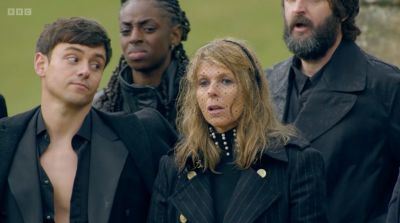 Tom Daley makes his thoughts about Kate Garroway clear.
BARB changed its viewing methodology part-way through the year, so we cannot give a precise list of the most popular shows. We can say that The Celebrity Traitors was the biggest entertainment television programme of the year. A cast of massive stars – Jonathan Ross, Stephen Fry, Alan Carr – were flanked by brilliant young things like Cat Burns and Ruth Codd, and by unlikely bookings like Celia Imrie.
Celia was the absolute star of the show, came in as everyone's favourite maiden aunt, went out as the woman who shrieked down a well, and pulled a giant wooden horse, and had to be murdered by having Shakespeare quoted at her, and broke wind in a crowded shack.
If The Celebrity Traitors hadn't been the show of the year, it would have been the civilian Traitors. We're going to be slightly contrarian and say this really wasn't a great series, compared with the earlier series or with the subsequent Celebrity version. We enjoyed elements from Raven and Incredible Games and Crackerjack making a welcome return.
 A contestant fortifies their tea with a little something.
But we suffered from missions and discussions both pulling in the same direction, and people being wrong and loudly wrong. Contestants took great offence at any slight, real or imagined, which often left a sour taste in our mouth. The whole show rather broke down in the final, when we knew the last Traitor had gone and that we didn't much care for any of the remaining contestants.
Other channels tried to capture the lightning in a bottle. The Inheritance on Channel 4 starred Taped Liz Hurley. It asked contestants to do physical labour, and state their claim to be the most deserving person that day, and eventually divide up the money between themselves.
 This game's not all sitting around.
Part social game, part physical, part trust, The Inheritance was an interesting format. If they'd wanted to market it as the iterated Prisoner's Dilemma, they could have done. Sadly, it was let down by its execution. The host was Rob Plank-Of-Two-By-Four, a lawyer with even less charisma than a John Major-a-gram. While The Traitors is scones and backstabbing, The Inheritance was weak tea and weaker handshakes. And it led our emotions in a way Studio Lambert's other show didn't. There's no particular surprise to find The Inheritance won't come back.
ITV's response, The Fortune Hotel, was much improved in its second series; teams got out of their rooms, we saw them enjoy Grenada at its finest, and holding the case early proved to be valuable. Viewers thought otherwise, and with the series burned off during the summer, it won't be coming back.
One reason behind its failure was Destination X, the BBC1 trip across Europe on a coach. A confusing opening made for difficult viewing, and the show didn't have faith that its central question "where are we right now?" was sufficient to support the entire show. We saw bits of central Europe, but never quite enough to be satisfying. Clues were very simple, basic to the point of insulting the viewer. And the show felt intellectually dishonest: red herrings weren't explained, a recurring motif about Ingrid Bergmann was unclear.
 Where are we? X marks the spot.
Challenges were monotonous, mostly memory and observation tests, very little chance to test other skills. The atmosphere amongst the contestants felt frosty, three players had been introduced to the game late and they were never accepted by those who had been present all along. And with the conditions on the bus verging on psychological torture, it's no surprise that everyone was tired and emotional by the end. Although the BBC series was a reasonable success, it was co-produced with North American network NBC, and their version was less successful. Renewal is not certain.
Skills challenges
It's almost ten years since Breadxit, when Bake Off moved from BBC1 to Channel 4; it's now clear that Channel 4 know what they're doing with the show and haven't turned it into a travelling circus. The fourth channel has tried other skills programmes, this year adding Game of Wool to their roster.
 Tom Daley wears another restrained outfit.
Hosted by Tom Daley, the contestants on Game of Wool were tested on their design skills, their ability to knit at speed, and their ability to knit at volume. The results were lovely, a uniformly good quality, but we can't help but feel that they'd have been noticeably better under less strained conditions. And when a couple of contestants feel the need to step out of the barn because of stress, the producers need to ask themselves some harsh questions.
For the first time in over a decade, there was no version of The Voice on nationally network television. That's except for viewers in Wales, who had Y Llais. It took the familiar spinning chairs round, filled them with Welsh-language talent and Cymraeg stars, and eventually found its winner. Like all other winners of The Voice, Rose Datta has vanished back into the ether.
Indeed, for the first time this century, there was no elimination singing series on nationally network television at all. No round of The X Factor, nothing from Fame Academy, no Pop Idol. The Week of fifteen years ago would be gobsmacked, but then we remember that there is no immutable law that currently popular shows must remain popular.
They might wish to bear this in mind at the Eurovision Song Contest, where the Senior version continues to be mired in dispute and ill-feeling about who exactly should be invited to take part; the EBU appears incapable of identifying the root cause of the problem. Opinions of shows can go down as well as up, and it is easy to squander years of good work – just ask The X Factor of 2015.
 Sabre and Amanda recall their duel.
Gladiators continued to brighten the first quarter; new events and two new Gladiators allowed a bit more variety, while behind-the-scenes show Epic Pranks helped to flesh out their characters. They also managed to tell stories between contender and Gladiator: Mus's ongoing head-to-big-head with Legend, and Sabre seeming to wink and say "hi, Amanda". We've also seen the Gladiators (and the people behind them) appear on other shows: Legend's House of Games (3), most of the squad on DIY SOS, and Hammer making a very good effort on a Sewing Bee special. By reviving Gladiators, the BBC has a group of familiar faces they can drop into other shows for extra star power.
Cheap and cheerful loveliness
Channel 5 has always been the home of low-budget programmes, since the days of cheaper-than-chips programme 100%. This year, they've given three further examples.
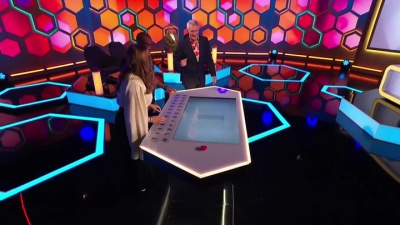 Contestants and host gather at the letterbox.
Celebrity Puzzling was a loose reinvention of a highbrow quiz for very smart people which didn't quite catch fire a couple of years ago. The celebrity version featured a faffy letters board, and Jeremy Vine trying to make a catchphrase of "don't rotate the shape!". It was amiable viewing, a pleasant enough way to while away an hour. We weren't surprised to hear that it had been recommissioned; we were surprised that they've gone for 50 episodes until we figured that that's probably not much more expensive than another 10 eps.
Sally Lindsay was a regular on Celebrity Puzzling; she also hosted a 70s Quiz Night (and apparently also a Christmas Quiz Night, though we missed that). The usual mixture of nostalgia, archive clips, slightly snarky commentary, and getting the celebs to gently embarrass themselves. The format is infinitely extendable, and we expect a few more shows in due course.
Big Game Night wrapped around Channel 5's coverage of NFL-ball games around teatime on Sunday, and in particular the way action stops for loads of commercials that Channel 5 can't show. To fill the time, they've some very short games with the teams – often take as long to explain as to play, which is a complete momentum-killer. Success in a challenge results in an extra ticket in the winner-takes-all draw, and the winner of the draw might earn a holiday. Big Game Night offers some analysis of the sporting event, and completes its game well before the NFL-ball match ends. It's an attempt to do something different, we don't think it quite works as live television, but then the first sixteen weeks of SM:TV were rubbish and then they got much better.
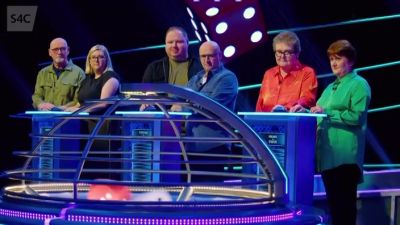 Roll 'em!
Y Deis is this year's primetime game on S4C. It's a quiz based on the roll of some dice, and with a strong tactical element as to when to play and when to pass. A solid show, plenty of quiz and jeopardy until the final moments, though they might have done a bit more with the dice in the second half of the programme. S4C also gave us children's science quiz Boom Bang, explosive experiments and reaction games and science knowledge and some gunge.
The daytime schedule hasn't much changed: Pointless on BBC1, joined by Bridge of Lies and The Answer Run and The Finish Line; the last of these had a week at 5.15 just before Christmas, which might indicate the Beeb's direction of travel. ITV continued with The Chase, Deal or No Deal, and Tipping Point; new series of Lingo and Jeopardy! and Riddiculous also made their mark, though none of them were must-see tv. Countdown continued on Channel 4, and there are still ravens at the tower.
Other primetime shows
Back in the spring, BBC2 spent eight weeks airing Chess Masters: The Endgame, a programme about chess. Reminded us of the opening game on 99 to Beat: in a room with zillions of beanbags it still ended up sitting on the floor. By assuming basic knowledge of how chess works, half the audience who know no chess was put off. By not showing matches seriously, by not explaining how victory was earned, many of the serious chess players were deterred. By inviting good club players, chess snobs were up in arms asking how these enthusiastic amateurs could be called "masters". And by exempting the best players from most of the challenges, Chess Masters wallowed in mediocrity for most of its run.
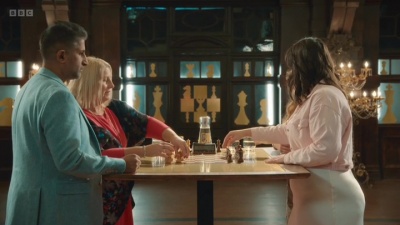 Move the castle to just by the horsey.
Worst of all, it didn't work as a television programme. The series opened with three boards in play at once, three games completed and edited down to about twelve minutes of airtime. We were asked to try and follow three matches at the same time, keep three different boards and six different styles in our heads. And, intercut with these clips, profiles of the players we're meeting tonight. Chess Masters gave the viewer headache-inducing amounts of work: it asked us to do about twelve different things at once. It's no wonder that viewers turned off to something less intellectually demanding, like KYTV's Teach Yourself Nuclear Physics With Martin Brown.
Chess Masters filled in for Quizzy Mondays after Only Connect had finished for the year. OC and The Chase have vied as the most popular quiz for parts of the year, but both are behind in the ratings to The 1% Club. There is a suggestion that ITV risks over-using this particular show. For the second year running we had 20 new Saturday episodes, this year adding a celebrity edition, and a five-night Rollover special event.
And we've seen The 1% Club completed – Clarke Carlisle won the maximum £100,000 on the football celebrity special, a feat repeated by Lucie Alcock during the Rollover week. The Roller also produced the show's biggest winner, Michelle McArdle earned £194,000. The natural point to end The 1% Club is with a special episode featuring 100 people who are already in the 1% Club, to find the show's ultra-brain; at present rates, they may be able to cast that show during 2027.
 A pair of contestants look for their next move.
Worlds Apart came to Channel 4 in the autumn, a travelogue matching young people with pensioners, and putting them in Japan, and asking them to complete various challenges. One could argue that the game design didn't work, some teams were given a much easier ride than others. It is possible to say that the opening narration was misleading, and the producers might have wanted more conflict than they got. But, on the positive side, the programme was gentle television, it gave a fair showing to the more obscure parts of Japanese culture, and it was a pleasant wind-down after the hurly-burly of Bake Off.
Quick mention for a couple of shows we enjoyed. Sound Mate on Radio Ulster, a game of sound effects and archive audio, which has been picked up for a full series. House of Cats on Channel 4's website, in which cats are given things to do; basically, it's a cat video and we all like cat videos.
Shows we're less enamoured with
No particular success on the digital channels. Comedy Central asked Am I the A****** With Jimmy Carr, a title answering its own question to render the programme redundant. The Dave channel gave us Silence is Golden, an attempt to show comedy to an audience who are paid not to make a sound: the idea worked in the head of Richard Bacon, but didn't survive on screen.
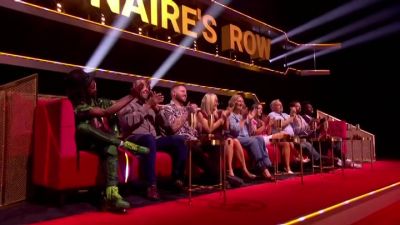 People came, everybody tried...
Win Win was a massive advertisement for The People's Postcode Lottery Company. It revolved around opinion polls; we have a theory that opinion polls are cheap and easy to do, but incredibly difficult to do well. Win Win tested that theory hard, it asked for the most popular answer in various questions to find the average, the mainstream, the mass appeal. All of this was in line with the sponsor's values, being big and mainstream and mass appeal. There was a playalong element for viewers at home, and prizes that money could barely buy.
Win Win was a confident show, it had its values and it was going to stick with them. But the show had zero catchup value, and was burned off against Strictly Come Dancing, and hardly anyone watched it. They gave away a million quid in the grand final, that worked out at about 80p per viewer. It's not the floppiest flop of the year. A month later, Netflix's Squid Game The Challenge gave away £3.5 million to someone. That series finale was seen by less than 2.4 million viewers, which works out – at the very minimum – to £1.46 per viewer.
Daytime television also had its share of failures. The year began with Pictionary, Mel Giedroyc asked some people to draw things. The first half of the show was a massive tie-break for the second half, the adjudication was poor, and all of the rounds far too short for their own good. Derided by critics and ignored by viewers, Pictionary will not return.
 Lauren Layfield is on her own, but is she right?
The Inner Circle went out on BBC1, billed as an attempt to re-create the round table bits on The Traitors. The show had some interesting bits of quiz, co-operative and competitive games, but left us thinking that there isn't enough to be going on with. Perhaps it's the way Amanda Holden undermines the whole format with her constant claims to know "nothing", so much that she gives an air of incompetence, that she's a supply presenter while they wait for Vernon Kay to finish his other show. And while the show finishes with a Prisoner's Dilemma, this is only a problem because finalists aren't invited back when other losers are.
Interestingly, The Inner Circle was also played with celebrities helping some civilian players. These episodes felt more lively, there were people to bounce off and prove that two heads are better than one. The idea needs a bit of work, but might not be as terrible as some people think.
The Roll of Honour
(All results as transmitted are final)
Christmas University Challenge – Durham (Liz James, Tracey MacLeod, Carla Denyer, Sophia Smith Galer)
University Challenge – Christ's Cambridge (Anniko Firman, Brendan Bethlehem, Oscar Despard, Linus Luu)
Junior Bake Off – Austin
Bake Off Crème de la Crème – The Ned, City of London (Darian and Yadira)
Senior Bake Off – Jasmine Mitchell
The Traitors
(BBC) – Leanne and Jake
(RTÉ) – Kelley, Olin, and Vanessa
(BBC celebrity) – Alan Carr
Eurosong '25 – "Laika party"; written by Emmy Kristine, Guttulsrud Kristiansen, Erlend Guttulsrud Kristiansen, Henrik Østlund, Larissa Tormey, Truls Marius Aarra; performed by Emmy
Junior Eurovision (TG4) – Lottie O'Driscoll Murray
The Masked Singer – Samantha Barks as Pufferfish
Love Island
(all-stars) – Gabby Allen and Casey O'Gorman
(summer) – Toni Laites and Cach Mercer
Síorstíl – Austin Collins
Cân i Gymru – "Troseddwr yr Awr", written and performed by Dros Dro
Only Connect – Four Opinions (Jacob Epstein, Aron Carr, and Rafi Dover)
Dancing on Ice – Sam Aston and Molly Lanaghan
The Great Pottery Throw Down – James Stanley Watson
Landscape Artist of the Year – Ben McGregor
Portrait Artist of the Year – Chloe Barnes
Popmaster
(tv, spring) – David
(tv, summer) – a different David
(radio) – Peter Mattock
RTÉ Dancing with the Stars – Rhys McClenaghan and Laura Nolan
Strictly Come Dancing – Karen Carney and Carlos Gu
Strictly Come Dancing Christmas Special – Scarlett Moffatt and Vito Coppola
Counterpoint – Sarah Trevarthen
Home of the Year
Ireland – Amy and Eoin Martin for their 1970s home in Limerick
Scotland – Jessica Zanoni and Chris Labrooy for Hilltop House, Pitmedden
Y Llais – Rose Datta
Gladiators – Joe Fishburn and Amanda Wah
Celebrity Big Brother – Jack P Shepherd
Big Brother – Richard
Our Dream Farm – Ioan Jones and Sara Jenkins
Dubhlain DIY – Mairi and Mairi
99 to Beat – Caitlin
Mastermind – John Robinson
Interior Design Masters – John Cooper
Eurovision Song Contest – "Wasted love" for ÖRF; written by Johannes Pietsch, Teodora Špiri? and Thomas Thurner; performed by JJ
Junior Eurovision – "Ce monde" for France Télévisions; written by Linh, Jonathan Thyssens, and John Claes; performed by Lou.
Fighting Talk – Danny McLoughlin
Got Talent – Harry Moulding
Genius Game – Ken
Rostrum Camera – Ken Morse
Race Across the World – Caroline and Tom
Celebrity Race Across the World – Harleymoon and Roman Kemp
Glow Up – Jake Moran
Around The Islands Quiz – North of England (Stuart Maconie and Jenny Ryan)
Countdown
(June) – Rhys Jones
(December) – Jase Cullen
Taskmaster
(spring) – Matthew Baynton
(autumn) – Maisie Adam
(champion of champions) – Matthew Baynton
Game On, Grandparents! – Roman & Jordana
Destination X – Judith
The Fortune Hotel – Nella and Topé
Cooking with the Stars – Natalie Cassidy
Masterchef – Harry Maguire
Celebrity Masterchef – Ginger Johnson
Sewing Bee – Caz
Win Win – Sienna
Dress the Nation – Casey Dillon
BBC New Comedy Award – Eli Hart
I'm a Celebrity... Get Me Out of Here! – Angry Ginge
Game of Wool – Holger
Next week's highlights
Television's top show The Traitors continues (BBC1, Wed, Thu, Fri). The Great Pottery Throw Down starts its new series (C4, Sun), and Rob Brydon takes us to The Floor (ITV, Sun). We have new editions of Pointless (BBC1, nightly from Mon), and Time is Money begins its regular weekday series (ITV, from Mon). ITV also offers Millionaire Hot Seat (nightly from Tue). Channel 4 spends its Friday night in jocular company, with The Big Fat Quiz of Telly. Next Saturday is Sports Night on The Masked Singer (VM1 and ITV), and we have a new The 1% Club (ITV).
We'll be back next week with a quick look at the various Christmas programmes, and three episodes' worth of Only Connect as it nears its final.
To have Weaver's Week emailed to you on publication day, receive our exclusive TV roundup of the game shows in the week ahead, and chat to other ukgameshows.com readers, sign up to our Google Group.