
Weaver's Week 2026-01-25
Last week | Weaver's Week Index | Next week
It's Millionaire after drinking six espresso!
Back in the late 1990s, ITV invented Who Wants to be a Millionaire. It was an immediate and huge hit, and became the channel's biggest thing for a few years. Chris Tarrant became a massive star, and the show contributed enough catchphrases to keep Roy Walker in business for years.
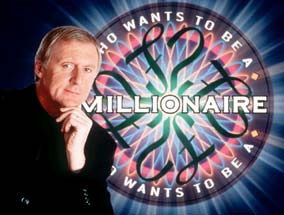
Times change, shows fall out of fashion, and Millionaire stopped being event television, and then stopped being interesting television. They tried to tweak the format – bringing a clock into play, and introducing various new lifelines, and chopping the first three questions from the show. None of this served to arrest the falling ratings, and Millionaire came off air in 2014.
Hot Seat was first shown in Norway and Italy, and became a major hit in Australia where it ran on and off for 14 years. The format's also had extended runs in Sweden and Portugal. Now, it's come to ITV, which has aired a new series of Millionaire since 2018.
Fast-track to a million
On the original Who Wants to be a Millionaire, we followed one contestant through their journey. From the start with a really easy £100 question, through the doubts in the middle section, and the lifelines. Will our player get to take the Free Shot at question 11? Might they get the big money; dare we dream that they'll see the million pound question?
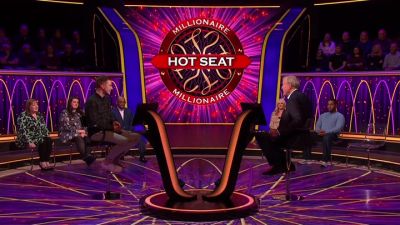 Six try to fit onto one chair.
Hot Seat does away with all of that. Six contestants gather, but rather than compete in a round of Fastest Finger First, the players are randomly assigned their order of play. People come and people go, and only the person in the hot seat for the fifteenth and final question will go away with any money.
Gameplay is reasonably simple. Whoever is in the central hot seat is asked a question and four possible answers. Play and give the right answer, and all is well – you remain in the hot seat, and get the next question for a bit more money. This is good.
Play and give the wrong answer, and bad things happen. You're out, which ends your chances of winning any money. It's bad for the other competitors, too – the top prize is removed from the game. We're no longer playing for £1 million, but for £250,000. And, if there are further errors, for £100,000, then £50,000, £20,000, and a bottom top prize of £10,000.
To avoid this minor catastrophe, players are allowed to pass. The player remains in the game, but rejoins the queue at the back – and perhaps will not have another chance in the chair. Whoever is next in line comes into the hot seat, and is given the same question – the new player cannot pass and must play. A player may only pass once in the game, the second visit to the chair must be the last one.
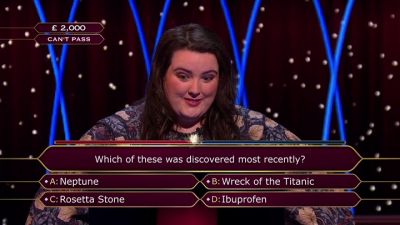 A player faces a tricky question; someone has already passed, so this player must answer. A fuse just above the question burns to show the remaining time to answer.
There are no lifelines as we know them. Phone a Friend is out, Switch has been cancelled, 50/50 covered in gunge, and although there is a studio audience, there's no point asking them. Questions are against the clock – 15 seconds to give a "final answer" for the first five right answers, 30 seconds for the next five, 45 seconds for the final five questions.
Whoever's in the chair for the final question can win the big prize. Get it wrong, and they leave with a consolation £1000. And yes, it is possible for six incorrect answers to be given before reaching this final question, and for the game to end in a prize of absolutely nothing.
Because this is Millionaire, the show uses nominal prizes for the first nine steps on the ladder: £7500, £5000, £3000, £2000, £1000, £500, £300, £200, £100. These smaller prize names are for display only, and cannot actually be won. They fit the Millionaire brand better than calling them "Question One" and so on. And the questions do pass muster as being for that amount of money – the earliest questions are almost insultingly easy, the fifth or sixth might give pause for thought, and most contestants are sufficiently scared of losing to pass than to guess at something they don't certainly know.
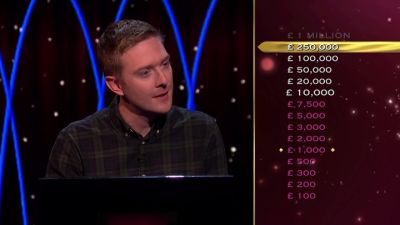 After a wrong answer, the jackpot - shown by a gold line - falls.
Fast driver behind the wheel
Host for the show is Jeremy Clarkson, who hasn't previously featured in this column. He's a broadcaster, farmer, and writer, best known as the initial host of Robot Wars before being replaced by Craig Charles. Later, he would appear on motoring magazine Top Gear, with an oft-imitated style describing cars as if they were something entirely un-car-like – kitchen utensils, ancient Greek sailing vessels, or arachnids. (Or was that the spoof on Dan and Nick's Wildebeest Years?) After being fired from Top Gear for punching his producer, Clarkson disappeared up the Amazon, and made documentaries about his farm. Clarkson is also the author of some books, and has a column in a little-read Sunday publication.
Clarkson is a perfectly fine host. He is able to read out the questions, enunciate the possible answers, and convey whether the answer is right or wrong. He can have a quick chat with the contestants, and riff off events earlier in the show for comedy.
Something he can't do: Clarkson is not able to deliver many of the trademark pauses – he cannot build up tension in the way Chris Tarrant did, nor can he really make us care about a contestant's journey. To be fair, we strongly suspect this is an inherent problem with the format – if you're trying to tell a complete game in 25 minutes, and have six people rotate through the chair, we viewers are never going to get much of a connection with anyone.
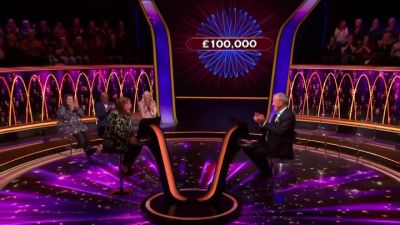 Our contestant's won £100,000 - and Clarkson paused for maybe 100 milliseconds.
And, at heart, that is the problem with Millionaire Hot Seat. It's a snack, a quick quiz, with literally a revolving cast of contestants. People aren't going to tune in to ITV specifically for Millionaire Hot Seat, it's something to watch while The East Enders is on the other side. And, for the night's supporting act, Millionaire Hot Seat has some very large prizes – if ITV is giving away six-figure sums on a throwaway programme like this, how much have they spent on the night's main attraction?
On the other hand, Millionaire Hot Seat is a bit of a change. Since the invention of colour television, Monday at 7.30 has been a soap opera on ITV – for many years it was Coronation Street, more recently Emmerdale Farm. Now the spot is given over to other programmes. To help viewers settle into the new routine, it's fair to bring back something reasonably familiar – even if we don't know the precise nuances of Millionaire Hot Seat, the basic rules are comfortable. The show looks familiar. So is the music, written by Paul Farrer and based on the Strachan & Strachan original score.
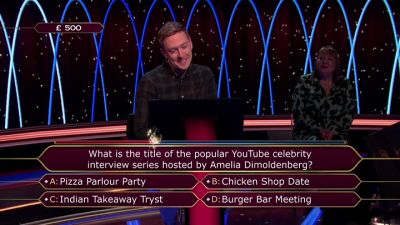 At a glance, the show looks like its familiar parent.
We've seen eight episodes of Millionaire Hot Seat. That's enough to form an opinion – it's a solid format, it's competently hosted and the questions are up to the usual Millionaire high standard. The fact that it's got a top-tier prize, but is otherwise a second-tier show, is rather strange. But not as strange as Deal or No Deal: Banker's Best Battles in the same slot, which is simply a re-working of daytime finals without the context or getting-to-know-you sections.
Ten more episodes of the Millionaire Hot Seat have been recorded, and they're going to go out later in the year. We can see ITV making many more episodes, and rationing them for short seasons – perhaps as a spoiler for something BBC1 are running, or to lead into special programmes of their own. Except that 8pm is now always Emmerdale Farm and Coronation Street, and the big new shows go out at 9pm.
We will see how things go.
Jennifer Turner
Readers probably won't know about Jenny Turner. To the best of our knowledge, she never appeared on television, never went on the radio, never sought any fame beyond this little corner of the internet. As a contributor to UKGameshows, and writer on her own Quizzlestick blog, she was the best. And this site is diminished as we hear that Jenny Turner died late last year.
Jenny was a fearless writer, able to skewer bad television in a single sentence. Her takedown of Love Thy Neighbour is the greatest piece of writing on this website, and the daytime show Perfection allowed Jenny to revel in her comedy talent. She was a long-time fan of Popmaster, often to the point of spotting the errors and solecisms in Phil Swern's questions. In the weeks before her death, Jenny contributed our review for The Inner Circle.
Behind the scenes, Jenny was able to keep the various UKGS writers in line. It's a job that requires tact, diplomacy, a sure knowledge of people, and the ability to drop a precision f-bomb. Whenever some of the bigger egos threatened to get out of control, and appeals to reason had failed, Jenny would chime in with the right words and the right actions to cajole all of us – this column included – to better our ways.
This column tends to be sweetness and light, we might pull a few punches here and there, perhaps we're a little soft on programmes that aren't as good as they ought to be. Jenny would know when to be sour – but she never wrote with malice, always with an appreciation of what had been done well. Praise from Jenny Turner was earned, and meant a lot.
As seems to be the way of the internet, this column doesn't know much about Jenny beyond her moments in the game show fan spaces. We know she lived somewhere in north-east Scotland, and we know that she would sometimes not log on for a few months, but that is all, no picture, no known age. Our thanks to the friend or family member who passed on the doleful news, and this column is very sorry for the loss.
Quizzy Mondays
The all-important third place play-off on Only Connect went to the Metrophiles, beating the Worker Bees by 18-13. It's the show with some of the sillier questions, including rock formations named after animals, the full name of Billy No-Mates, hits by exes of celebrity jam-maker Taylor Swift, spelling out the word NEPO as initials of nepo babies, and the suggestion that Jayne Mansfield opened the Chiswick Flyover.
Over on University Challenge, Merton Oxford came out on top of a nip-and-tuck battle with UCL. The lead changed hands more than we cared to count, which is always exciting. The game was played well, which is always fun to watch. First twelve questions were all correct, though there were only a couple of complete sets thereafter. Elliott Cosnett had the buzz of the night, on a question about a river separating North Korea from Communist China; UCL had the bonuses they wanted, on statistical mechanics.
The numbers: Merton were 51% overall, 56% bonus rate, which is about average for all teams. UCL were 45% overall, 48% bonuses, slightly below the average. Merton picked up three penalties, UCL one. Both of the winning sides in the group phase – Merton and Edinburgh – have been strong on languages and philosophy, but a bit weak on physics and maths. UCL now have to play off against Manchester, and need to hope there are lots of questions in the philosophy area as it's the only topic where they're stronger.
What with The Traitors and the news about our co-writer, House of Games (3) rather passed us by this week. Nigel Planer and Steen Raskopoulos carved up the wins between them, Nadia Jae repped 1xtra very well, and Tamzin Outhwaite could easily have bossed a weaker set of contestants. Looking forward to the summer repeats already.
Other news
A great weekend for Effie and Kevin, who scooped £750,000 on Limitless Win last episode. Having been there or thereabouts on many questions, they knew a question about the age of Nirvana's Nevermind album, and then got lucky with a guess that Ronnie O'Sullivan completed a 147 in just over 5 minutes.
Good news for all readers, the website has remained up long enough for us to complete the archive of Weeks we didn't put online during the last months of the old year. If you want to read our blow-by-blow account of The Celebrity Traitors, that's now up on the web. (The civilian series follows in a few weeks, once we've caught our breath and let folk catch up.)
A few updates on the social events we've mentioned recently. December saw us yapping about London's Transport Race; next one of those is scheduled for 28 February. That's also the final night for Phantom Peak in their current location, and a hiatus while they move to fresh fields.
Back in September, we wrote about the Strange Games events. The remaining tickets for the August Festival go on sale next Sunday morning; there are also shorter events in Bristol and Hailsham earlier in the summer, and tickets are on sale now. Strange Games are also planning a weekend in sunny Crawley at the end of May, keep an eye on their website for more details. This column intends to be at the Bristol and Festival events.
If you're staying in, watch out for Only Connect (2), the grand final (BBC2, Mon). RuPaul's Drag Race Against the World kicks off a new series (BBC3, Tue). Daytimes bring us Antiques Road Trip (BBC1) and Chateau DIY: Win the Dream (C4). The Traitors Ireland has begun on the I-player. And next Saturday's The Weakest Link reunites Chesney Hawkes and Sarah Greene, though this time not on a steam train in Sussex.
To have Weaver's Week emailed to you on publication day, receive our exclusive TV roundup of the game shows in the week ahead, and chat to other ukgameshows.com readers, sign up to our Google Group.