
Weaver's Week 2026-03-22
Last week | Weaver's Week Index | Next week
A bunch of people go up a mountain, and come down very rich.
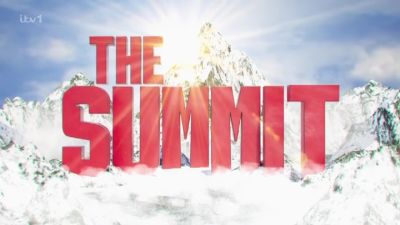
Our one-line summary sounds rather like a Hollywood movie. So let's take this to the extreme, and get Voiceover Man to describe it in full.
"Fourteen people went to New Zealand.
"They went up a mountain.
"They got a useless map.
"Some of them fell off.
"Some of them were voted off.
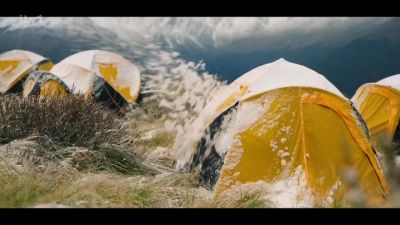 They camped in tents.
"They camped in sleeping bags.
"They were pursued by a bloke in a big black helicopter.
"Warren is The Priest.
"Charlet is The Annoying One.
"Tom is The Guide.
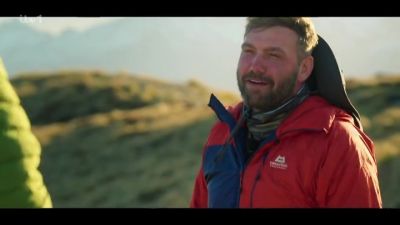 Dockers is The Count.
"The Summit. Coming soon. to an intermission near you.
"The Summit is sponsored by Honest Ron's Bookmakers, separating fools from their money since 1981."
So, yeah, that's the basic synopsis. Fourteen strangers turn up in a lush green meadow in the New Zealand countryside. One may reasonably assume that they've been given some sort of survival training, because some of them don't look like they'd last five minutes in the wilds of Great Portland Street Gardens. They're set the task of climbing to the summit of a nearby mountain, and given two weeks in which to do it.
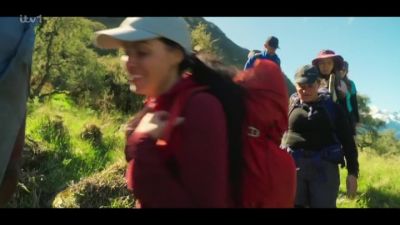 Just another day out in the woods.
Now, if this were a proper test of climbing and mountaineering ability, one might expect their route to be planned carefully, and to be as economical as possible. They would be issued with a precise map, multiple compasses, and many positioning systems for their safety. But that would put the best interests of the contestants at heart, and would probably complete the task in about a week. So they are issued with precisely one compass, and one map which looks like it's out of a tourist brochure. The group are to take a very scenic route, going up and down and up and down and up and down like a lift with a particularly bad case of the yo-yos.
The route covers all sorts of terrain, clearly mapped out and made safe by elements of the production crew. Ropes are laid, paths are forged, equipment is left around but it's up to the team to use it properly. Safety never takes a day off, and we can be sure that everyone's physical safety was assured as best it can be.
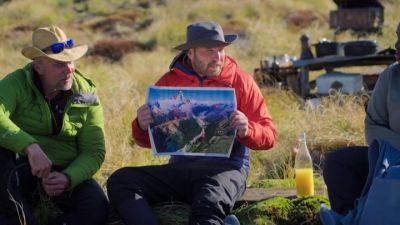 The "map" showed a line linking various points, somewhat less use than throwing grass into the wind.
But the route was bizarre. There are ascents up vertiginous banks, descents down waterfalls, ladder climbs, rope crossings, rickety bridges. If they made a five-minute game out of it on Raven, they'll make a fifteen-minute element out of it on The Summit. We don't actually recall Raven leading their charges through a snowfield, though they did make a series in the horribly wet summer when it may as well have snowed in July. (See, we remember details of Raven two decades on. We will not remember details of The Summit two weeks hence.)
From time to time, the route passes through "base camp". These are campsites erected by the production company, with proper tents, decent meals, a good fire, and all mod cons. And the familiar face of Ben Shephard, the host of The Summit. Ben is there to chat to the team, keep their spirits up, and preside over the inevitable vote off.
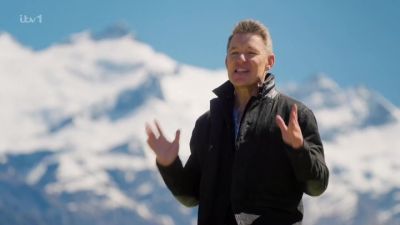 Ben Shephard stands in front of a mountain.
Ah, the voting off. Fourteen started on their journey to The Summit, but at least five would have to leave the trail. At each of the base camps (other than the first), there was a vote amongst the group to throw someone off the trail. Why would they do that? Well, there is a time limit, and the group aren't allowed to split up and get out of each other's sight. If the survivors don't make it to the summit by the end of day 14, the whole journey will be "a failure" and no prize money will be awarded. So slowcoaches were likely to be voted off, so were people struggling to keep up with the pace, or who were just getting on everyone's wick.
Prize money? Did we mention prize money? Ah, prize money. The group set out with bulging backpacks – sleeping bags, changes of clothes, food, essential supplies. And bags of money. Each player was weighed down with their share of £200,000 in used bank notes. (To be precise, each player had a bag containing £14,280, the remaining £80 wouldn't divide equally and was last seen chatting up a particularly fruity squeeze behind the hotel bar.) Why did the producers choose such an atrocious amount? Why not give everyone £14,000 and pop the extra £4000 in a bag at the first base camp?
 Bags for money, borrowed from Craig Charles.
Anyway. Players who were voted off the trail left the climb, but dropped their money into a bag carried by one of the continuing contestants. Players could also leave the trail through injury or physical exhaustion, and in that instance their money would be lost to the team. The climber voted off at the camp? Their money stays. The climber who injures themselves climbing a ladder and has to be withdrawn by the doctors? Their money goes.
From time to time, the climbers would also be buzzed by a black helicopter. The sound of whirring blades, the stirring of ominous music, the cries of "oh, that's never a good sign". Yes, in a nod to a much more successful ITV show of yore, Interceptor put in an appearance. (For some reason or other, he was always called "The mountain speaker", no idea why, probably a mistranslation from the Maori.) These days, Mikey can never get close enough to give a good zap, so Interceptor has to make do with dropping a bag from a low height.
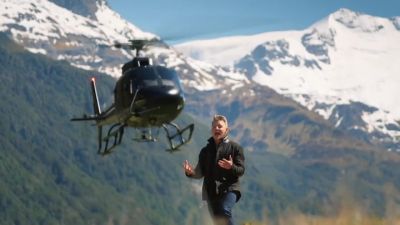 Ben Shephard (right) dodges to avoid the draught from The Interceptor.
Interceptor's bags contained trivial challenges and simple moral dilemmas. In the opening episode, the team was asked to determine the crossing order on a rickety bridge, and to cut the ropes while the last person was making their crossing. That person would be out of the game, and their money would be lost.
Now, the team could have decided not to do any of this, and to reject the mission. It would have been the honourable thing to do, and it would have made better television. Might also have resulted in the producers getting seriously narked, going on strike, and the whole project being cancelled before the end of the first filming day, and everyone being sent home from New Zealand with zero reward. And that would set a new world record as the largest Bit Of A Wasted Journey Pointer in history. And it would leave ITV with eight hours of primetime to fill and nothing new to fill it with. How many times can they show Basil Brush on The Celebrity Chase?!
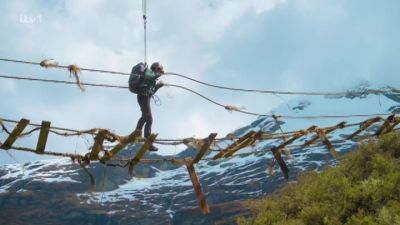 You never caught Raven putting up with this pish.
To avoid the schedules going completely boom boom, the utterly contrived situation played out. The biggest ego in the group decided to made a decision that came across as homophobic, and end the challenge from someone younger and nicer who might have rivalled his self-declared "alpha male" status. Fast forward a week or so, and we find the same contestant cheering for The Priest, who was previously one of the original ITV Gladiators. That made Warren the actual alpha male of the group. Warren was one of two people who we might uncharitably term "stunt casting"; the other was Afton, the younger daughter of food crank Gillian McKeith.
Indeed, the whole programme felt like one contrivance after another. We were depressed by the rows between contestants; the situation was physically and emotionally draining, the producers ramped up the stress, and spirits were low. The edit brought out as much of the argy-bargy and bickering as it could, evidently the producers wanted to showcase people being beastly to each other in a barely-hospitable environment.
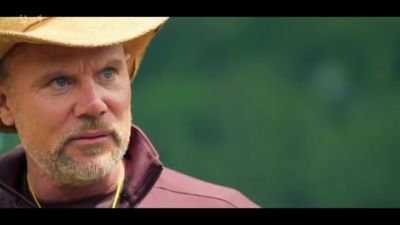 Rev. Warren, formerly Ace from Gladiators.
As the show wore on, it became clear that the producers wanted to tell us how they wanted us to feel. Big Brother style "letters from home" were introduced part-way through, and a video phone call lifted spirits on a difficult day when weather prevented the finalists from moving. The Interceptor and his helicopter became a nothingburger: too far away to be a physical danger, too frequently used to be a psychological threat, too banal in his challenges to be interesting.
The producers also had a particular storyline they wanted to follow, and they were happy to manipulate events to bring it about. When it became clear that only a couple of people were going to quit the trail voluntarily, extra eliminations were forced on the group. When it became clear that the group were dangerously far behind schedule, lifts were arranged to make up some of the distance and keep them on track. The producers might not have particularly cared who was going to make it to the finish, but they did insist that some group would make it to the finish, and preferably on the afternoon of the last possible day.
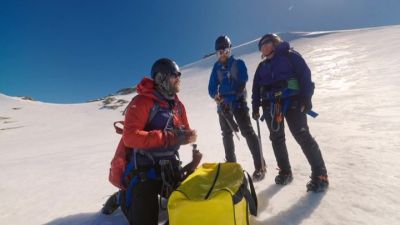 Will he throw someone off the mountain within 500m of the top? Naaah, can't be bothered.
There had been some little personal growth on the trip. Painted as the villain on day one, Dockers was reminded that other people may have their own stories, their own reasons for winning. In the final kilometre, the final intervention from Interceptor gave him the option to chuck someone else off the trip; Dockers chose to share the winnings with the people who had helped him get there. Even this moment had the shine taken off; The Summit had been scheduled to transmit last autumn, but was held over to the new year. And by the time we were allowed to see it, we'd already watched a similar dilemma resolve on The Traitors – and to a much more sympathetic character.
Other international versions have a final twist: the contestants who didn't make the finish sit in judgement on the few who did. The prize money will go to those who made the top, but how much money each person gets is decided by those who were thrown or fell off the mountain. Mercifully, we didn't have to suffer this gratuitous twist, the show came to its natural conclusion with the three winners on top of the mountain. Perhaps it would have undercut the final episode's emotional climax, Warren falling on his ice-pick with tremendous grace, to allow the others to fulfil their dreams.
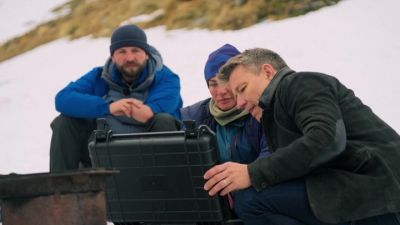 Ben brings up the laser display satellite phone.
Yes, there are other international versions, all of them filmed in the same mountain range of New Zealand. The Summit has been a moderate hit on Australian television. Aussie telly is a strange place: we are just about better than wisecracks about Neighbours being serious drama, and Blankety Blanks the height of intellectual discussion. But the shows that work down under seem not to travel at all reliably; for every Married at First Sight there's a flop like The Block. No other broadcaster has made The Summit work, and that suggests the fault is not with the viewer, or the broadcaster, but the format itself.
And we are unhappy about The Summit being sponsored by a bookmaking company. We really don't like how the show said "change your life through hard work and effort and being selfish" and the sponsor said "change your life through the fickle finger of fate". ITV really needs to think more carefully about accepting money from gambling, it makes the network feel tawdry and cheap and grubbing for every last penny however much it undermines ITV's reputation.
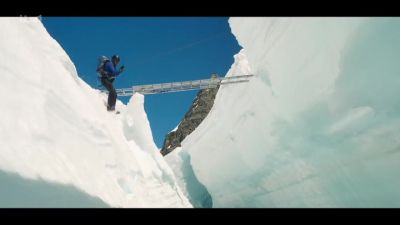 The ladder to cross this ice crevasse may have come from Do It All.
Even after watching the whole series from start to finish, we still have no clue what they were on about. Did The Summit make sense as a mountaineering show? No; the technique was exactly what we'd expect from enthusiastic amateurs, and some of the equipment they used (such as a ladder from DIY Dan's Garden Shed Toolshop) was inadequate.
Was this meant to be a show selling Beautiful New Zealand to the viewers? If it was, it didn't work: we weren't told the locations: starting from Glenorchy, cross Precipice Creek, criss-cross the Rees River and Shotover River valleys, including a scramble up and down Cone Hill, the waterfall climb may have been at Alexander McKay Falls, rowing at Lochnagar, before reaching the Grant Glacier to finish atop Mount Head. It's all filmed in the Southern Alps, near the bottom of South Island.
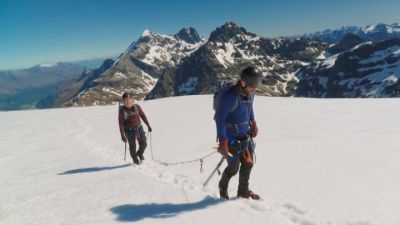 A slow trudge through fresh snow.
Was this meant to be an emotional programme? Must have been, when we've eliminated the other possibilities, we must go with what's left. But even as an emotional show, The Summit failed: it was too contrived, too manipulated. If there's one thing The Traitors does properly, it's allowing emotions to emerge naturally, without force, just let the branches go and fall as they may. The Summit told its contestants that they were going to show particular emotions (rage and frustration, mostly; sometimes compassion and empathy and tiredness) and forced them to perform like a troupe of actors in thick winter gear.
Over the years, we've seen some great shows, and we've seen some bad shows. We've seen some shows that were interesting flops, and we've been able to get a reasonable article out of most programmes. The Summit falls into the absolutely worst category: a show so uninspired and so uninspiring that we are going to forget about it within weeks. Shine Television (part of Banijay) may have made some great television, but The Summit is not a show to live long in their repertoire.
Quizzy Mondays
A rollercoaster edition of Mastermind concluded with victory for Diane Howe. The housewife and carer took the singer Jeff Buckley as her specialist subject, and chose to pass rather than get questions wrong. She kept up a great pace, and added general knowledge to a total of 20.
And, though 20 is rarely a winning score, it was this week. David Slater had a great general knowledge round, but had already been undone by his specialist subject of the Routemaster bus. Max Bougeard did well on Rafael Benitez, and Matthew Patenall on Andy Warhol, but neither young man was able to add enough general knowledge points to overhaul Diane's total. Diane put in a perfect round in her heat, so must not be underestimated.
Darwin Cambridge survived in University Challenge for another week, outpointing Warwick by 175-125. On paper, this should have been Warwick's to win, all the stats said they were the better team. But Darwin just came alive when it mattered, winning a lot of close races to get starters. That opened the door to bonus questions; neither side was distinguished (Darwin 42%, Warwick 48%; overall rates were a poorly 44% and 40%). We got the feeling this week was dipping into the old-style questions – the likes of aether, Sam Houston, Mendelssohn, and Kierkergaard could have come from the Bamber Gascoigne era.
We think Darwin next play Merton Oxford. Darwin have the edge on Geography, but Merton the advantage on Language and Literature and especially on Maths & Physics. Merton are also prone to buzzing just too early and picking up penalties – errors very nearly cost them the win against UCL earlier in the group phase – and we cannot count Darwin out just yet.
"If I didn't give points to people who cheat, there'd be a national points shortage". Richard confirmed that House of Games (3) is just for fun. It was Champions Steve week with Pemberton and Backshall joining Sam Quek and Rachel Riley. Once again, Answer Smash proved to be the key to victory – in this case by Pemberton, though Rachel won a couple of days. We are sure the questions are a bit more difficult, and all contenders were there or thereabouts at some point.
Other news
 Michael Sheen (centre) with Alan Carr and London Hughes.
Michael Sheen is the new host on House of Games (3), he takes over from Richard Osman next winter. Sheen is best known as an actor, playing Kenneth Williams on Fantabulosa and Chris Tarrant on Quiz. He's also been an occasional visitor to the shows we call game – regular panelist on KYTV's There's Something About Movies, guest host on Have I Got News for You, and participant on Pointless Celebrities and The Wheel.
Sheen is a big catch for House of Games, we were expecting someone from the panel show circuit or an established presenter. We weren't expecting a Hollywood star, and he might be the most eyebrow-raising signing since David Tennant on Genius Game. We look forward to assessing him against the old bloke, Michael Sheen certainly has big shoes to fill.
Speaking of Hollywood stars, congratulations to Jessie Buckley. The runner-up from I'd Do Anything, Jessie has transcended the limitations of an Andrew Lloyd Webber casting show and become a major film star. Already the winner of the Best Actress BAFTA award, this week she's added the Oscar award from the Hollywood-based Association of Motion Picture Arts and Sciences.
 Tom wears the latest knitted carpet.
News from Channel 4. Another series for Game of Wool, the speed knitting competition hosted by Tom Daley. We hope that the new series concentrates more on the quality of knitting, and less on the speed we saw last year. Two more series of Popmaster, and a couple of celebrity editions, all expected to premiere on More4.
From the BBC we hear that Picture Slam has been renewed again, six civilian episodes and three celeb editions, one of them going out over Christmas. Picture Slam is the Name That Thing show hosted by Alan Carr.
Big new show this week is The Hunt, people are in a forest and either hiding or seeking others. That's on Channel 4 from Sunday to Tuesday. Celebrity Bake Off returns (C4, Sun). It's the grand finals for Masterchef Goes Large The Professionals (BBC tv, Thu), Gladiators (BBC1, Sat), and Richard Osman's very last House of Games (3) (BBC2, Fri).
To have Weaver's Week emailed to you on publication day, receive our exclusive TV roundup of the game shows in the week ahead, and chat to other ukgameshows.com readers, sign up to our Google Group.