
Weaver's Week 2026-04-26
Last week | Weaver's Week Index | Next week
A pair of Quizzy Monday finals? On the same night? You do spoil us, BBC Custard, so let's make a Hullabaloo about the big events. "Who will be able to shout 'Hooray!' at the end of the show?" Good question, Clive.
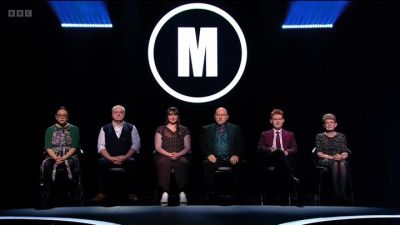 The sensational six.
Lorna Frankel, a medical secretary, is first into the Big Black Chair. Her specialist subject is Julie Andrews.
As is traditional, all of the contenders tonight have made a short film to introduce themselves, and expound on their specialist subject. We learn that Lorna has been a quizzer for absolutely yonks, watching Countdown as a young 'un with her grandparents, and more recently spots on University Challenge in 2018 and Only Connect in 2021. Lorna revises by multi-tasking, knitting and crocheting. She gets a field trip to meet Pamela Hutchinson at the Theatre Royal in Drury Lane, where Andrews made the role of Eliza Doolittle.
Lorna gets a lot right, there are a couple of errors in there, and the final score is 11 points (and no passes). Yeah, that'll be a strong start, sets a high bar for everyone else.
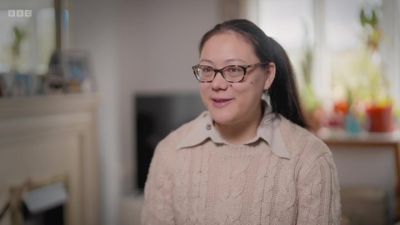 Lorna Frankel.
Ross Taylor, a publishing director, offers the Films of Danny Boyle. He's been involved in quizzes five nights a week, lots of online work and apparently there's a World Quiz Championship where he's involved. We meet his mother, wife, and son for the revision. Siobhan Synnot is the guest reviser, they're at the Pulp bar in Edinburgh which played a role in the film Trainspotting.
Answering the questions, Ross answers crisply and sharply, swiftly enough to squeeze in an extra question compared to Lorna. There was precisely one error in there, so a total of 13 points.
Danielle Connolly, an administrative assistant, will tell us about Beatrix Potter. We meet Danielle's mother, her greatest supporter, and fellow quizzer. On her travels, Danielle meets David Pepper at Canfield Place, Beatrix's childhood home; Danielle's own link to childhood is that her mother bought a complete collection of Potter stories for her daughter. She also gets a good luck message from Dawn French, who played Beatrix in a movie.
Danielle's round features a few pauses, an error, and (gasp!) the first pass of the night. Final score is a perfectly cromulent 11 points (and 1 pass).
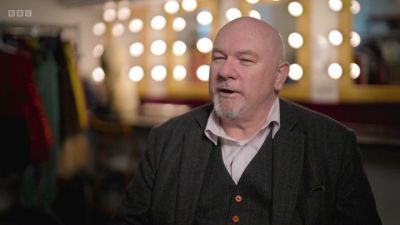 David Ford.
David Ford, a soon-to-be-retired civil servant, will tell us about Robert Burns the poet. David's main pastime is in the theatre, where he's a triple threat – he can act, write, and construct a set. David's wife applied on her husband's behalf, and it proved to be a successful idea. We also meet David's sister and daughter; then it's off to Ellisland Farm, where Burns once lived, and Gerard Carruthers of the University of Glasgow delivers a very short lecture. David sees the original manuscript of "Auld lang syne", a familiar song.
David's round covers the poetry – "Tam O'Shanter", "Ay fond kiss" – and the life, his farms and Masonic meetings and other books. Although he's perfect up to the buzzer, David can't quite recall the last detail after the bell, so finishes on 10 points.
Miles Searle, a student, talks about Nôtre-Dame Cathedral in Paris. Although from Wimbledon, he's studying art at the Sorbonne, and takes a subject quite easy to revise from his university room. There's no site visit, but we do get a video call with Agnès Poirier who is standing on a balcony near the cathedral. Not sure which city she's in. We see Miles revising with his mother and father. And he points out – as he did in the heats and semi – that he would be the youngest ever winner of Mastermind.
An error quite early on ensures that there's no perfect round here, but Miles is able to make up for lost time with brisk answers to the questions he knows. But then there's a string of errors, and the final score is only 8 points. We know from the heats that Miles has a superb general knowledge, but has he left a bit too much ground to make up?
Diane Howe, a housewife and carer, takes the astronaut Jim Lovell. We learn that Diane is a practiced aeronaut, having been up and down and even done a skydive. It's her second time on Mastermind, having appeared six years ago. We meet her husband, and a friend from the cattery where she works. Jim Lovell was the commander of the Apollo 13 space flight, which went wrong. On the visit, she meets Ed Kellond-Turner at the Space Centre in Leicester, who tells Diane about the plans for the failed mission, and offers good wishes from top astronaut Tim Peake.
It's a strong round, looked at one time like we were going to see perfection. An error fairly late puts that out of play, but a perfectly fine 12 points is her total.
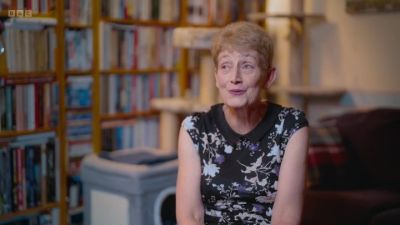 Diane Howe.
Credit to all of the contenders, who chose good subjects for the final. Julie Andrews, Beatrix Potter, Jim Lovell, Robert Burns – all are famous names who we'll have heard about, but the general public won't know most of the details of their lives. And the lives have been documented well, but not with an exhaustively long bibliography. We can make similar remarks about Danny Boyle's films; perhaps Nôtre-Dame proved a little larger than the contender expected.
Mastermind has an awkward slot in the schedules. It can't begin until after the cricket has finished in early September, so is commissioned for a series of 31 episodes. It's a very simple format: winner of each show progresses in the contest, everyone else is out; compare that to the "are they in or not" question on University Challenge. Contenders who are drawn against someone on absolute fire are out of luck and will have to apply another year.
Some have suggested that fairness requires some high-scoring loser slots; to be frank, we're OK with the series format. Where we do have a problem is that a lot of the heats are a trifle ho-hum, a lot of people win with modest scores of a good but not brilliant quality. Would it make a better series to cut the order to 20 heats, and bring back the four highest-scoring losers to compete for one last spot in the final?
We're also unimpressed with the way the series stopped for over two months while they had Minor Celebrity Mastermind. As an occasional treat, Celebrity Mastermind was mildly entertaining. These days, they bring in almost as many celebs as civilians, and the quality of celeb is not there, and the quality of quizzing is not there, and the reputation of the main show suffers. Yes, we know Mastermind is outsourced to independent producers Hat Trick and Hindsight; yes, there may be contractual reasons why the BBC has to order 31 civilian and 14 celebrity editions. Contracts expire, and we very much hope that the next one allows for a higher quality of quiz.
Back to the programme. General knowledge comes next, two-and-a-half minutes of rapid-fire questions.
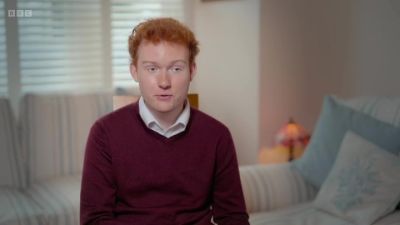 Miles Searle.
Miles Searle is back in the seat first, because he's at the bottom of the scoreboard. "Who won The Celebrity Traitors?" is one early question; another asks for the location of Llanfairpwllgwyngyllgogerychwyrndrobwllllantysiliogogogoch, as in which island is it on. Miles answers what he knows, and makes fair guesses at what he doesn't. But there are few points for these guesses, and quite a few of them, so Miles finishes on 17 points. Doesn't feel like a winning score, sadly.
David Ford returns next, a strong round with answers on painters, Japanese straits, and literature including The Hunger Games. Didn't we review that last week? Anyway, David starts off with a storm of points, becomes becalmed for a long time, keeps his head going and finishes on 20 points.
Lorna Frankl starts with a question on archery, which is something we've not seen on a game show since Raven. The prolific works of Barbara Cartland, the wife of Henry V, succubi and garlic – these answers all feature in the round. Lorna answers carefully, thinking about every word Clive is saying, and mostly getting the answers right. The final score is 25 points: not convinced it's a winning mark, but it's a mark for the others to aim at.
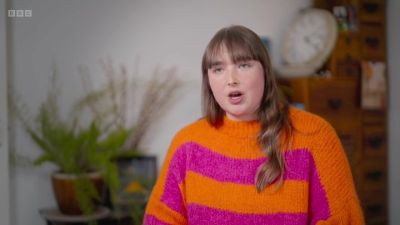 Danielle Connolly.
Can they get there? Danielle Connolly remembers Bitcoin, and the lion of The Wizard of Oz, and the recording works of Madonna. A slight smile plays on Danielle's face as she answers questions, and perhaps she's glad to be there. If she is, good on her, and good on all the contenders – it's a tremendous achievement to be in this position, very few people ever get to be Mastermind finalists. Danielle's final score is 21 (and 2 passes).
Diane Howe has a slightly smaller task, having finished one ahead of Lorna in the specialist round. She knows about the hyphen, and the recording career of Adele, and the noble gases. Again, after a strong start, the questions get a little bit more difficult, and Diane finds it harder to pick up points. Unlike most of the other contestants, she does pick up points, and eventually makes it to 25 points.
Ross Taylor can win this. He needs to double his score of 13, otherwise it's a play-off. And Ross is going like the clappers, answering quickly. Sometimes without thinking – Bloemfontain and The Yeoman of the Guard would surely have been identified if the contender had taken a moment to consider the question's last word. But he's getting most right. Aah! A reflex pass on the location of the soap Hollyoaks, that could be crucial. Having passed once, Ross has nothing to lose by passing on anything he doesn't know, a desperate effort to fit in the extra question. It never arrives. Ross's final score: 24 points (and 2 passes).
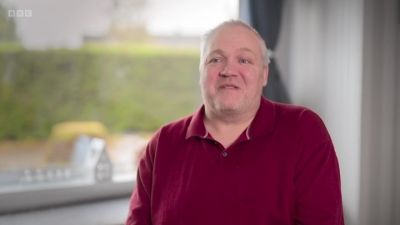 Ross Taylor.
The end of the round. But not the end of the contest. We have a tie.
Does the Mastermind budget stretch to two glass bowls? Evidently not.
The same five questions will be asked to the two contenders; time is not a factor, and most right wins.
Kinetic energy, Ant-Man, Watling Street, a talent show judge, and a month in the French revolutionary calendar. Lorna knows she's got the first two right, had a good guess at the next one, and shots in the dark for the last pair. Two, maybe three out of five?
Diane gets the same questions. First two are right, as is the Roman road – but didn't Lorna say a different road? Neither contender knows the recording output of Deal or No Deal alumnus Olly Murs, nor the month of Germinal.
It's the Fosse Way to victory! Diane Howe is the victor, and takes the coveted glass bowl.
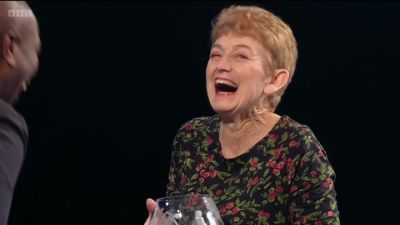 Diane Howe with the winner's bowl.
Amol Rajan has come in his best smoking jacket, Edinburgh in suits and waistcoats, Manchester in smart tops. It's the grand final.
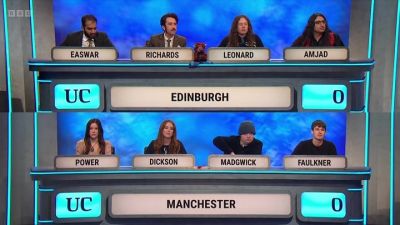 Let the challenge begin!
And it begins with… a dropped starter. Wolstencraft's dedication to Tallyrand falls into neither team's wheelhouse, and nobody answers correctly.
Normal service is resumed with the next starter, asking after the greatest time zone difference across a land border. Communist China to Afghanistan is the answer, four-and-a-half hours fall off the clock in a single step. Kai Madgwick got that, and their Manchester team pick up two bonuses on the works of Pushkin. The scores are quickly levelled, Amjad Rayhana for Edinburgh on the links between Bose and Einstein, then football clubs founded by British people abroad.
There's then a starter on donkeys in film; the question started with Eo, and we're sure it would have finished with Shrek, except Johnny Richards buzzed in earlier. Edinburgh pick up a full house on parasitic plants. Manchester get the first visual round, flags critiqued in the 2001 pamphlet "Good Flag, Bad Flag". "The flag's overall complexity defeats its purpose", said the Vexilological Society about the flag of Damascus. "Good grief!" said the Manchester side. After the visual round, Edinburgh lead 45-30.
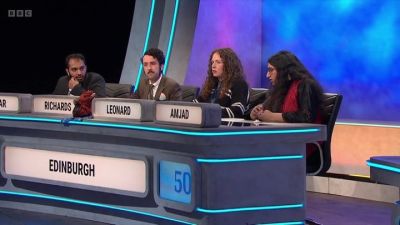 The Edinburgh team consider a bonus question.
Edinburgh this year are represented by Parthav Easwar, Johnny Richards, Rayhana Amjad, and captain Alice Leonard, who wears the most marvellous cardigans and jumpers. They beat a misfiring Newcastle side in the opening round, Trinity Cambridge in the eliminator, Manchester and Merton Oxford in the group phase, and Darwin Cambridge in the semi-finals. We've been impressed with their ability to ferret out bonuses, and their knowledge of Literature and Social Sciences. Edinburgh are going for their second series win, having taken the trophy in 2019.
Edinburgh's lead lasts just moments longer: a penalty for an incorrect interruption, a correct buzz after Madgwick has heard the question on the Nestorian church, and the score is deuce, 40-40. Later, there's a long quote by Rainer Maria Rike, and Madgwick guesses as soon as the question has stopped, because there's no use in getting a penalty when the other lot don't look like buzzing. Bonus sets on non-narrative films, characters from Greek myth, and the second Crusade, plus a starter on degenerate states, all add to Manchester's lead.
The audio round asks for a Russian composer. Nobody knows the works of Mussorgsky, Manchester lead 90-40. Fire in classical music the theme of the later bonuses. Nobody knows about the BAFTA-winning video game Hellblade Senua's Sacrifice; at some point over the past decade, video games have moved from mundane pop culture filler to the subject of academic scrutiny, and this is reflected in their presence on UC.
There's been a coup in the Central African Republic? Blimmey, they should have appointed Osman and Armstrong presidents-for-life. Manchester get a bonus set on the continuum hypothesis, about different sizes of infinity. A penalty for Manchester, adding Argyll to the question about Bute, allowing Edinburgh to get a set of bonuses on Durkheim's sociological jargon. The Scottish side gets one there, and completely blanks a set on the process by which Zimbabwe claimed independence.
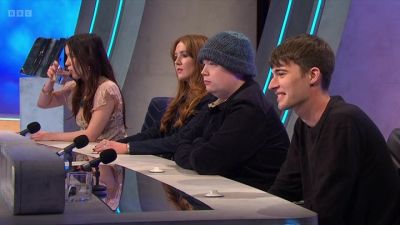 Manchester draw strength for the approaching questions.
Manchester lead by 100-80 going into the second visual round. They're represented by Ray Power, Kirsty Dickson, Rob Faulkner, and Kai Madgwick, whose fashion contribution is colourful beanie hats. They looked impressive when beating New College Oxford in their opening match, then defeated the LSE on the strength of Madgwick's buzzing. The defeat to Edinburgh at the start of the group phase was followed by wins against UCL and Sheffield, and last week's trouncing of Imperial in the semi-final. Madgwick's buzzing is the team's not-very-secret weapon, and they're particularly strong on History and Mixed Bag questions. Manchester will be looking to lift the Auld Book for a fourth time, having won the final match of the series in 2006, 2012, and 2013.
Werner Herzog's picture introduces a set of pictures about the film-maker, and Manchester stretch ahead. Edinburgh keep pace with pomegranate syrup and the element rhenium. Manchester pick up another penalty on isomers, being too general for the specific one being asked.
But then starters about The Exeter Book, then six arrows of Ataturk, fall to Manchester. Paintings by Bastitat add to the lead. Edinburgh get a starter about the Dom Mountain, but there's only time for one bonus.
And at the gong! Manchester have the win, 145-105.
The teams get to go out for the trophy presentation, at the Clapham Grand, and awarded by UC alumna Miriam Margolyes. She remembers getting a question wrong, dropping an f-bomb, and it flimmin' well went out on air.
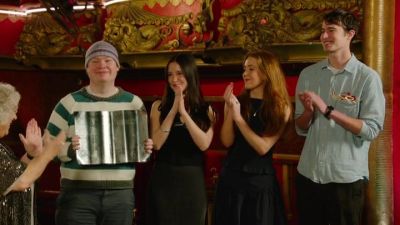 Another win for Manchester, the team everyone wants to beat.
Quickly through the night's stats. Edinburgh 15/40 overall, 8/19 on bonuses, one penalty. Manchester 22/48 overall, 13/27 on bonuses, two penalties. All of these are around or slightly below average for the series.
All nine of Manchester's starters were got by Kai Madgwick, which we score as a personal contribution of 116, and their third successive century. The total of 56 starters in seven matches goes down in history, the second largest total in the BBC revival, behind only Alex Guttenplan's 62 in the 2009-10 series. Gail Trimble, whose buzzer prowess in 2008-9 brought a new audience to University Challenge, "only" recorded 46 starters, but that was from five matches; her average of 9.2 starters remains a revival record for a winning team.
Series stats: average score across all teams was 153 points, with teams answering 47.5% of the questions they faced; the average bonus conversion rate was 53%. On average, teams heard 97 questions in each episode (but remember that starters count twice, as each team heard it), and each team gave 1.93 incorrect interruptions per episode.
Yes, a brilliant buzzer can lead a team to victory – something we've not really seen since Alex Guttenplan back in 2010. Like that Emmanuel Cambridge team, Manchester had strength in depth, complimentary skills and knowledge, and the ability to turn reasonable guesses into points.
Unlike that Emmanuel Cambridge team, Manchester didn't need some helpful decisions from the chair. We always got the impression that predecessor Jeremy Paxman favoured Cambridge over Oxford over everyone else, but could not tell if Rajan ever has a favoured team; his enthusiasm and support for the teams is most helpful.
And we could see that Manchester were having a whale of a time. Everyone on the team contributed to the victory; some by filling in the gaps in their captain's magnificent knowledge, or by reassuring each other that it's only a game. And University Challenge is only a game; prestigious, hard work, fulfilling, but ultimately a bit of fun testing one's knowledge against one's peers and the sharpest writers in the business.
Other news
"Amol Rajan, who became host in 2023, was pointless." Ouch! A round on Pointless asked for hosts of various television game shows. This column completely blanked on Andy Collins' time hosting Family Fortunes, well done if you got that. We're surprised fewer people remembered Bradley Walsh as a host of Blankety Blank than the David Walliams pilot from about ten years ago. And more people remembered Paddy McGuinness on A Question of Sport than David Vine? The hundred never cease to amaze us.
 What a pointless waste of a grand piano.
Pointless also asked after acts that failed to trouble the scorers at the Eurovision Song Contest. Our thoughts went "Oh, er, um. The Makemakes, they were absolutely robbed. Jengu Macrooy, he deserved a lot better. Er, um, who was that noodle with the massive dancing thumb? Um, er, did Mae Muller get anything from the juries? Crikey. Garry Lux came back in 87 and did miserably, but he scored, otherwise Black Type would have hit us over the head with a picnic table, right? Gah, ten seconds. Stuff it, let's go obvious. Jahn Teigen, Jengu Macrooy, The Makemakes."
Would have won us the jackpot and the bonus – the only pointless act the Pointless Hundred had heard of was Jemini, who can't even be relied on to get nothing. We later did the research: Jendrik had the dancing thumb and was blanked by the televote; Mae did indeed get 15 from the juries; and Garry Lux received 8 points. Jahn Teigen was responsible for the abomination that was "Mil etter mil" in '78, although compared against some of this year's entries, it's a masterpiece.
Giant became the first Gladiator to leave the BBC revival, stating "this wasn't a decision I made to step away. I was faced with a choice that didn't align with my values." We wish him well, and doubtless there will be a fresh face on the series next year.
Where are the American Gladiators? Last week, we noticed that Amazon Prime's American Gladiators had been promised, but hadn't appeared for viewers who pay for Amazon's product. The programme was shown as "coming soon". This week, we learn that Amazon Prime didn't actually have the rights to American Gladiators, and has quietly deleted the page from its catalogue.
Why has this happened? We can but speculate. It is entirely possible that the BBC's licensing agreement gives them first refusal on any other versions of Gladiators in the English language. We can think of a situation where the BBC saw the version made by Amazon, thought "this is abysmal and will damage our show's high reputation", and exercised their rights to acquire the show with the intention of never actually airing it putting the episodes out on BBC3 at 3am. According to poor unfortunate correspondents who have actually seen the prog, this would be a very reasonable response.
Whatever the truth, it's clear that Amazon Prime have made promises they cannot keep. Any slightly competent broadcaster would have made sure they had the rights before issuing breathless press releases to all concerned. The whole affair leaves us wondering what other shortcuts and compromises Amazon's programmes take, and whether we can actually believe anything we see on the platform.
Promises we hope will be kept: Holey Moley arrives on ITV, the crazy golf show was A Big Thing late last decade in North America, and now it's being hosted (and co-produced) by crazy golf fans Ant and Dec.
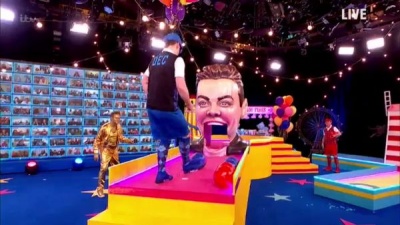 Build your own sentence from "kick" and "Stephen Mulhern's head".
"A brand-new unscripted format development opportunity with an innovative and compelling twist on a studio-based game show" is promised from the BBC and NBC. It's to be made by Expectation and Plegazoid, the companies of Ben Wicks (I Literally Just Told You, In With a Shout) and David Flynn (Million Pound Drop, Game of Clones). The broadcasters have previously collaborated on The Traitors (most obviously a hit) and Destination X (we're obstinately waiting to be convinced).
Coming up this week, Y Llais finds the voice of Wales (S4C, Sun). Bridge of Lies returns to daytime (BBC1). David Mitchell on Radio 4? That's The Unbelievable Truth (Mon). The Traitors India arrives on BBC3, and The Neighbourhood continues on VM1 and ITV.
The World's Biggest Music Quiz (Greatest Hits Radio, Thu), where Ant and Dec host a massive multi-player quiz on popular music. They hope to break a world record and raise lots of money for charity.
With Quizzy Monday having come to an end, we plan to take next week off. (Celebrity Sabotage gets a review when we're back.) BBC4 has Quizzy Monday Classic Editions from 4 May: University Challenge from the 2022-23 series, and baby Only Connect (2) from 2008. Pointless and Have I Got News for You take scheduled moves to BBC2 on Friday 8 May, making way for bletheration and waffle on the main channel.
To have Weaver's Week emailed to you on publication day, receive our exclusive TV roundup of the game shows in the week ahead, and chat to other ukgameshows.com readers, sign up to our Google Group.