
Weaver's Week 2026-07-19
Last week | Weaver's Week Index | Next week
Unbelievable, Jeff!
El Rosco
We've previously mentioned the very long-running dispute about the Spanish game show Pasapalabra. The case appeared to reach some sort of conclusion in the past few weeks.
Our story begins in 1996, when young Andrew O'Connor brought The Alphabet Game to BBC1 daytimes. A cheap and cheerful presenter, a cheap and cheerful show where the points mattered far less than the taking part.
The format went to international channel owners Mediaset, who turned it into competitive game Passaparola (Italian), and then Pasapalabra (Spanish). The game eventually came here, as ITV's two-series wonder Alphabetical. Andrew O'Connor sold his production company Objective, and it's ended up in the maw of ITV Studios.
For Spanish viewers, Pasapalabra is the biggest quiz show of them all, their equivalent to The Chase. ITV Studios wanted to get their fair dues on this programme, and there was a dispute about exactly how much should be paid. Two matters came before the court: who invented the final round El Rosco, and who actually owned it?
Who invented El Rosco?
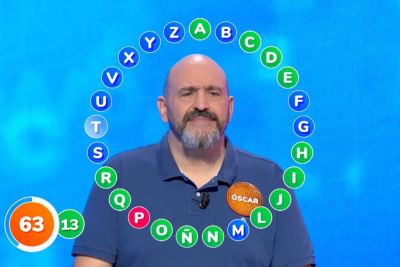 El Rosco, going right round the circle with correct answers.
Mediaset said they did. Their key evidence was that the endgame "El Rosco" was not performed on The Alphabet Game and was something they'd invented. ITV countered with evidence of contracts and rights fees, and that they had put the work in to develop the programme.
The court case arose from a money dispute. Between 2000 and 2006, Pasapalabra had aired on the channel Antena 3, where they modified the rounds as the show evolved, and developed the final, El Rosco. Mediaset bought the show from A3 in 2006, and renegotiated the contract with ITV in 2009. ITV wanted rights money, they would produce the show themselves, and 10% of the profits from the show.
Mediaset were annoyed at the steep price. They argued that after nine years, the show was barely recognisable from The Alphabet Game, an amiable daytime chatfest. Ideas had been brought in from the original Spanish production company BocaBoca, from the Italian Passaparola. About the only thing left from the original concept was to have questions from A to Z.
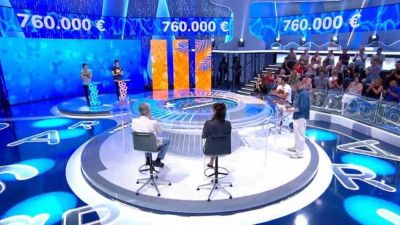 The show's set is bright and welcoming.
So, by the end of 2010, Mediaset had registered El Rosco as a trademark, introduced more changes, unilaterally declared the contract void, and sued ITV to have the fees repaid. That case finally came to a decision nine years later: Mediaset's argument was rejected entirely, the show was briefly taken off air, and Mediaset owed ITV €14,8 million in rights fees.
Appeals were filed on both sides, Mediaset still reckoned the format was enough of their work to be original, ITV reckoned they were due further compensation. Eventually, finally, a conclusive judgement emerged in May 2026. As they might say on the sportsball commentary: ¡D-E-S-A-S-T-R-E-P-A-R-A-M-E-D-I-A-S-E-T! And that could spell "¡desastre para Mediaset!"
The Madrid Provincial Court ordered Mediaset to pay ITV Studios €73,2 million in damages. The court said that Mediaset had illegally exploited the Pasapalabra format without a valid license between 2012 and 2019.
How had they reached this figure? €44,3mn came from the base licensing, the fees that needed to be paid in order for Mediaset to legally make ITV Studio's intellectual property. The remaining €28,9mn is "indirect advertising revenue", a share of the money gained by Mediaset from the massive audience to the show, and the large audience that stayed through the ad break for subsequent programmes.
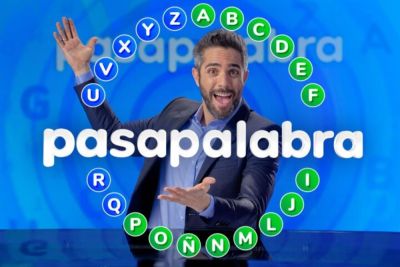 Until recently, the show's logo featured El Rosco.
Reading the judgement, we note that cited sources include the UKGameshows write-up of The Alphabet Game, where we note the show's descendant in Spain.
Who owns El Rosco, then?
A separate case at the Spanish Supreme Court said that the intellectual property rights to El Rosco do not actually belong to ITV. The round-the-alphabet format is actually owned by the Dutch production company MC&F Broadcasting. And that meant Antena 3 was not allowed to continue with El Rosco until it had secured the separate licensing rights from MC&F.
Until that happens – if it ever happens – Pasaparabala has a different endgame. The new finale is "A la Z" (A to Z). It's a similar game, based on DallAZetA (from A to Z), which is clearly owned by the Swiss-Italian broadcaster RSI, and clearly licensed from them under contracts even the most useless judge would find convincing. MC&F Broadcasting are going to ask a judge to take a look, claiming that the new format is too similar to their own work.
How is "A la Z" a similar game? Goes through the letters, in alphabetical order, answer questions beginning with each letter in turn. How is it different? Most notably, letters are arranged in a line, not in a circle. Also, one contestant takes letters from A to Z, the other answers questions going from Z to A.
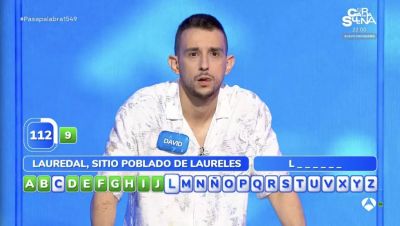 The new endgame, from A to Z and back again.
On the show, the champion and the challenger are given 110 seconds just for turning up, plus whatever they can get from the main game. Whoever's in the lead chooses whether to go from A to Z or backwards. The presenter, Roberto Leal, reads a short definition of the word, the contender is to give the word. The player can pass by saying "Pasaparabala", or call "Lettre" to get an extra letter somewhere in the word – but this costs five seconds.
Pass, or give an error, and play goes over to the other player. Whoever's got the more right answers (and fewer errors) wins the show and €1200 and comes back as tomorrow's champ; a tie gives €600 each.
Ah, but if someone goes from A to Z or back again, they win the jackpot – which grows by €6000 per day, and increases until it's won – most recently by Rosa Rodriguez in February, taking over €2,7mn. That's almost enough to pay off the licensing fees!
The daily loser also returns on the next day, facing a new contender who hopes to take their place. Each day's show features the two playing contenders, assisted (or hindered) by two celebrities. It's common for people to stay on Pasaparabala for absolutely ages – Rosa's win came on her 307th edition, all of them facing Manu Pascual, and defeating hundreds of challengers between them.
The decision of the Supreme Court is expected to be final; there's already a claim that the new format is a bit familiar, and the amount of money to ITV Studios will doubtless be subject to an appeal. When will all this be decided? Er, pasaparabala.
Quizzy Mondays
All three of BBC2's evening quizzes returned this week. (But no new Bridge of Lies, Pointless or House of Games, the other shows this column has on series link and will discuss.)
The first heat of Mastermind was won by David Rhodes, taking the footballer Roy Keane. Although he thought that Banzai was a card game rather than a betting extravaganza, that was about his only mistake. Ravi Meah did very well on the music group Depeche Mode, though fell into a pass spiral in his general knowledge round. Holly Simmons took the films of Yorgos Lanthimos, and Sarah Klein the monarch Edward IV.
Only Connect has a new tournament structure. It really is very simple.
First phase – same as it's been for a few years. Four groups of four teams, two losses to eliminate, two wins to progress.
Quarter-finals – will begin in December, and it's the same as they've done on University Challenge for quite some years. Eight teams, two losses to eliminate, two wins to progress.
Semi-finals, final, and The All Important Third Place Playoff remain. Teams can meet a previous opponent, either in the last match of the first phase, or towards the end of the quarter-finals, or in the later knockouts; we expect the producers will have minimised such repeats.
But in order to have a re-match, you've got to have had a match. Let's spark tonight's mixture of sulphur and wood to see what sparks.
Makeweights beat Culture Club 25-21. Bonuses were swapped for most of the first round, before the Makeweights buzzed in with about 0.001 seconds left to claim a sequence on the crimes committed by Goldilocks. They also knew all about words that go before K Pop Demon Hunters, though neither team could find "hide" hidden in the word "seek". With two perfect walls, and nothing between the sides on vowels, it's clear that Sequences decided this game.
Over on University Challenge, Imperial made the first step to another final, with a 220-160 victory over Bristol. We knew it wasn't going to be Bristol's night on the second starter, when "enthropy" was penalised for the answer "entropy". Time after time, they were just a beat behind Imperial's buzzers; Dennis Reppen and Charlie Lowman picked up five apiece. Bristol were never out of it, and a score of 160 could well be enough for a repêchage place in October.
Stats pack: Imperial got 61% of their questions right, Bristol 53%, both slightly above the average from last year's first round. Bonus rates were Imperial 61%, Bristol 59%, again ahead of last year's average. Two penalties each was absolutely average. The teams combined for 59 correct answers, and this might be the highest of the series. A lot of biology and chemistry questions this week, and both teams acquitted themselves well.
This week, we learned:
- German television used Depeche Mode's "People are people" as the title music for its 1984 Olympic coverage. Depeche Mode as television title music? It'll never work!
- At the time of recording, the Chancellor of the Ducky of Lancaster was someone born in the far east: Bristol, to be precise.
- "Suffering succotash!" shouted Sylvester. Was he talking about the dish of sweetcorn and lima beans? Or does it just sound good when snarled at the innocent bird Tweety Pie?
Other news
Quite a few obituaries this week.
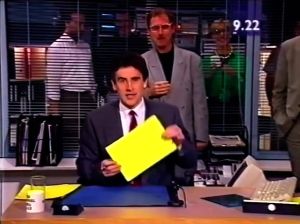 Dermot ends the Channel 4 Daily.
"One final look at the headlines: there they are (shows paper to camera, tosses over shoulder)" Dermot Murnaghan died, aged 68. Born in Devon and raised in Northern Ireland, Dermot's career began on The Business Programme, its live spin-off Business Daily, and especially its early-morning reports into The Channel 4 Daily. As the show evolved, Dermot moved from the finance desk to become the show's main anchor, working alongside Jeff Stelling, arts correspondent Joanna Kaye, and incomprehensible cartoon Mio Mao.
After closing The Channel 4 Daily with his joke, Dermot moved to ITN, hosting longform report show The Big Story and daily bulletins. As the best announcer in London, he broke the news of Princess Diana's death to viewers. Moving to the BBC in 2002, Dermot was a lead presenter of Breakfast, once again waking up viewers with a pleasant and friendly manner; he also got to host major events including the second wedding of Prince Charles. While at the Beeb, Dermot hosted the short-lived revival of Treasure Hunt (2) and the very successful Eggheads; he'd remain with the latter series for over ten years.
Dermot moved to Sky News in 2007, where he was again the face of the channel, and broke the news of Queen Elizabeth's death to viewers. He was always blessed with a human warmth, he spoke with authority without losing the compassion for people. Dermot retired from Sky in 2023, repeating the same joke he'd used three decades earlier. He spoke on television last year about his diagnosis of prostate cancer, which claimed his life. Dermot is survived by his wife Maria and their four children.
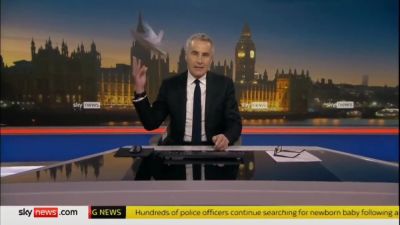 Classy to the end, Dermot Murnaghan.
A great outpouring of grief when we heard that Bonnie Tyler had died. The singer with the gravelly voice will be remembered for her 1983 hit "Total eclipse of the heart", an all-out sonic blast of emotion. She also popped up on light entertainment programmes, including panel show Never Mind the Buzzcocks, as the Singalong Live guest on both Saturday Night Takeaway and Best Time Ever, and as the BBC's entry to the 2013 Senior Eurovision Song Contest. Bonnie Tyler was 75.
 Bonnie Tyler (right) with Ana Matronic at Eurovision.
The death of Ann Widdecombe, aged 78. She was a politician by trade, including a spell as prisons minister in which she personally inspected every single institution, brought about more humane treatment of prisoners, and demanded that prisoners giving birth were chained up lest they escape. She frequently quoted the maxim: "nobody has the right to live their life free from offence". Widdecombe was the MP for Maidenhead from 1987 until 2010, briefly an MEP, and still appeared on political programmes in the last hours of her life. She died last Wednesday; in a concluding clause we wouldn't wish on anyone, the police are treating her death as a potential murder.
Where's the game show connection? After briefly retiring from frontline politics, Widdecombe became a regular guest on panel shows and light entertainment programmes. She recorded long runs on Strictly Come Dancing and I'm a Celebrity, and on shows as varied as Pointless and The Crystal Maze. Widdecombe also hosted Sky's quiz Cleverdicks. Producers have said that she was always charming and easy to work with; this is completely at odds with the image she portrayed to the public, often advocating cruelty for cruelty's sake and appearing to deny that other people were actually human. Within her lifetime, some suggested that Widdecombe was using light entertainment to make herself – and by extension her ongoing political career – more palatable.
Paul Gambaccini, the Counterpoint host and music presenter, told the world that he has Alzheimer's. We wish him the best.
Onwards, ever on. New series this week include Picture Slam (BBC1, Sat), great news for the Alan Carr fan club. Just a Minute starts another series (Radio 4, Mon) Coming to a conclusion: Bake Off The Professionals rushes to a finish (C4, Tue and Wed), and Wales' Home of the Year finds a winner (BBC1 Wales, Thu).
To have Weaver's Week emailed to you on publication day, receive our exclusive TV roundup of the game shows in the week ahead, and chat to other ukgameshows.com readers, sign up to our Google Group.