
Weaver's Week 2026-09-20
Last week | Weaver's Week Index | Next week
With summer coming to a conclusion, we make one last trek to the beach. Windbreaker, sausage 'n' chips with lashings of vinegar, and squeeze a few final drops out of the suncream bottle.
And then there's this booming Scottish voice making all sorts of dodgy puns.
Race Against the Tide is a game of competitive sand sculptures.
It's played by teams of two, made up of one ordinary person with no experience, and one regular sand sculptor. Each episode has a broad design challenge ("the sea", "monsters", and so on), and the basic idea comes from the newbie. The sculptor brings their expertise in how to build and make the artwork. Additional labour comes from the "Sand Crew", a group of people who will collect sand and move it about, all at the behest of the players.
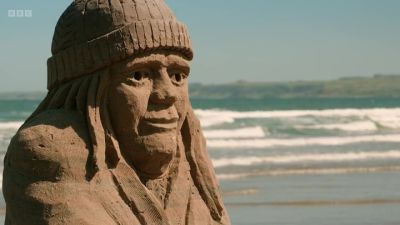 The aim is to create a sculpture like this.
Each episode follows a similar pattern: the challenge is set, people start work. Then, one by one, we see artist's impressions of the sculpture they want to create, how it might ideally look in the mind's eye. We follow the progress, the ups and downs. Six hours of building is compressed into about twenty minutes of television time.
We quickly become accustomed to the tropes of sand sculpture. Large amounts of beach sand are gathered up and compacted into "forms" - large rectangular wooden boxes, missing a top and bottom. When the wood panels are removed, the idea is that the wet sand will support its own weight, and can be carved. At least, that's the theory: almost every week, some of the sand falls away, plans fall out of the window, and the teams have to improvise.
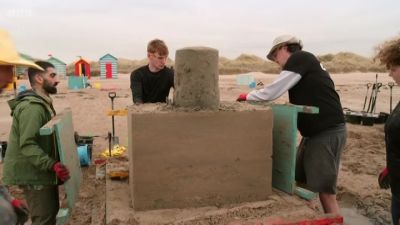 A tense moment as the "form" - the wooden box - is removed.
Then comes the judging. Sadie Clayton and Jamie Wardley have been looking at the various sculptures as they take shape, and know what they're looking for. They want larger-than-life creations, ones that seem to move and leap out of the sand at you. A well-executed static piece will probably be enough, but will certainly lose out to a playful and vibrant creation that might have a few muffed edges.
The show fits into a BBC half-hour, which is shorter than the leisurely standards of a commercial hour (and positively frantic when compared with Sewing Bee). Although each episode only has one challenge, the brief running time means there's not much time to gad about: quick introductions and straight on with the show.
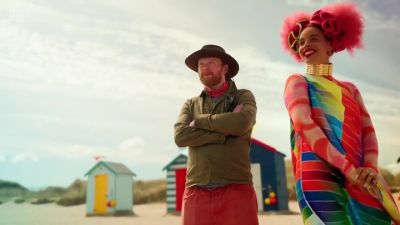 Jamie and Sadie, the expert judges.
There's a good reason for this haste: the show is, literally, ruled by the title. All of the sculptures are made on the West Beach at St Andrew's in Scotland, where there's a decent tidal rise and fall. The waters rise by about 5 metres in sheer height, and that corresponds to a hundred metres or more on the beach. Plenty of wet sand, plenty of sand that was literally under water an hour or two ago.
When the tide has receded as far as it can, a yellow flag is waved, indicating that there's about three hours in play. And once the tide reaches the mark to say it's coming in, there's a red flag, and just ten minutes to finish off the construction. This red flag moment can arrive earlier than expected, particularly if the wind is being blown on-shore by a strong wind.
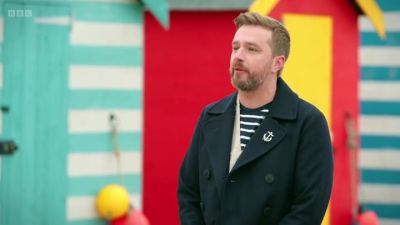 Host and narrator, it's The Fabulous Iain Stirling.
There's not a moment to lose! The host reflects this urgency in their energy. The Fabulous Iain Stirling hosts: you'll know him from Taskmaster, Celebability, The Dog Ate My Homework, and mostly from larking about with Hacker T Dog. He's unflappable, runs around and makes all sorts of jokes – noticeably some exquisitely groanworthy puns. There's a lot of The Fabulous Iain Stirling on this programme, and if you can't stand him, the show will not be to your taste.
If we're being absolutely honest, nor is the judging particularly to our taste. While Sadie and Jamie have their areas of expertise (artistic impression and technical merit, respectively), we got the impression that the teams were being judged as much for their contribution through the series as for their work on the day. This is an absolutely fine and fair thing to do, so long as it's made clear to the audience, and if that's what they were doing it wasn't made sufficiently clear.
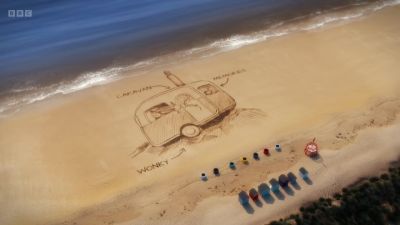 Artwork shows the planned designs.
More tellingly, Stirling's persistent wisecracks undermine any pretence that Race Against the Tide is a serious programme. The judges assert that competitive sand sculpture has depths and nuance, but this is not presented in the programme. A wry tone from the narrator will attract viewers, but Stirling is always silly and never allows the space for anyone to be earnest.
Worst, when he's not making jokes about the contest, he's being snippy towards the contestants. Contestant: "Who knew that making something with straight lines could be so stressful?" Voiceover, dripping with sarcasm: "The sand sculpting expert may have mentioned it. Several times." Stirling, shush, let the irony stand on its own.
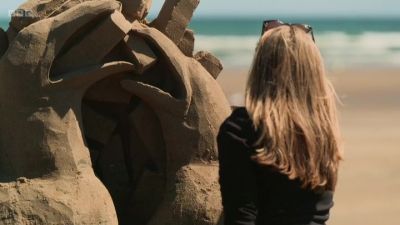 A contestant is hard at work on their sculpture of a seagull and chips.
As is the way of all making competitions on television, a winner of the week is declared, and then someone is invited to leave the contest. The show continues with the next build, filmed a day or two later and shown the following week.
What of the sculptures? They've been built below the high water mark, so the sea is going to come in and reclaim the ground it owns. All of the sculptures are just visiting, and will return to the compacted wet sand from whence they came; the closing sequence sees many of the artworks crumble under the inexorable waves.
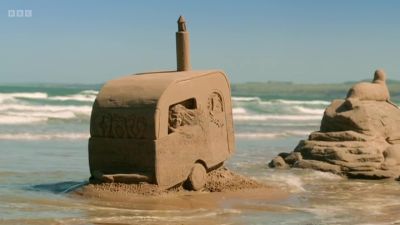 A caravan gets flooded.
Most of the other competition shows – Bake Off, Game of Wool, Sharpest Rose Pruner – embed tips and tricks for budding creatives to follow. Race Against the Tide can't really do this, because there aren't very many sand sculptors around; if one squints a little, many of the techniques can be replicated for clay sculptures and artwork in other semi-resistant media.
Race Against the Tide is a lightweight programme. The BBC press release described it as "high stakes", which is complete cobblers: this programme couldn't be more low stakes if it tried. It's good-natured fun, perhaps needs to take itself a little more seriously, but we can see further series being made. Would we watch a second run? Probably, though we wouldn't set our video for it.
In other news
Strictly Come Dancing begins this Saturday. We never completed the contestant line up, did we?
- Bethany Antonia, actor from House of the Dragon.
- Cach Mercer, Love Island type person.
- Chris Appleton, celebrity hairdresser.
- Dani Dyer, actor and celebrity daughter.
- Delta Goodrem, singer and songwriter.
- Graeme Hall, dog trainer.
- Jaime Winstone, actor from Made in Dagenham.
- John Nellis, internet memester.
- Lacey Turner, familiar from The East Enders.
- Lawrence Robb, from Emmerdale Farm.
- Melanie Walters, who acts in Gavin & Stacey and in Death Valley.
- Sarah Storey, retired athlete.
- Shaun Wright-Phillips, former footballer.
- Tabby Stoecker, skeleton bob racer.
- Will Best, quondam host of Big Brother.
About the Week With summer now at an end, we're going to stop spending all our weekends on Birmingham Beach, which frees us up to post stuff on the internet. New editions of the Week will be published on Sunday from next weekend, 27 September.
Quizzy Mondays
Modern Mastermind: "The term camelopard, derived from Greek words for camel and leopard, is an archaic name for which tall African mammal?"
Mastermind 1977, repeated on BBC4: "The camelopard was an early name for which animal?"
Taz Modi won this week's Mastermind, taking the specialist subject Neil Young. Eleven points on general knowledge shows he's a decent contender, and if he has more luck with specialist questions, could go far. Charlotte Long (specialist: Rory McIlroy) ran Taz hard, but didn't quite have the general knowledge to win. Gustav Adler, answering on British Brutalist architecture, may have been working in a second language, so hats off to him. Lauren Church answered on Sally Ride; sad to see that the pressure of the chair got to our contender, who we reckon will come back in a few years and do marvellously.
A very close-run Only Connect sees a win for the best-dressed team, as Merseyside Eyes beat Marvins by 21-20. Eyes got off to a good start, picking up a bonus on music containing games in the title, and on the superlative Lego sets. Marvins pulled back with the link "No [x] like [y]", such as "no party like an S Club party". This is why we pay our license fee, Victoria encouraging two teams of geeks to sing along to their childhood memories.
Eyes completed two sequences, and gained the match-winning bonus on the guess of "South" – turned out to be the largest islands in New Zealand. Marvins could have won it on the picture sequence, which was a Chain Letters round, moving a letter along the word; they didn't buzz in time. Perfection for both sides on the walls, and though Marvins won the Missing Vowels by 7-2, Merseyside Eyes were just far enough ahead. They'll return to brighten our screens in mid-November.
UCL won University Challenge, beating the Royal College of Art by 210-115. RCA got off to the better start, opening up a thirty-point lead in no time at all, but UCL kept buzzing and getting answers right. Max Emmett got five starters, the night's best, as UCL converted 61% of their bonuses, and 57% overall. They're very strong on History and Biology-Chemistry, and played in a week without many Geography or Maths-Physics questions.
We don't like questions asking "give a sense of a foreign word", especially when they expect a precise translation. Contrary to the ruling on screen, "hope" is a fair sense of the word translated as "hopefully"; the question editors need to either accept more loose answers or ask for a precise translation. We've no preference which, it's the uncertainty that looks unfair.
A distinct tsk at the host: even if "Salt 'n' Pepa" was incorrect on one of the music bonuses, it was a very reasonable guess – a female rapper going with intensity and style and flow. Rajan really shouldn't react with such vehement negativity. Nobody – not even Amol Rajan's mother – watches University Challenge for the host.
We do watch it for the silly: one of the Royal College of Art students introduced themself as "Hyder, from Reading, reading writing".
Saturday's main contest is the European Tram Driver Championships (tramem.eu). There's also a new run of Win Win (ITV, Sat), and Wisdom of the Crowd is the latest one-versus-the-mob format (BBC1, Sat).
Another autumn favourite is back, Bake Off (C4, Tue). Winners emerge on The Traitors Ireland (RTÉ1, Tue) and Race Against the Tide (BBC Scotland, Mon; BBC2, Tue).
For the politically-minded, The Wargame tries to figure what would happen in various black swan eventualities (The Satellite Channel, from Mon). Tempting Fortune has more pound-shop morality (C4, Tue).
To have Weaver's Week emailed to you on publication day, receive our exclusive TV roundup of the game shows in the week ahead, and chat to other ukgameshows.com readers, sign up to our Google Group.