
Wisdom of the Crowd

Synopsis
Can a single contestant give a better guesstimate than a studio full of people? £10,000 says they can.
You know how The 1% Club tries to find the best out of 100 people in the crowd? Well, the same company's Wisdom of the Crowd goes twice as far, cramming 200 people into its massive studio set.
John Bishop leads the group, the comedian plays it like it's one of his massive arena gigs. Everyone has a keypad on which they'll enter guesses and estimates to number-based questions.
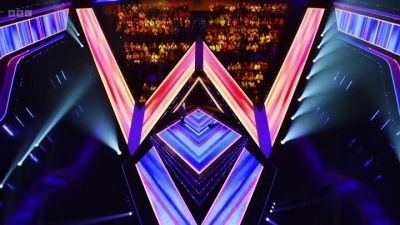 Just some of this series' crowd.
One player has been picked by the producers, and they walk on through a split in the studio's giant LED screen. After a quick chat, we're in to the meat of the game.
Our contestant – and the 200 people in the audience – hear a question. It has a number as the answer. The question has previously been asked to 1800 people by a reputable polling company. The 2000 answers from the studio and home players will be taken together, and the average found.
We see the players' answer appear on a digital display screen, then the answers of the studio players roll into place, each as disembodied head.
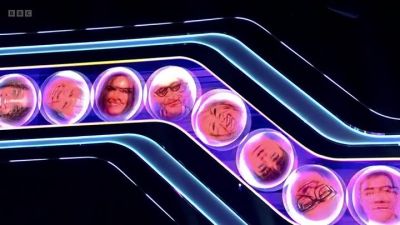 Some heads are gonna roll.
The crowd is reduced to a single number. Our contestant will also have entered their number. And, on this first question, if the contestant is more accurate than the crowd, then they will have won. Won the round, won £10,000, and won everyone's admiration.
But, almost inevitably, the crowd's answer is nearer; this first question seems to be one where the bulk of home players clumped around one answer, and statistics suggests this is likely to be the right answer. And that means the crowd wins the question, and collectively pockets £2500. That's £12.50 each – except the money doesn't get divvied up just yet, for reasons we'll come back to.
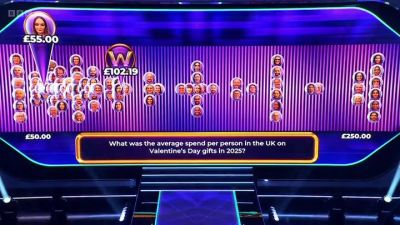 The player's and audience's answer.
Second question, just like the first. Enter answers, rolling heads, £7500 for the improbable closer answer, but almost inevitably the crowd will win that too.
Between each question there's some chat with some of the crowd: "did you really think that the average person spends £5.68 on presents a year?" or something like that. John Bishop's questions often conflates "how much does the average person spend on presents according to information provided by this advertiser" and "how much do you personally spend on presents"; his questioning can comes across as slightly hectoring.
The third question arrives. Same procedure as every time: answers, heads, a potential £5000. But now the contestant has a decision to make. They know their answer. They know the distribution of the audience answers, and they know where the crowd's mid-point is. The only thing missing is the actual answer.
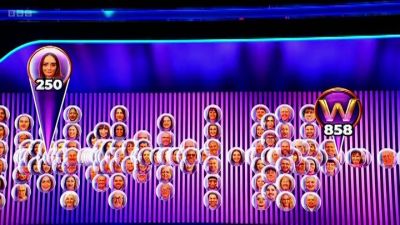 Does our player think there's 100 people to their left, and further away on the right than them?
Our contestant has a dilemma. Play on, win £5000 if they're nearer than the crowd, and leave with nothing if the crowd win once more? Or abandon the money and try to take a seat in the crowd?
To do this, they'll have to be more accurate than half of the players – 100 of the 200 in the studio. Should our player try to take a seat, we see the actual answer, and then a graphic lights up actually in the audience, they hope to rise above a certain line indicating half the audience. It looks cool, but is gone in a flash and is slightly underwhelming – do they not have individual lights for players in this studio?
Repeat three times, and then we get to the final.
Three contestants have come. Three contestants have tried their luck. Three contestants have failed to take the £10,000, and most of them have left with no money. There's a rather large amount of money in the audience pot – perhaps the full £30,000, perhaps a little less. Time to give everyone a share?
But they don't want to give you that! Not when they can have a nerve-shredding finale!!
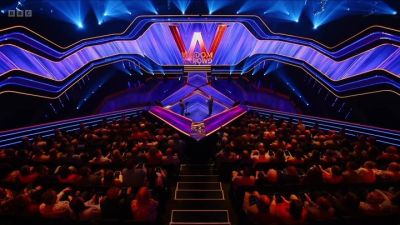 Who's coming down this stunningly huge set?
First of all, who gets to play? People from the crowd can volunteer to play, and the most successful gets to play. (Most successful in the episode, or the series, we're not sure which.) While most of the crowd will stay for the entire series, whoever plays is going to leave the show tonight, and they can only hope it's with a large wodge of money.
Our new hero comes down, and faces five true-or-false questions about everyday life. The panel in the studio also play the same questions. Whoever gives the correct answer gets a point – and it's very possible for both the player and the crowd to get a question right at the same time.
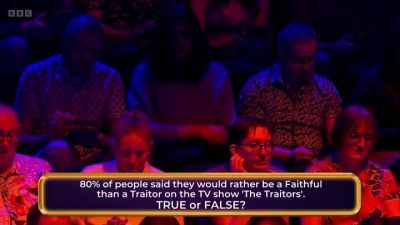 The crowd consider a nerve-shredding final question.
Five such true-or-false questions are asked, and whoever's ahead wins the cash. The solo player takes the money, a win for the crowd means that the money rolls over onto the next show. If they need a tie-break, it's back to the main game, a question requiring a number as the answer. Whoever's closer wins the dosh.
And, if they win the last episode of the series, it's the remaining crowd in the studio who take the accumulated money. Wisdom of the Crowd will give away exactly £30,000 per episode, no more, no less.
There's a great game to be had in beating the crowd. It's the sort of thing great novels are made of, the hero proving that they are a true everyman, know the people even better than the people themselves. But this is not a great game, or a great show.
One small presentation detail they've missed: when it comes to reveal the answer, the pointer goes up, and then it stops, and that's the result. They could make the pointer dance around, go forward and back, add to the tension. But they don't.
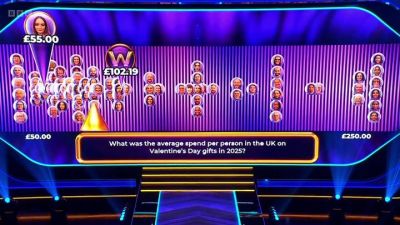 The little gold arrow only ever moves to the right.
And the questions are taken from sponsored market research (do we trust advertisers? on the BBC?). And John Bishop is great at shouting to a crowd but less experienced at the subtleties of a television studio. And every round is exactly the same. Especially the bit with the rolling heads, which they do after Every. Single. Question.
It's a shame: Wisdom of the Crowd has merit on paper, and with a few tweaks could turn into a hit as compelling as Magnum Media's established The 1% Club. But this is not a great show, and we're disappointed.
Catchphrases
"Let the heads roll."
Inventor
Dean Nabarro and Andy Auerbach
Theme music
Twin Petes
Trivia
Aired on Saturday evenings after Strictly Come Dancing, a slot occupied a few years earlier by The Wall.
John Bishop's first time as permanent host of a game show - the comedian and actor had been a regular on our screens for about fifteen years, but never assumed the host's chair before now.
The opening titles for Wisdom of the Crowd cited the work of Francis Galton, an early 20th century statistician, who observed a "guess the weight of the ox" contest at a country fayre. Galton found that the median guess was more accurate than almost any individual suggestion. The show consistently claimed "the science says the audience should win", which somewhat misrepresents Galton's work: after all, correlation does not imply causation.
The format first went out in Germany as Die Weisheit Der Vielen. It wasn't renewed.
A mole reports: At the pilot episode, there were five questions per contestant, as opposed to three. If the contestant failed to beat the Crowd on the first question, they could only progress if they had beaten the 20 worst Crowd members; later questions required the player to beat increasing numbers of players. The end game was also planned to be a one-shot guess, along the lines of "guess the weight of the ox".