
Weaver's Week 2026-11-29
Last week | Weaver's Week Index | Next week
Someone has remembered Long Tong Pickup from Lightning, and designed a game around placing balls with numbers on them. Except they've replaced the tongs with a vacuum cleaner.
Three very clever young people have taken time away from their smart activities and join this programme. The youngsters are great at coding, mega at maths, and so intelligent they could reprogramme the Pointless hostbot in even less time than it takes us to correctly spell dispropsium.
And these young clevershoes have agreed to share their knowledge with someone who really, really needs it. The cream of comedy, nine Dave channel regulars like Maisie Adam, Ivo Graham, Guz Khan, and Tim Vine. Host for the series is Jack Dee, and in an effort to attract casual viewers, it appeared in programme guides as Jack Dee's Help Me Tiny Big Brain.
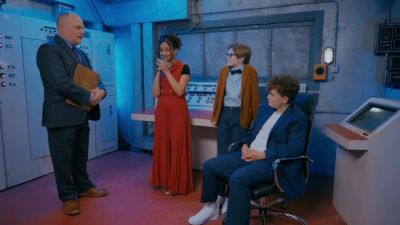 Jack Dee (left), with intellectual giants Alayna, Arlow, and Finlay (seated).
Each episode consists of three challenges, played in the same order. First is a test where the comedian wears a camera strapped to their forehead; the two can talk to each other, but their young partner is in another room and can only see what the camera sees. Here, the objective is to manipulate some physical objects to achieve some sort of result.
What sort of things are they being asked to do? High school science, basically. It's the sort of thing a reasonably astute thirteen-year-old would pick up, and the sort of information a forty-year-old comedian would probably have not used since they were in short trousers.
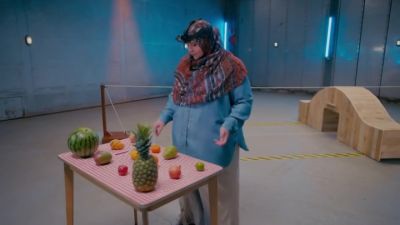 Deliver the right fruit under the low bridge.
For instance, one challenge asked the teams to reproduce various colours on a pH chart. There were various coloured fruit around, a blender, some water and other liquids, and some cabbage. The key to the challenge was the cabbage: it turns out that red cabbage juices, when heated, will turn red in the presence of acids, and green when around strong alkalis. Gosh, the things you learn when you're twelve and then completely forget as you grow old.
Indeed, the teams all forgot (or did not know) that red cabbage juices have this remarkable property. Some of them found it out through trial and error, blending various combinations of fruit and liquid to produce approximately right colours. Jack's explanation makes it sound simple, and it is a simple principle. But you've got to know it, or be hinted towards it, or discover it through luck.
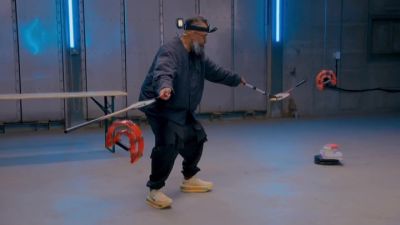 Ding, and in all probability dong.
Another opening challenge wanted two tambourines to ring at the same time. They were suspended in mid-air on taut wires, too far apart for anyone to reach and tap both. The wires were floor-and-ceiling connections, so the instruments couldn't be swung like a pendulum. The teams used various strategies: construct an extension to the arm using some long poles, or rattle one tambourine while throwing books at the wires.
The producers had come up with the idea of a domino rally using the books: put them in order from smallest to biggest, and the books will topple over and the last one can hit the tambourine. While the books are toppling, the comedian can run to the other tambourine and start playing it. That was the producers' idea, nobody tried it, nobody even thought of it, and frankly it seems more complex than the naïve techniques used by the teams.
Challenge two is broadly similar, as the team are again split up: the comedian is in the big room with the props, the youngster in a smaller control room. This time, the youngster's view is from a fixed camera, looking down on the playing area.
The tasks here benefit from a bird's eye view, being mostly about spatial awareness. Where are various cities of the world, and can the young player guide their older counterpart to the right place? Is it possible to connect plugs to sockets without crossing the wires?
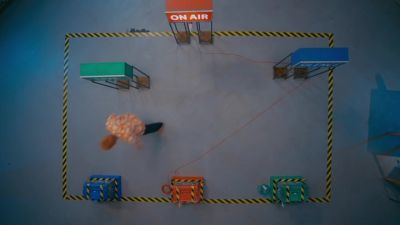 Blue (bottom left) to blue (middle right), red to red, green to green, without crossing.
All of the challenges are available to play along at home: we're not shown the answers beforehand, though host Jack Dee will demonstrate afterwards if needed. That allows us to see what each team does, pick the best answer we see, perhaps improve on it, and in that way feel smug because we've got the answer and that smartie-pants comedian is wrong.
It is a competition, they do keep score. Three points for the best performer on each challenge, one for the next best, and nothing for the worst player. Whoever's bottom of the scoreboard after this second challenge is in third place today, and will not play the physical challenge.
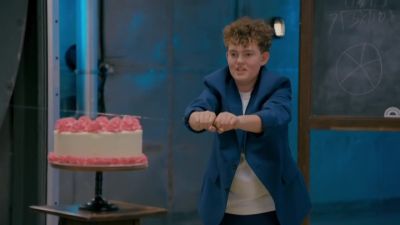 Finlay uses a cheesewire and a passing Ivo Graham to cut a cake.
That final challenge sees comedian and child on opposite sides of a divide, with a task to achieve in the middle. They could, for instance, be asked to put balls representing planets into a scale model of the solar system. Or to cut a cake so as to have exactly one-seventh. Difficult enough when you're able to move freely, fiendishly impossible when you've also got to manipulate across a divide.
Each challenge is a little mini-programme of its own, with a setup, and a denouement, and the main plot in the middle where we quickly intercut between all three teams' efforts. The style of cutting between people as they tackle a complex task is familiar, not least from Channel 4's recent Secret Genius. And, with just three teams to cut between, we're never at risk of getting too badly confused about who's where in the puzzle.
Game show fans might recognise the style of a thinker and a doer; it was the hallmark of legendary French game show designer Jacques Antoine, who came up with the formats we know as Treasure Hunt and The Crystal Maze. Indeed, many of these challenges could have been done on The Crystal Maze, if only they'd allowed themselves the luxury of six-minute games.
But you can't have The Crystal Maze without the cacophony from the other side of the door: "Bang one tambourine so hard it falls off!" "Pour boiling water from the kettle onto the base so the wire breaks!" "Stretch your arms like a piece of elastic!" "Put the teacup in the teapot!!" Having one comedian and one child talking to each other was quite enough, hell would be found in a chorus of five advisors whose loudness was inversely proportional to their usefulness.
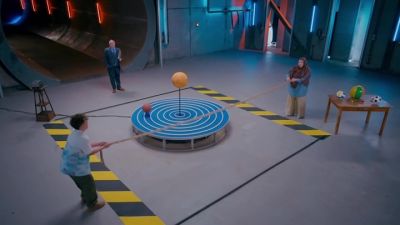 This planets game is similar to one played by Richard O'Brien.
Another forebear of this type of puzzle: The Adventure Game. Residents of Arg would set up fiendish little challenges, it amused them greatly. Many of the puzzles needed outside knowledge to be solved, often high school science nuggets like how an iron core works, or how red cabbage is a pH indicator. The Argonds would talk through the solution for the viewers before showing it to their guests, so we knew where the likes of Derek Griffiths and Nerys Hughes were going wrong. And the Argonds popped in to give some clues, both subtle and obvious.
Each episode is about 30 minutes of television, stretched into a 40 minute billing on the Dave channel. It's short enough to be a side dish of an evening's viewing, long enough to be a small meal in itself. The host is Jack Dee, whose deadpan delivery and general glumness has never endeared him to this column. He does get one thing absolutely right: he will always make wisecracks against the comedian, and won't attempt to snark at the child. Jack, at least, is not a bully.
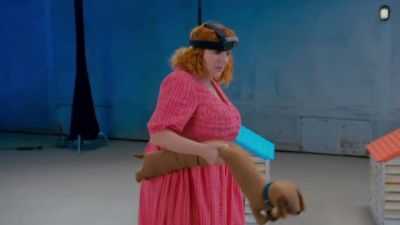 Sophie Willan (left) and a stuffed dog.
We're sure that the production company had excellent support for the children, and it looks like they made sure the youngsters weren't over-worked. Children are only allowed to be on set for a few hours each day, and comedians are expensive, so each episode had to be filmed on one day. And that, more than anything, means they probably won't make hour-long episodes of this show.
How could they improve in a putative second series? Well, we learned a lot about the children (summary: the kids are all right), and little we didn't already suspect about the chosen comedians. The show was entertaining and fun to watch, but we don't expect to get anything out of a second watch of these episodes. For a second run, we'd like to see a broader celebrity pool, contestants who aren't comedians: drama actors, or grandad-rock singers.
Is Help Me, Tiny Big Brain worth watching? (watch on the UKTV player) We give it a soft recommendation, mostly for people who think they'd be able to play along with some of the challenges. Likely to get an ad-free repeat on BBC linear telly? Plausible, it would be a fair pair with QI.
In other news
Gopher it Last week, we heard that Gordon Ramsay is to appear in a new series of Hell's Kitchen. This week, we hear that the shouty cook is to host a revived Top Gear, not that he'll be a quarter as good as Angela Rippon was. Just so long as nobody tries to commission another series of Bank Balance, we should be OK.
Quizzy Mondays
A lovely week on House of Games; great bonhomie between Chesney Hawkes, Rebecca Keatley, Catherine Bohart, and Jason Mohammad. The last pair tended to be best on the buzzers, with Catherine quite the whizz at Answer Smash, but both Rebecca and Chesney gave correct answers. There was common ground between Jason and the host, both being from the Port Talbot area. We'll have more weeks like this, purlease.
Kai Laddiman achieved a Perfect Round on his Mastermind specialist subject, the mathematician Carl Friedrich Gauss. Some room for improvement on general knowledge, where the contender seemed to pay the price for answer before thought. The others on the show were Kim Rayner (who took Marilyn Monroe), Stephen Cottrell (tv series The Sopranos), and Marie Allitt (Katherine Mansfield, the short story pioneer, whose life sounds very interesting).
Lions, lions everywhere on Only Connect! Meat and Two Veg handled the big cats best of all, beating the Six Sevens by a distance. Other highlights: red hands, going from U to XXXX, French terms of endearment, and the spectacular good luck of guessing a cricket question correctly. Six Sevens got types of mushrooms, and the caption of the night: on a question about the Romantic poet, "Isn't it Byronic?"
"I've nothing to add, so say Kant". Can we discuss that philosopher before the watershed? Bristol tried to, en route to their crunching University Challenge derby win over Bath, 230-120. The writings of Mark Twain on German, maps of cities sharing a letter, and the Eastern Roman emperor Maurice, all of these subjects were grist to the Bristol quiz machine. Bath had got the first starter right, and didn't pick up another until just before the second picture round; their highlight came on some guesses about poems and songs beginning "Oh!". Bath got 61% on their bonuses, but were so often beaten to the buzzer.
Bristol, then. 55% overall, 54% on their bonuses, just the one penalty for incorrect interruptions. They're strong on Geography, and History, and Leisure, and Language; they've not got so many right on Maths and Physics, but do quite well on Biology and Chemistry science questions. We'll meet them again in the new year.
Two to note for next week. A new run of An Deis on TG4 (Tue), and Celebrity Race Across the World finally finishes (BBC1, Wed). We'll be back a little early next weekend with a news roundup.
To have Weaver's Week emailed to you on publication day, receive our exclusive TV roundup of the game shows in the week ahead, and chat to other ukgameshows.com readers, sign up to our Google Group.
Last week | Weaver's Week Index | Next week