
Weaver's Week 2026-04-19
Last week | Weaver's Week Index | Next week
A blonde woman, quite mature, is gently jogging through a meadow under sunny skies. Suddenly, she breaks into a run, trying to avoid a younger man. She tries to hide under a bush, but her pursuer knows there's someone here, and looks carefully in the bushes. "Captured" appears on the screen.
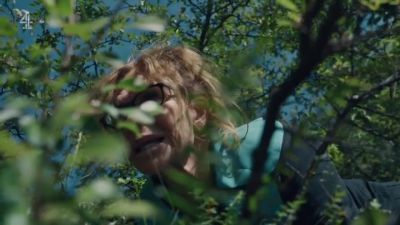 Hoping not to be seen...
Time rewinds, a blur of images and people, including the two faces we've just seen.
See, that's how we'd have begun the series. The producers at CPL chose to tell a strictly linear story, one where time never moved backwards. It was the worst mistake in a series that ended up being compromised by unforced production errors.
Rather than begin with that sniff of action, they start with players arriving. Ten ordinary people, of all ages and genders, have signed up for the show. One by one, they arrive at a modernist house in the middle of nowhere; from the exterior, it's all angles and sharply-sloped eaves. Introductions and compliments and greetings and hugs. And it takes forever.
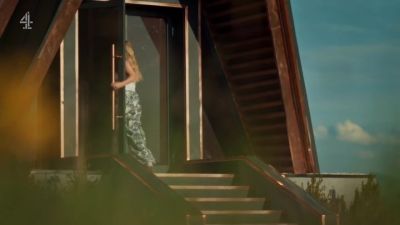 Another contestant enters.
Ten minutes into the show, and it's all still the nervous excitement of meeting people, finding out about them, sharing a drink of something. People relax on the large sofas in a modernist living area, complete with a fake wood fire, subdued lighting, and plants everywhere. Only then do we get the basic ideas explained to us. We're going on a People Hunt.
Half of the contestants will become Prey; their task is to find challenges in the forest, complete them, and bank cash. The other half will become Predators; the task here is to make physical contact with a Prey. When this happens, the players swap roles, and the cash is handed to the new Prey (the old Predator). Whoever is a Predator at the end of the hunt could be voted out by the Prey, in something known as the "Culling".
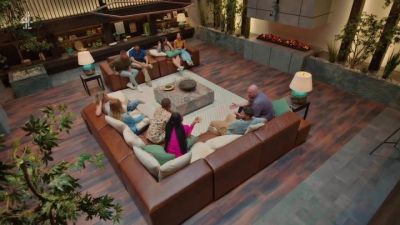 The comfortable and modern sitting area. Feels cold to us.
Who are our initial Predators? That's for the group to decide: first the inaugral Pred, then they name someone else, and the new Pred names the third of the group, and so on until five emerge.
Now do we get to hunt? No; the Predators and Prey go off into separate rooms where they can plot and scheme amongst each other. The Prey can work out where the challenges are, the Predators can propose a pact?
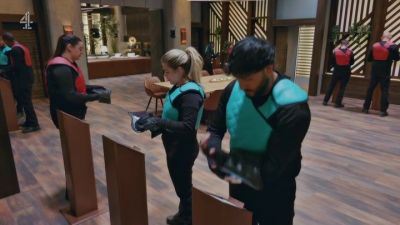 The players get into their game garb.
Now do we get to hunt? No; the costume has to be right. Prey wear a blue gilet, with a velcro fastening over the left shoulder. Predators wear a red gilet, with a velcro fastening over the right shoulder. The gilet is a sleeveless jacket, sewn by seamstress Emilia Smith, which contains a small location transmitter, and the blue side has a clear target on the back that will doubtless give a signal when hit. And the players wear gauntlets, little microcomputers on one wrist that can show a map, their status, or other information. The look is there, the tech is cutting edge.
Now do we get to hunt? No; we need to get into large vehicles and be driven to the hunt arena. Everyone stands on a plinth – a small wood circle – in a clearing known as the Glade.
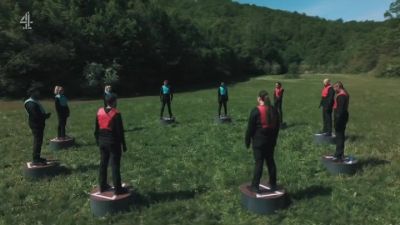
Tributes! Predators and Prey!
Now do we get to hunt? After 19 minutes and 15 seconds of television, and one advert break, the hunt finally gets under way, and the Prey leave their plinths in the woodland clearing. Within seconds, the Prey pair have split up, and lost each other. It's another 62 seconds of screen time before the Predators are allowed to start the hunt proper.
*Now* we get to hunt!
Almost 25 minutes of real time before we get going. That's a long time; long enough to watch a whole episode of Alien Fun Capsule, and Harry Hill's show is more entertaining. Chalk this down as another unforced error by the producers.
Two minutes later, Shelley is captured by Roy, the scene we described in the introduction. They swap roles, reverse their gilets, and Roy is allowed to run off. Soon enough, he finds a challenge – roll three sixes on a normal dice; any other number and he's to cut a wire in a fusebox and hope he doesn't cut one to trigger a siren. There's barely enough time to appreciate the coherent look to the challenges, Kate Purdy and her team put shards of blue ice in the middle of the green forest. As the series progresses, we see quite a few of these challenges, many of which could fit into The Crystal Maze or Fort Boyard – including the two-player games we never see on telly.
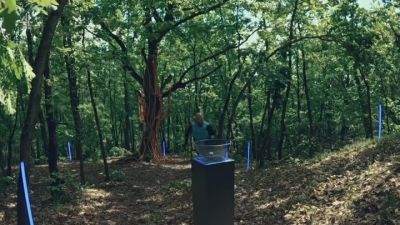 Blue poles stand out in the forest, without looking completely out of place.
Roy's set off a siren, alerting the Predators. This gives us a chance to look at the map, showing the location of the challenge and of the pursuing players. But it's hard to interpret this map at a glance: it's a single colour, showing contour lines and nothing more. We don't get to see where the vehicle paths are, or the streams, and in the few seconds it's on screen, it's not particularly easy to take in where the hills are. Given that they're going to refer to this map throughout the series, it needs to be very clear – going down a forest slope can be slower than jogging along a flat track. And there's no clue as to scale: Nathan appears closer, but how close is he? The map is another unforced error by the producers.
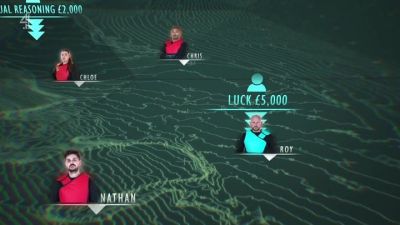 The worst map we've seen since The Summit.
If we're to believe the screen, Roy won the challenge with three seconds to spare. Later in the series, we'll find that almost every challenge that's won is won with about three seconds to spare. This tells us one of two things: either the games were tested and timed incredibly well and the producers got very lucky that so many were won; or the timing caption is not strictly true. Because it happens so often, the most likely answer is the latter, and we end up doubting the integrity of these details. And that's another unforced error by the producers.
Most of the action is shot by camera people who go around with the contestants. It means there are lots of pieces to camera recorded from in the forest, and relatively few added in from back at base. This is a sound editorial decision; the dominant style in this market is to present real footage, with an omniscient narrator to give any factual context. The Hunt has two narrators; in-game announcements by Joanna Eliot, and viewer narration by Mark Bazeley. Other cultures adopt different styles, the North American norm is for contestants to describe their own activities in the past tense. We're glad the producers got this right.
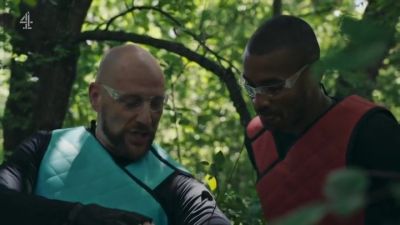 Two contestants swap information from the gauntlets. We viewers never got to see the actual display, only simplified mocks; another unforced error from the producers.
We're properly impressed with the tech on this show. The gauntlets carry a positioning map, showing a player's own position and the locations of the day's challenges. They can also carry messages from the producers, such as when some new players enter the game (new players are going to enter in the middle of a hunt, because of course). All of this is powered by a small Bluetooth transmitter from the camera person to the player, and the camera person gets an audio message from the producers to activate a particular message.
The producers also constructed a very good computer network in the forest, so that footage could come back from the cameras and be replayed by the adjudicator, Julie Hewitt. They took the time to make the correct decision, even the very close calls. That little forest, outside Gabrovo in Bulgaria, must be the best-connected hundred-acre wood in the world.
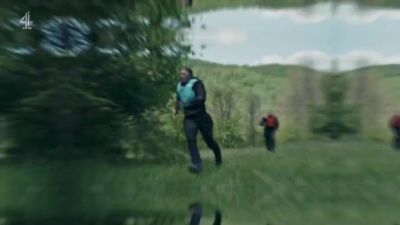 Two small figures run across the meadow.
But because the action is shot by camera people, and they can't really get in the path of contestants, it means that most captures take place just off the edge of the screen. We see Mel racing across a clearing, Chris in hot pursuit, the pair round a bush, Chris piles into the undergrowth, then it cuts to the "Captured" sting. We didn't see the touch, we have to take their word for it. Chalk that up as another unforced error by the producers.
The hunt is a timed event, one hour from start to finish. With ten minutes on the clock, the Glade re-opens. Prey are safe once they're standing on one of the plinths. Across the series, this is the most dangerous part of the game for Prey. Later in the series, the Predators become outnumbered but get a "perk" – to freeze a Prey of their choice for one minute. This would be a great time to use it.
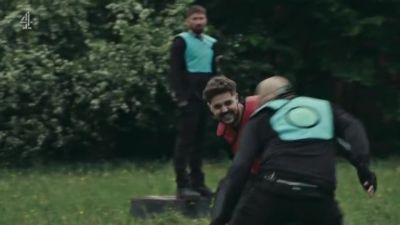 Nathan tries to lay a hand on Roy; Marc is on a plinth and safe.
Who leaves? They decide
Then it's back to the base camp, for a cool down, de-brief, and the social game. Ah, the social game. The Hunt is not wholly about what happens in the forest, it's also about what happens back at base. This wasn't emphasised to viewers in the pre-show publicity, in the trails and press articles and web marketing, and that marks another unforced error by the producers.
Do not watch this show expecting multiple levels of deceit like on The Traitors, or even surprises like on Survivor. There was no attempt to deceive, or to be subtle. While there was a lot of talk about being able to sway votes, and perhaps one or two ejections might have been altered by lobbying, it was generally clear to everyone who the lead candidates were, and only once were we even slightly surprised about who left.
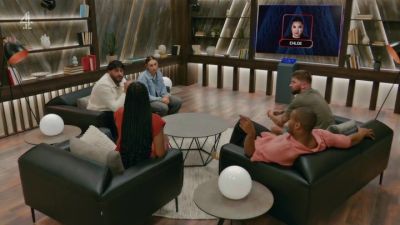 Do you want to vote out Chloe, or someone who actually looks like a threat?
A very simple metric applied: if there's a Predator who's a threat to most Prey, boot them while the chance arrives. If there isn't, boot the Predator who will most hurt your greatest rival. And, with three blokes sent packing in the first three episodes, the series ended up as the last blokes against the strong women plural, and then the one strong woman and her allies, and then chipping away until just the strong woman remained, and then she was gone.
The Prey voted individually and in secret, though with no more than five votes, it was generally quite easy to work out who had voted for the eliminated candidates. It was all far too over-wrought, turning a simple decision into twenty minutes of not-particularly-exciting television. Error, producers, unforced.
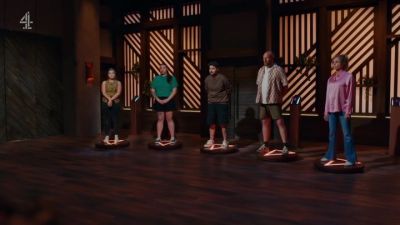 Stand on a log until your name is called.
The "Culling" ceremony was done in a second room, just off the main living area; Predators stood on individual podia, and when they were declared safe would walk through a door back into the group. One would not be called safe, and would be gone from the game. (The announcements used the phrase, "gone for good", even when this was a strategic error from the group. "Gone for good" embodies a very subtle value judgement, and needs to be used with greater care; chalk this up as a teeny-tiny unforced error by the producers.)
Hunt by day, cull by night
And so the show continues, day after day. The cast is briefly replenished, but dwindles as the show goes on. By episode six, we were down to one Predator, and the programme needed a "rebalance". This was an opportunity to give the cast a welcome rest day, where they didn't have to exert themselves physically. And it was an excuse to do a banquet like on The Traitors, where everyone explains what they'd do with the money if they win, and gently talks about their own personal circumstances. It's the "sob story" episode, if you wish, and is very much an outlier from the rest of the series.
 They made a big thing about breakfast on this show: another Traitors comparison?
Marc, one of the Prey, had basically sat back and done nothing on the show up to here. He had gone to ground, been first back when each hunt neared its conclusion, and hadn't really attempted to complete challenges. While Marc knew he'd coasted so far, and viewers knew he had been a passenger, we wonder if the other contestants knew this fact. He was turned into a Predator, so if he wanted to stay in the game he would have to actually do something, and that would become a personal best.
Also at this banquet, the top-rated Prey chose one of the others to turn into a Predator. In the fullness of time, this would prove to be the pivotal moment in the series, and it was spotted by the cameras and got a clear reaction at the time. (Yes, we've found the one thing The Hunt did better than The Traitors. But it is only the one thing.)
Both of these new Predators had some money on their back. This dosh was given to other continuing Prey, which is a choice by the producers. They could have said that the Predators retain their money; if they catch a Prey, they take that Prey's money in the normal way and add their stashes together. But if the Predator is eliminated through the cull, they take the money with them and it doesn't go to the winner. The producers chose not to follow that rule, and we see their logic.
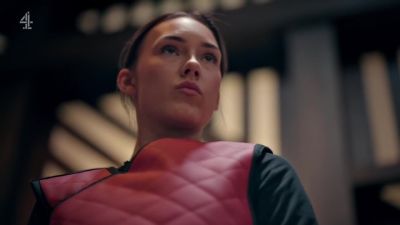 Mia does her best Katniss Everdeen impression.
The Hunt had a style and an atmosphere. The obvious antecedent is The Hunger Games, the hunt uniforms bear a passing resemblance to Katniss and Peeta's outfits in the film, the event starts with everyone standing on plinths in a circle, and information appears to be transmitted by loudspeaker. Visual inspiration included Dune, most notably the slightly out-of-phase colour shift for flashbacks. No, your telly is not wonky, the programme really is intended to look like that. Any slight headaches you might experience are yet another unforced error from the producers.
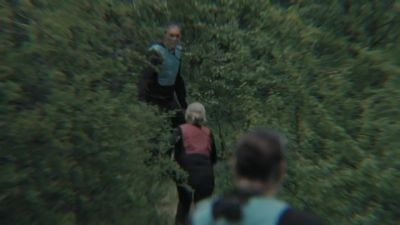 Do not adjust your specs!
The Hunt also had some unseen rules, given out to the contestants but not mentioned to the viewers.
- After capture, the new Predator must give the new Prey time to escape.
- Any Prey captured during the final chase to the glade cannot re-capture, and the capturing Predator is safe.
- There's a safe zone around most challenges, but it was never clear how that was communicated to Preds, or what the penalty was for breaking the zone.
- We saw a Predator camping out at a challenge; this was legal but seen as unsporting. The producers may have intervened to stop this.
- We also saw a Predator give warning to a Prey that a second Predator was coming; this was legal but seen as unsporting. The producers may have intervened to stop this, too.
- The one-hour timer for the main hunt appeared to be elastic; doubtless there were All Stop calls whenever the adjudicator had to make a ruling. We strongly suspect that the hunt ended at the convenience of the producers, rather than on the clock. We never saw what the consequence was for a Prey who wasn't safe at the end of the hour.
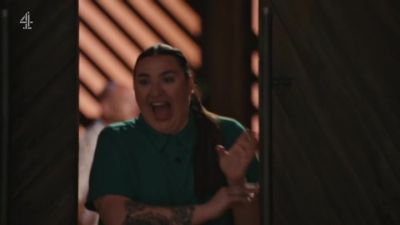 Of course they wouldn't vote Chloe out. Not today.
All of this added up to a programme with an awful lot of artifice. Sure, we expect a game show to be a bit artificial, because you wouldn't normally have grown people playing tag in the middle of a wood in Bulgaria. And The Hunt was very artificial, because we've never experienced a game of tag that suddenly incorporates a buzzwire challenge. Hang on, strike that, yes we have: Journey to the End of the Night, a tag game run by amateurs that's great fun to play but would be fiendishly difficult to turn into a telly series. We digress.
The Hunt was artificial, and we have no problem with that. But The Hunt pretended to be less artificial than it really was, and we found it slightly misleading at times. Most obviously, there were obvious "frankenbites", contestants talking in what sounds like a fluent way, but if you listen carefully their speech has been edited together from many little bits of other conversations. It's a naughty tactic, it's using the player's voice to express thoughts they certainly did not say, and may not agree with. "Frankenbites" were particularly clear in the sequences where the Prey decided who to vote out; episodes 4 and 5 were particularly egregious. This is an unforced error from the producers, and we think it's the worst unforced error of them all.
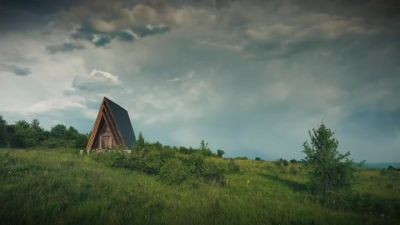 The triangular house stood alone in the wilderness.
Viewers were not impressed by The Hunt. Less than 200,000 saw the third episode live, though it was up against a particularly interesting football match on BBC2. The prog moved to 10pm from episode 5, which may have allowed ratings to pick up a little, it being less depressing and less peabrained than the news. But Channel 4 had clearly given up – all of the episodes were now up on the website, and advert breaks were mostly promos for other Channel 4 programmes and maybe one paid spot. The last few episodes included a call for viewers, "to apply for a potential next series of The Hunt", and that gave us the biggest laugh of the whole series. Indeed, the only laugh of the whole series – The Hunt took itself far too seriously, there was precious little light to the shade.
The finale was a question of trust. Four took part in the last hunt, and the one remaining Predator was ejected as soon as the hunt ended. Three remained, and one of them was culled before the format continued. Again, this is a choice by the producers, and we think it's another unforced error. A three-way Prisoner's Dilemma would break new ground and be interesting, so of course The Hunt wasn't going to do that.
The final two – Marc and Ameer, the last two men from the original intake – were given a three-cornered Prisoner's Dilemma. Marc knew which option would split the prize equally, which would give Marc the cash, and which gives Ameer the lot. He could talk with Ameer, and suggest which one to pick. But the final choice would be made by Ameer. It ended with Marc winning the entire £97,000 pot, a victory that will change his life, but is a very feel-bad decision. Compare and contrast against the precedent set by The Traitors and The Summit earlier this year. We cannot fault the producers for choices made by the players.
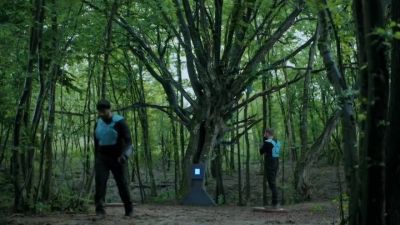 The defeated player leaves, not allowed to offer congratulations or otherwise be human. That'll be one final unforced error from the producers.
The Hunt has had a lot of criticism, most of it was warranted. It's a swing and a miss; there's a great technical achievement to make the show, and the basic idea has some potential. But there were lots of faults, which added up to almost totally undermine the programme. Most of the faults are fixable.
We were going to say that CPL will never get to make a better edition, but we've heard this week how The Hunt has been commissioned for the German market. Maybe they will get to make a second run for Channel 4. Maybe we're going to see how this show will be better.
Quizzy Mondays
Mastermind first. Robert Cohen scored 15 in total, he'd had a bad round when answering about the red wines of Burgundy; surely that would be great for the final and its field trip film. Ben Abbott also scored 15, the songs of Noël Coward are fine entertainment but proved poor hunting for points.
Carolyn Rowe was cautious and correct during her round on the aviation pioneer Amelia Earhart; her general knowledge set is equally cautious, and almost as correct. Her total is 24 points, already the third-highest of the semi-finals.
Miles Searle has the advantage of youth; he was brisk and correct in his round on Laurence Olivier – though only managed one extra question, and got that wrong. He's brisk in his general knowledge round, but the younger contestant has a few gaps in his general knowledge.
A few gaps, but not too many. Miles Searle, a student, raises his score to 26 points, and takes the final spot in next week's final.
Over on University Challenge, Manchester raced away to the final, trouncing Imperial by 250-70. Just to set this in a bit of context: 250 is the third highest score of the entire series, behind only Southampton in the first round and Sheffield in the second. Manchester were right on 56% of the questions they faced, a rate we've not seen since before Christmas. Bonus rate was a solid 57%. The side worked out some of the answers, offered plausible guesses that were sometimes right, and never looked like being headed.
The match was won on the buzzers; Manchester were first to buzz on all but one of the first eight starters, and got all but one of those buzzes correct. Imperial won the buzzer race just once, and came away with nothing more than a penalty for their efforts.
Ray Power of Manchester got the night's best buzz, asked for a given name and with just the clue "Barbara Loden", she named "Wanda" almost before the host saw the end of the question. Kai Madgwick (a non-binary player, uses "they"-series pronouns) continued their one-contestant assault on the All-Time Buzzer title, picking up ten starters here. Our scoring system credits Kai with 143 points, the highest personal haul of the season and their third individual century score.
Imperial were just behind on almost every buzz, and had to see the others answer questions to which they knew the answer. The London side had a remarkable 75% bonus rate, one of the highest ever: but it's from just 12 questions, one of the lowest ever.
So it's Edinburgh versus Manchester in the final; the grinders versus the buzzers. If Edinburgh get to answer bonuses, they'll score well, but will Edinburgh get to answer bonuses? Manchester somewhat rely on one player, and we saw in 2009 what happens when a superlative buzzer talent is locked out for the first half of the final. Our category analysis reckons that Manchester has the advantage on History, but Edinburgh is better on Language, Literature, and Social Sciences. And Edinburgh has the head-to-head win, having beaten Manchester 195-80 at the start of the group phase. Does that give Edinburgh a psychological lead. Does it give Manchester a revenge mission? Does it give viewers an excuse to ask for Best Of Three?
Winners to both contests will be found next week, and we'll report on both in our next edition.
Other news
Back to The Hunt, and we mentioned Journey to the End of the Night, which took place in London last evening as we publish. Hope everyone had a grand time.
We also heard about Strandfall, an experimental "outdoor larp" planned for Edinburgh later this year. It relies on a personal portable computer, perhaps quite similar to the gauntlets used on The Hunt. Someone will have to go and investigate.
Operación Triunfo is to come to the North American market. The format is also known as Star Academy, and is responsible for developing many worldwide stars including Nolwenn Leroy, David Sneddon, Kalomira, Maxime Landry, Polina Gagarina, and (er) James Fox.
The rights holders, Telemundo, claim that the show is coming to North America "for the first time". This is not actually correct; a version of Operación Triunfo began in 2006, and ended after just two weeks because almost nobody was watching. These days, of course, a viewing "figure" of 0.4% would be a massive hit, and we hope Telemundo can succeed where ABC's Mickey Mouse operation failed two decades ago.
A streaming version of Gladiators was meant to launch on Friday. All of the paper listings magazines published breathless articles, repeating the press release saying it was going to launch on Friday. And did it actually appear on Friday? No. It did not. Amazon Prime's version is not only unavailable, but it does not feature Legend, so we doubt anyone's missing anything much.
Finals week across our game shows. Mastermind and University Challenge find their champions (BBC2, Mon), then it's Great Local Menu (BBC2, from Mon). Ireland's Home of the Year is named (RTÉ1, Tue).
There are new series, too. Interior Design Masters and Masterchef Goes Large both kick off their spring runs (BBC1, Tue). And as I'm a Celebrity South Africa reaches its conclusion, ITV launches The Neighbourhood with great fanfare (Fri).
To have Weaver's Week emailed to you on publication day, receive our exclusive TV roundup of the game shows in the week ahead, and chat to other ukgameshows.com readers, sign up to our Google Group.