
Weaver's Week 2026-06-14
Last week | Weaver's Week Index | Next week
"I'm going to up-play the way that I done"
Nobody's Fool
The setting is familiar: we gather at a big mansion house in the country, well-appointed rooms with lots of comfortable furniture and fittings. There's a suit of armour in the corner, a fox motif everywhere. The show has an ambience of refinement, culture, and class.
Hosts for the show are Emily Atack and Danny Dyer. Emily Atack is a name we've not featured in this column before, she's an actress from The Inbetweeners, did rather well at Dancing on Ice, and hosted an eponymous comedy show on ITV2. Danny Dyer is a gruff Cockney, we know him from The Wall and The East Enders.
 Emily Atack (left) and Danny Dyer.
There's a charming division of labour, Emily Atack is The Brains, asking questions in the quiz segments and keeping tabs of the money. Danny is The Viewer, recapping what's happened and explaining the rules to the show – he would be the muscle of the hosting duo, but is never asked to break a sweat. They work well together, better than either would be on their own.
Ten contestants join Danny and Emily in their mansion; unlike some other reality shows on ITV, everyone arrives in the opening minutes and there are no entrants part-way through. Ten contestants is a good number for this series, it allows us to get to know something of the contestants in every episode, without showing any individual so much that we know they're going to be first out.
 Line yourselves up, most foolish on the left.
Nobody's Fool is a game on many levels. The basic challenge is to earn money in quizzes, and these quizzes are taken in the "Quiz Pod". It's isolated from the rest of the house behind soundproof double doors, it looks very different with futuristic neon lighting strips, and it has stark furnishings: a chair, perhaps a table, maybe a prop or two.
In the Quiz Pod, contestants will be asked quiz questions. They'll earn money for the pot with each right answer. Many of the quiz rounds were themed: after simple general knowledge questions on the opening day, we got questions starting with each letter of the alphabet, a challenge to work out what links pictures, some pop culture, and maths questions.
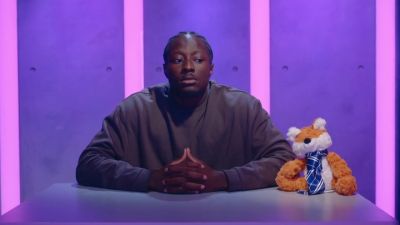 Kamaal prepares to take today's quiz.
The first time we see someone go into the Quiz Pod, we see their whole session, straightforwardly through, tackling the questions from new. Everyone else follows in a series of intercut vignettes, hopping from one contestant to another. There are synchronised correct answers, there are split-screen sighs of recognition.
Editing tells us two stories. First we see how difficult the questions are so we can play along at home, and then we see how each contestant did. They could spend half the show asking the same questions over and over and over, but that would quickly become dull, and we might switch over. Those of us who watched Secret Genius earlier in the year, we recognise the style, we appreciate the style.
 Press red for a choice of quiz players.
"What happens in quiz pod stays in quiz pod" is the first cardinal rule. Contestants are told how many questions they got right, and how much they've put into the prize fund. But that is all the information they're allowed to directly reveal about the quiz. In part, this is to keep the programme honest, it would be possible for someone to collude and trade answers in the hope of favour later. And in part, it's to not make it too easy to catch someone out in a lie.
But wait, there's more! No programme would be complete without Challenges, and Nobody's Fool has a different challenge every day. Can you remember what items appeared on a conveyor belt as it passed beneath you? Can you strike out on your own, or will you follow the crowd? Later events included a tennis-themed anagrams game, some clay-pigeon shooting, and a game of pass the parcel.
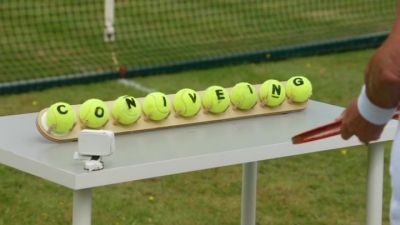 That's not the orthodox spelling of "conniving".
At the end of each challenge, a winner would emerge, and they would get a reward. It could be a subtle reward, such as the casting vote in the event of a tie. It could be a clear reward, such as extra money to put in the pot. Or it could be an advantage in the quiz, seeing the answers (but not the questions) before they came up.
Elsewhere in the show, there are other challenges, which aren't for money or for advantages, but can impress the other players. Open the box of cutlery by knowing which symbols appear above numbers on a computer keyboard. Silence the alarm by working out a maths puzzle. Get the coffee machine to work by threatening it with a trip to Ethiopia via the window.
 It's a table, and it's not round.
So we've got the quizzes, and we've got the challenges. What else is there? Ah, the eliminations. Got to have some eliminations, otherwise we'll never find a winner. All the contestants gather in the Great Hall, and sit around a Lozenge Table. There, they have a face-down card; on the other side is the amount of money they've earned today. Each player announces their total to the group; the players do not have to report an honest number, they can inflate their score.
Emily is keeping track, and will confirm the actual amount – and how much people have over-claimed. But there is a second cardinal rule: do not, under any circumstances, show anyone else the number on your card. It's a game of calculated bluff, not demonstrated lying.
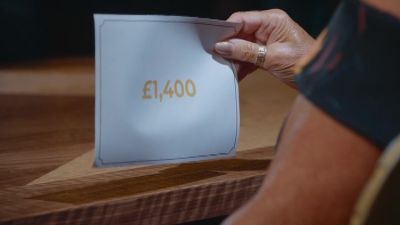 "Tonight, Matthew, I put £2400 into the pot.
Then the discussion takes place. The ideal is to vote out the person who has contributed the least to the group's total. A simple majority of votes will eliminate someone; if there's a tie, the players concerned leave the room and the others come to a consensus. Although we're told that the votes have been locked in, the visual grammar doesn't support this – there are no wipe-clean boards, no cards showing people's names, only a statement "Tonight, I'm voting for Kate. Sorry."
Whoever gets the most votes goes, but then we find out – were they the weakest link? They were? Brilliant, all the money goes into the pot, and the weak player leaves the game. But did someone else score less? Oh dear, the money for that day is halved, so the £12,600 turns into a somewhat more modest £6300.
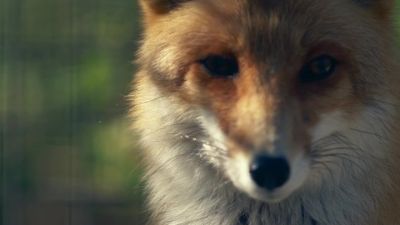 As sly as a fox...
Nobody's Fool went out as six episodes, and should have had enough game content to fill six episodes. In the event, the producers were stymied by two decisions from players. One contestant had played the game with great honour, did not lie, did not mislead about his earnings; rather than pretend that he had scored more than £0, he chose to withdraw from the show.
Later, another contestant chose to reveal to the group how much he had on his card. The group chose to eliminate that player from the game, rather than either of the two tied players whose fates they were discussing. This sort of thing felt like it was bound to happen, if only by accident: flimsy card is too prone to being wafted off the table by people gesticulating. If there's a next series, invest in some natty wooden covers to protect the information.
 Melissa and John inspect the decor at the mansion.
We rather suspect that the producers would have liked to structure the series so that each episode covered a day, with its challenge, a quiz, and a vote-off; losing two contestants in such unorthodox fashion seemed to send them into a bit of a tailspin. It certainly looked rather odd on screen, as though the programme was being stretched out to fill the required duration.
That said, the final was rather rushed. All the players were offered a bribe to leave the game: the money they'd won in the last quiz would be theirs, and not placed in the pot. Only one player took the offer. The remainder went out and tried to identify pop songs played by a string quartet, and then to complete the lyric when it's sung in Italian and suddenly stops. Winner of this round chooses another player to eliminate.
Then there was a straightforward decision where each player individually chooses to eliminate one other – somehow, they managed to get two people to agree to get rid of the weakest link.
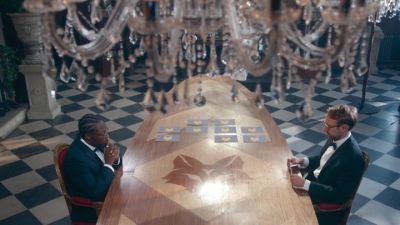 Is that a truth, or a lie?
Our finalists picked a card containing two statements, one true, one false; the player picked out one to read, and the other was to determine whether it's true or false. Winner of this scoops the prize pot, well over £80,000.
It's clear that there was a lot of love for game shows in the production, and plenty of inspiration drawn from the genre's best bits. Across the series, this column and other viewers spotted:
- the intelligence line-up from Big Brother and The Traitors
- hosts who reminded us of Larry Grayson and Isla St Clair on The Generation Game
- conveyor belt from The Generation Game, complete with cuddly toy
- Runaround played behind podia
- one of those over-confident businessfolk from The Applicant who you just know will be dismissed by episode three
- re-arranging nine-letter anagrams like on Countdown
- a cuddly mascot from Blockbusters
- name that thing from The Finish Line
- and groups of linked pictures like on Only Connect (2)
- childish games have a grown-up twist, as seen on Squid Game: The Challenge
- Starshot, the long-forgotten clay-pigeon shooting contest
- showing the answers to someone like on I Literally Just Told You, though they decided not to end the series on a memory quiz
- the buy-out from The Inheritance
- obvious clues to songs as on Name That Tune
- answering the question before it's asked, as foreshadowed by The Two Ronnies
- complete the words as seen on Sing It Back: Lyric Champion 2007
- a collective choice of the winner from Unanimous
- and, to finish, a round of Would I Lie to You?
The whole ambience was reminiscent of The Traitors, except that the reveal was "I am, and always have been ..... King Stupid!"
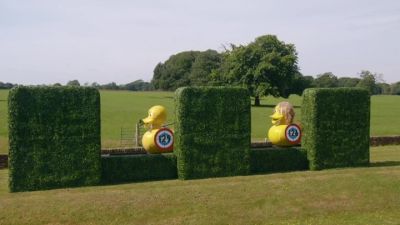 Oh duck! No, we said duck!
Actually, we should do some content notes. There is an awful lot of swearing and bad language on this programme. The contestants and hosts throw about the F-word and the S-word, as though they're filling in for the time signal. May wish to exercise caution if there are young ears who hear what's on the telly.
We should also mention that one of the contestants describes her career as a "dominatrix", in the sense of being a sex worker. While there's nothing explicit or titillating about the contestant, and her career choice is presented in sober and neutral terms, it is a discussion some grown-ups might need to prepare for.
One final thing for people to be aware of: sponsorship by a bookmaker, and sponsorship featuring Danny Dyer; we fear it blurred the boundary between show and advert.
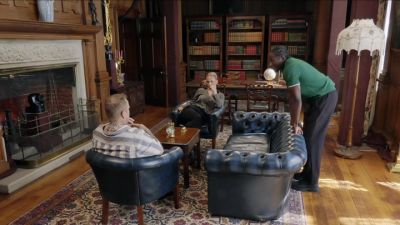 Billy, Ella, and Kamaal plot to remove Harry.
As Nobody's Fool continued, it became less about the quiz and the mechanics, and more about the personal interplay between the contestants. One of the younger women openly tried to flirt with one of the younger gentlemen, to the extent that everyone noticed, and the parting shot was "think with your brain, not your hormones". The final five was pleasantly diverse, which shouldn't be noteworthy but appears to be.
There was a very overt attempt to build up an alliance and get the strongest link out of the game: never mind that it'll cost the group £10,000, because it massively increases the individual chances of winning the final prize, and £80,000 is almost as good as £90,000. But the plot failed, perhaps because it was too blatant and the cast had become sufficiently good friends. Nevertheless, this sort of discussion is taking place, and it's not being dismissed out of hand; perhaps the ITV viewer is prepared to tolerate some tactical selfishness.
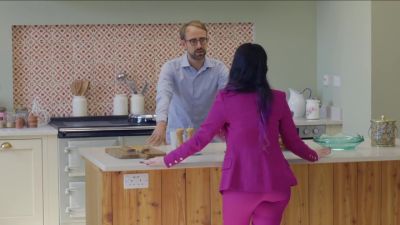 Harry and Sonja scheme to protect him.
At the start of Nobody's Fool, it was reasonably clear who had been cast for their brains, and who had been cast for their ability to blag. The three contestants who were going to add lots of money to the prize pool, they stayed in to the final. The contestants who were rubbish at quizzes remained rubbish at quizzes, and were sent out of the game quite quickly.
The interest lay in those players who were decent-to-good at quiz, and decent-to-good at the social aspect of the game. Billy, the contestant who turned over his card, was clearly in this category: he was the architect of the campaign against top quizzer Harry, on the assumption that the final was certain to be a straightforward quiz. Ella, the flirtatious young player, didn't have the quiz smarts, but absolutely aced the part on being someone great to have around.
And this is where Nobody's Fool can be replayed, and earned a second series. To make the final, you've got to have a decent quizzing knowledge – be in the top half of the pack throughout. To win the final, you've got to be able to bluff, and to tell lies, and that is where one top quizzer failed, allowing victory for a less good quizzer – but a much better social player.
This show has layers
 They used the fox as a recurring motif and logo.
, it's not just quiz, it's not just social deduction, it's not just Emily Atack and Danny Dyer larking around a big country estate. This show is better for having layers.
When compared to The Neighbourhood, it's clear that Nobody's Fool is a better programme. This is a fun show, most of the time it doesn't take itself too seriously, and it looked like the players were genuinely having fun. Is this the successor to Genius Game? Perhaps: we could certainly see the contestants from Genius Game having a great time on this prog, and we could imagine some of the Nobody's Fool crowd doing well in Tennant's hexa-lab. The casting was somewhat off, they really needed to have everyone be quite good at some form of quizzing; most of the eliminations were quite predictable.
There is work to do – there is a lot of work to do – but we can see a second series of this show being quite a hit. And let us remember that the first Dutch series of De Verraders was also rough round the edges, and it took a few goes to turn it into the world-beating hit.
And if it doesn't come back, we will file Nobody's Fool alongside another one-series wonder: Jamie Theakston's Beg, Borrow or Steal from a couple of decades back. It's the one where a group had four questions to discuss, privately or as a group, and everyone who got all four right would earn some money, and whoever had the most money at the end of the game would try to win it and could invite others in if they failed. Only ran for six weeks, the Beeb eventually went with Eggheads in the 6pm spot, but there's a universe where Theako became a top quiz host and Beg, Borrow or Steal ran for years.
 Another one on the conveyor belt of formats.
So, would we recommend Nobody's Fool to you? Yes, so long as you're fine with a mostly social game, and with quite a lot of bad language. It's well-made, there is texture and something different in every show, and all of the characters in the final have some sort of personal growth. And that's enough for us.
Other news
Sorry to hear that Kanya King died last week. She'll be remembered for founding the MOBO awards, which gave visibility and exposure to music of Black origin, and confronted the "real music" snobbery of the late 90s. She had a glancing association with game shows, as one of the panel on ITV's Fortune: Million Pound Giveaway in 2007. Kanya King died of cancer, she was 57.
Also sorry to hear that Anthony Head died. He was a versatile actor, starring as Rupert Giles on Buffy, as Uther Pendragon on Merlin, as a star of The Rocky Horror Show, as the prime minister of Little Britain, and as one half of the Gold Blend couple advertising coffee. Anthony never hosted a game show, he would have been suave and assured and unruffled; he rarely appeared on a panel, he would have been the voice of sense in a world of blanks. Anthony Head was 72.
Viewing figures for the recent Senior Eurovision Song Contest have been published. 131 million viewers in the participating territories, down by 35 million (and two markets) from the 2025 edition. The EBU also reported increased viewing figures for its content on anti-social media platforms, though we cannot exclude that "growth" being from non-human viewers.
ITV Play marked its first birthday, and ITV's put out a glowing press release. Average audience up 95% compared to ITVBe, the reality channel it replaced. Measured by total audience, it's up to number 27 in the channel rankings, which suggests ITVBe was amongst the least-watched of all Freeview channels. Top slots are 7pm, which has been consistently filled by word game Lingo; and 9pm, which has been used to showcase some of ITV's premium quizzes such as Beat the Chasers, The Floor, and Limitless Win.
Rumours are circulating that ITV have recommissioned Win Win; we're not able to confirm this by pointing to a press release from ITV headquarters or another reliable source. We would not be surprised if this show returns: it's effectively an extended commercial for the sponsoring company, ITV get some primetime hours for free, and can schedule the more expensive shows in other slots where people might actually see them.
Strictly klaxon! The recent end of the summer means that it's time for the Strictly Come Dancing celebrities to be announced. First name is Lacey Turner, an actor in The East Enders. More names will be dotted around the BBC schedules over the coming weeks: we expect one to "drop" at half-time in next Thursday's match between Uzbekistan and Colombia, and another in the closing announcement on Radio 4 Long Wave when it closes forever in the early hours of the 29th.
Lots of green grass on the schedules this week, unfortunately there's also a lot of men who think it's their divine right to run all over the grass. We do have Déjà News (Radio 4, Sun), archive news with Lucy Porter. The Traitors Us (BBC3, Thu), in which Yankee celebrities try to be as stylish as Stephen, or as subtle as Harriet, and fail.
To have Weaver's Week emailed to you on publication day, receive our exclusive TV roundup of the game shows in the week ahead, and chat to other ukgameshows.com readers, sign up to our Google Group.