
Weaver's Week 2026-10-11
Last week | Weaver's Week Index | Next week
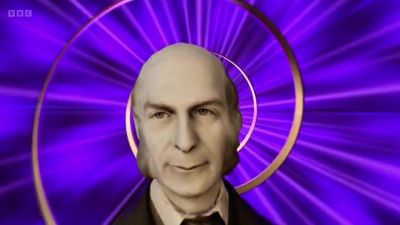 Francis Galton, the most unlikely Saturday night star since Andi Peters.
A great philosopher once wrote, "it is possible that the many, though not individually good men, yet when they come together may be better, not individually but collectively".
And the next day, Aristotle went to see Genesis play in the Agora, and thought "that Peter bloke would be better off alone".
BBC1 isn't interested in ancient Greek philosophers, that's far too highbrow for Saturday night telly. However, they are happy to tell us about Francis Galton, a statistician who saw a "guess the weight of an ox" contest at a country fair. He noted that the guesses of over 800 people were widely distributed, but the middle value was within 1% of the actual weight.
And, yes, Wisdom of the Crowd talks about this in the opening spiel where they ought to be running shiny titles and bright music. Or, indeed, play one of Genesis's greatest hits. "We can't dance", that's an appropriate song to follow Strictly, right?
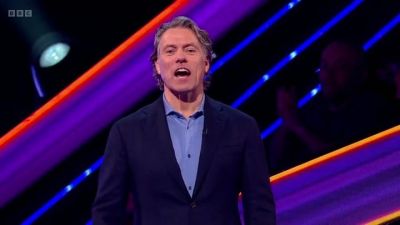 John Bishop.
Anyway, eventually, we get to meet John Bishop. The comedian has been on the scene for absolutely ages, and we were amazed to find that this is his first game show hosting job. He told the listings magazines, "I'm treating this more as a gig than a quiz show"; we'll see later how accurate his assessment is.
John isn't alone in the studio. Far from it. He's joined by 200 people, sitting on steeply-raked studio seats, and with a giant notch cut out of the bottom middle. It looks like a pair of fangs coming to nibble at our neck.
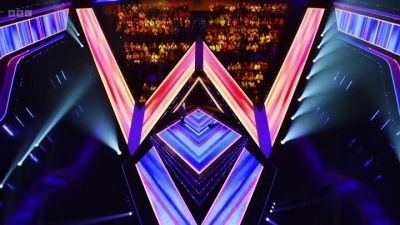 Pass the garlic, please.
The bulk of the show is the same round played three times, with one contestant trying to beat the crowd.
One Versus Two Hundred
The studio's giant LED screen splits in the middle, and a player walks out. Loud music plays, probably "Turn it on again" or something equally raucous. John greets our new player, and talks to them about their life. Clearly, we're meant to find something in this chat, we're meant to have a reason to root for the player and not for the mob.
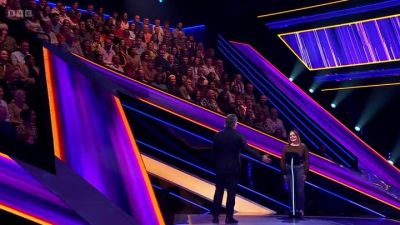 The contestant is dwarfed by the huge crowd.
Soon enough, we're into the heart of the game. Our contestant – and the 200 people in the audience – are about to hear a question. It'll have a number as the answer. The question has previously been asked to 1800 people by a reputable polling company. The 2000 answers from the crowd will be taken together, and the "average" found.
The answers of the studio players are displayed on the giant LED screen, as a series of disembodied heads that roll into place.
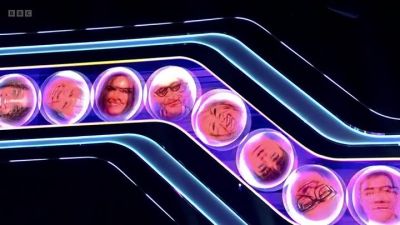 Roll with it.
Mathematicians note that they never declare whether it's the mean (add 'em all up and divide by 2000), the median (arrange all 2000 values in order, pick the one in the middle), the mode (single most popular answer), or some other average.
Viewers are quick to note that the producers introduce the heads with one of three pieces of music: a bad cover of the theme from Rawhide, Steve Winwood's "Roll with it", and someone screeching "Rollin' on the river". Could they not afford some little variety in the music? "Rollin'" by Linkin Park is there for the taking, as are "Roll to me", a fair few "Rollercoaster". So is the utterly appropriate "Some heads are gonna roll" by Judas Priest. And "Rollin' in my five point oh" by another core Saturday night comedian, Vanilla Iceberg Lettuce.
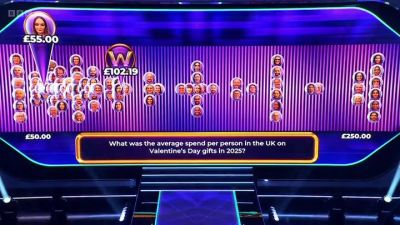 The player has one answer, the crowd a substantially larger answer. Spot the clumping around the round numbers.
However they've done it, the crowd is reduced to a single number. Our contestant will also have entered their number. And, on this first question, if the contestant is more accurate than the crowd, then they will have won. Won the round, won £10,000, and won a five minute break from the bad tunes. Honestly, it would be almost long enough for John to fill the gap by singing "No son of mine".
But, almost inevitably, the crowd's answer is nearer. And that means the crowd wins the question, and collectively pockets £2500. That's (checks maths) £12.50 each, just about enough for a copy of Genesis's Greatest Hits on CD. Except that money doesn't get divvied up just yet, for reasons we'll come back to.
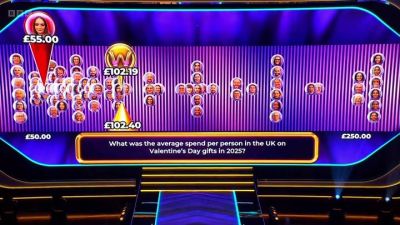 The crowd was right. Of course the crowd was right.
Second question, just like the first. Enter answers, rolling heads, the carrot of £7500 is dangled, but almost inevitably the crowd will win that too. Between each question there's some chat with some of the crowd: "did you really think that the average person spends £5.68 on sandwiches a year?" or something like that.
The third question arrives. Same procedure as every time: answers, heads, a potential £5000.
But now the contestant has a decision to make. They know their answer. They know the distribution of the audience answers, and they know where the crowd's mid-point is. The only thing missing is the actual answer.
Does the contestant play on, win £5000 if they're nearer than the crowd, and leave with nothing if the crowd win once more?
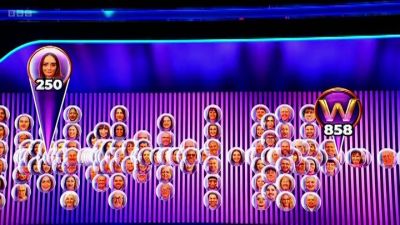 Does our player think there's 100 people to their left, and further away on the right than them?
Or does the contestant abandon the money and try to take a seat in the crowd? To do this, they'll have to be more accurate than half of the players – 100 of the 200 in the studio. Again, our player can see where they are in relation to the others, so it's a decision made in good knowledge. The only thing they don't know is whose seat they'll take, and that's going to be the most inaccurate player in the show (or the series?) so far.
Should our player try to take a seat, we still see the actual answer, and then a graphic lights up actually in the audience, they hope to rise above a certain line indicating half the audience. It looks cool, but slightly underwhelming – do they not have individual lights for players in this studio?
E Crowdibus Unum
Three contestants have come. Three contestants have tried their luck. Three contestants have failed to take the £10,000, and most of them have left with no money. There's a rather large amount of money in the audience pot – perhaps the full £30,000, perhaps a little less. Split between the crowd, that's a very useful amount, hundred quid or so.
But they don't want to give you that! Not when they can have a nerve-shredding finale.
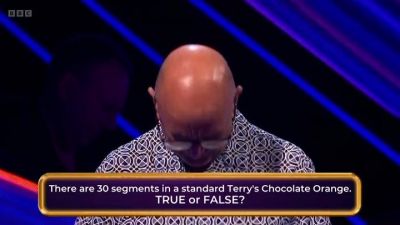 A player considers a nerve-shredding final question.
First of all, who gets to play? People from the crowd can volunteer to play, and the most successful gets to play. (Most successful in the episode, or the series, we're not sure which.) Whoever plays is going to leave the show, and they can only hope it's with a large wodge of money.
Our new hero comes down, and faces five true-or-false questions about everyday life. The panel in the studio also play the same questions. Whoever gives the correct answer gets a point – and it's very possible for both the player and the crowd to get a question right at the same time.
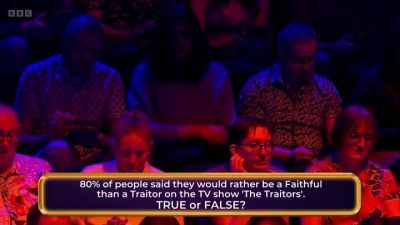 The crowd consider a nerve-shredding final question.
Five such true-or-false questions are asked, and whoever's ahead wins the cash. The solo player takes the money, a win for the crowd means that the money rolls over onto the next show. If they need a tie-break, it's back to the main game, a question requiring a number as the answer. Whoever's closer wins the dosh.
What do we think of the show?
Reader, we wanted to like Wisdom of the Crowd. We went in to the first show expecting something innovative, something different, something entertaining. After two-and-a-half episodes, we got so bored that we turned over to Win Win on ITV+1.
Wisdom of the Crowd is closer to Win Win than either show might like to admit. Sure, the BBC's prizes are an order of magnitude smaller, but the central conceit is the same. How well do you know the average British person? Can you predict the most common response to a survey question; can you guess various factoids about other people? This column finds the subject matter bland and dull, we reckon averages of the average tend to be as flat as "Paperlate". This column also accepts that – on this point – we're an outlier adn should not be counted.
One point of difference is the hosting. Win Win is hosted by Mel and Sue, experienced television hands. They've been working together since before some of their contestants were born, and it shows. They can finish each others' sentences, riff and fill naturally, are unfailingly lovely to everyone they meet, and have had decades of experience in a television studio.
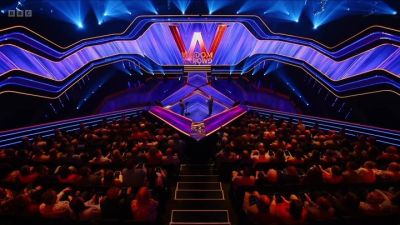 Seriously, that's a huge set.
John Bishop is new to this hosting lark, and it shows. He's greatly experienced in working a live crowd, and his studio sounds more vibrant and boisterous. Sounds like a bear pit, and occasionally gets a bit close to being a bear pit: some of his chats with players are close to the knuckle, and can come across as borderline patronising or insulting.
John said he would treat this programme as a live gig, and it shows most clearly in his microphone technique – it's the practice of a live gig. Sounds as though John is forcing and straining his voice, that he's shouting down the microphone. Some people make a fine living from shouting on network television – Tony Dortie presented Top of the Pops for a couple of years at the top of his holler – but we find the constant racket is wearing on the ears.
Wisdom of the Crowd does one important thing very very well. Everyone enters their own guess, without conferring. There's no danger of social influence, nobody is asked what they think before the crowd puts in their numbers. This independence is absolutely essential to getting a genuine random sample, which should be Normally distributed around the actual mean.
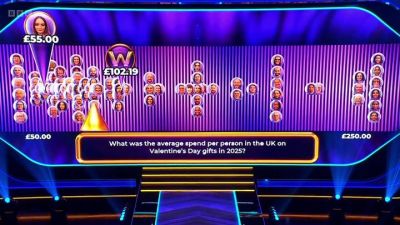 The little gold arrow only ever moves to the right.
But Wisdom of the Crowd makes too many unforced errors. Here's a little one: when it comes to reveal the answer, the pointer goes up, and then it stops, and that's the result. They could make the pointer dance around, go forward and back. But the way they've chosen to do it saps a lot of tension from the result.
And while we don't claim that any show is rigged, we do reckon that Wisdom of the Crowd does all it can to stack the deck against the solo player. The first question in any player's career is for the full £10,000, and a correct answer would leave the show with a gap to fill. It appears that the producers have chosen questions where the home players have given a consistent answer, and even if the studio crowd are wildly inaccurate, they won't shift the average by all that much. The second question, similarly, is not going to move much from the home answer.
Sure, if the solo player is knowledgeable, or very very lucky, they might just get the answer spot on and win. But that is a very unlikely outcome. The best that most contestants can hope to play for is £5000, and even that seems to be rather difficult.
Our abiding memory of Wisdom of the Crowd will be John Bishop bellowing "Let! The! Heads! Roll!" while they play some tune we've heard twice already. It's repetitive, and it's boring, and it's not fun.
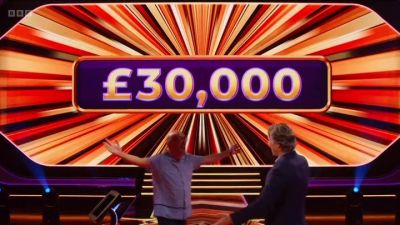 A contestant celebrates their big win. We celebrate the end of the episode.
And this is a shame. There's a great game to be had about beating the crowd. Producers Magnum Media could have given one contestant ten questions to beat the mob, be more accurate than each of them at least once; but that might be a bit too close to their other hit show The 1% Club. Or they could have set increasingly difficult targets for more money, and when the main contestant leaves, their replacement is drawn from the remaining members of the crowd; but that might be a bit too close to One Versus One Hundred.
As it is, Wisdom of the Crowd will continue in its furrow. It's not a show we'll be watching; but if it's your bag, fill your boots. Laters!
In other news
Sorry to hear that Richard Morecroft has died. He was the host of Letters and Numbers, the Australian version of Des Chiffres et des Lettres, via our very own Countdown.
Also hear that George Fenton has died. He was a composer, wrote the music for a zillion great films including You've Got Mail and Groudhog Day. On telly, he wrote the music for seminal 1980s drama The Jewel in the Crown, and for the BBC news bulletins of the 1990s. George also contributed the zappy theme for Telly Addicts.
While reading obituaries for Lena Martell, the singer, we learned that she was "discovered" on an ITV show Find the Singer circa 1965. If it was a game show, it's not one we were aware of. However she came to fame, Lena was a regular face on BBC telly during the 1970s, and enjoyed a string of hit albums – and one hit single, "One day at a time". After retiring for a time to care for her mother, Lena returned to the studio in the new century, and played to her fans. If she's got a remote game show connection, she's earned her place here.
Quizzy Mondays
House of Games (3) had a new host, Michael Sheen. Warm and welcoming, and it turns out that he talks in a clear Welsh accent. Wonder when that'll appear on The Celebrity Traitors.
Contestants this week were Nina Wadia, Shona Gupta, Mister Showbiz Andi Peters, and Stephen Mangan. We learned about Andi's showering habits, and he took a photograph of the scoreboard to remember the time when he was in the lead. We had a day of Answer Smashes set to music, a day when Stephen ran away with it in the first round, and a day when the other contestants could have co-ordinated to all finish joint second and keep themselves in the hunt for the weekly prize.
And we had Andi Peters in his new shades.
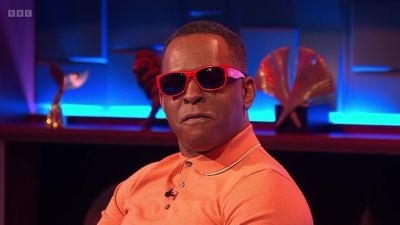 Television's mister cool.
A perfect round provides an excellent start on Mastermind; to nearly double your score on general knowledge marks you out as a contender to watch. Rob Hayman managed to do just that, perfection on the Aztec empire, and a wide GK round. He finished some distance ahead of Sarah Knapper (Janis Joplin) and Jag Bhogal (Max Verstappen); both contenders had great specialist and not-so-brilliant general knowledge. Polly Allen finished fourth with Agatha Christie's Poirot.
Two Hearts were the first team to book their place in the Only Connect quarter-finals. They took a very early lead, and scored three on connections about characters dressed as nuns, and things represented by two dots and a line; a guess about Commonwealth countries boosted their score. Both Two Hearts and their opponents Makeweights are quite young, and did not know about the plays of Dennis Potter or the acting career of Derek Jacobi.
Very one-sided match of University Challenge, where Glasgow beat Goldsmith's by 235-90. It was a late run, almost all of Goldsmith's points came in the final three minutes. With an overall rate of 41%, bonus rate of 50%, and three penalties, we will not see them again.
Though they weren't pushed hard, Glasgow were solid, buzzing quite early on some questions, but letting others take their course. Harry Braid was the captain, with six starters, all the team got at least two. Glasgow were right on 59% of the questions they faced, and 54% of the bonuses (but 58% up to the music round, after which the winner was clear). They're very strong on Arts, Entertainments, and Geography, and we can't say they were weak on any subject where they got a decent number of questions.
The result also qualifies either Bristol or the LSE, two losers on 160 points. We think Bristol have the stronger claim; the order of qualifying may be academic if next week's losers score less than 160.
New thrills: Final of The Celebrity Pottery Throwdown (C4, Sun) and The Box (ITV, Sun). A celebrity edition starts a new series of Y Deis (S4C, Wed).
To have Weaver's Week emailed to you on publication day, receive our exclusive TV roundup of the game shows in the week ahead, and chat to other ukgameshows.com readers, sign up to our Google Group.