
Weaver's Week 2026-05-17
Last week | Weaver's Week Index | Next week
A few weeks ago, we looked at The Hunt, an ambitious and expensive constructed reality show on Channel 4. It was the one with people playing hide-and-tag in the forest. You didn't watch it, you might have heard about it. Following underwhelming viewing figures, the broadcaster gave up and shoved all the episodes on the website and put the linear broadcast later in the evening. And, while The Hunt was compromised by poor decisions from the producers, we maintain that it was a perfectly decent format that could have worked.
This week, we look at The Neighbourhood, an ambitious and expensive constructed reality show on ITV. It's the one with people living in houses and being nice and/or beastly to each other. You didn't watch it, you might have heard about it. Following underwhelming viewing figures, the broadcaster gave up and shoved all the episodes on the website and put the linear broadcast later in the evening. We're going to argue that The Neighbourhood is a poor format, and that faults were so deeply embedded into the show that it could never work.
On paper, The Neighbourhood should have worked. At heart, it is a soap opera, a self-contained little bubble of households, with forced rivalry between the households, and some interesting plots within each home. ITV's viewers are very familiar with this sort of soap opera, the fictional Coronation Street and Emmerdale Farm have monopolised an hour of telly every night for years.
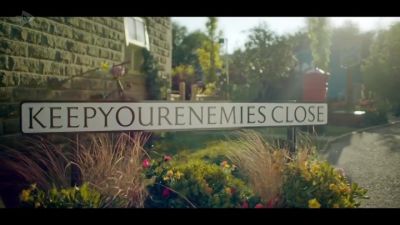 Keep your enemies close. It's a mangled version of a folk saying.
Who are these people?
The first problem for The Neighbourhood arose in the opening segment. Here are six households, moving into six houses. Between them, these households comprise 26 people. And we're being introduced to them all at the same time. Twenty six people! A whole alphabet, from A to Z, and we're expected to become familiar with them in no time at all.
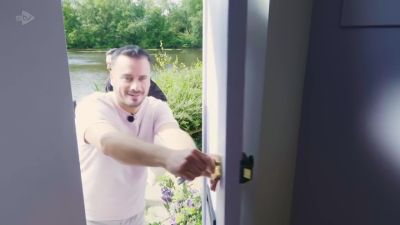 A household enters their new place.
Perhaps ITV are not familiar with techniques to introduce a host of new characters. The Traitors does it gradually, we see people arriving on the station platform, and then more people arrive, and we see even more people on the train. For ten minutes, we're chatting with people on the journey, seeing snatches of character, building up excitement, building up familiarity.
Or perhaps we might like to remember how a good soap opera introduced its new characters. Take Grange Hill as an example: the initial episode followed Benny Green into the playground, into the new school assembly, meeting his new classmates. We see the world through Benny's eyes, and while we meet a lot of new faces in that time, it never feels overwhelming.
The Neighbourhood baffled us with so many people, and so little to distinguish them. Even a simple visual cue – ask all members of the household to dress in similar colours – would have helped. But no, the producers didn't think about how to help their viewer.
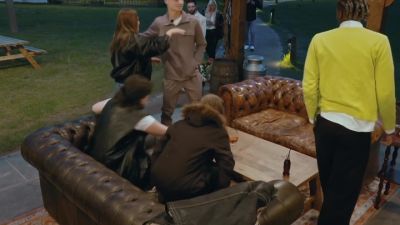 In the bar, the Browns and the Blacks talk, with one of the Canaries walking past.
Each household (some families, some groups of friends) move into a house. The house is painted in a bright colour. It would have been simple to put the colour of the house on the podium during the first challenge. But no, the producers didn't even put the colour on the podium. They absolutely do not want us to get a toe-hold into this show.
The first challenge turned out to be a turn-off for one UKGS editor, involving gratuitous electric underwear. It was one of quite a few challenges designed to stir up distrust and misfeeling between the households. We're very much not there for gratuitous hostility: it's not entertaining and it's blatantly planted. Not only do the producers not make their show easy to follow, they stir the pot to force the show they want to make. It's as if the producers didn't believe the audience would accept an honest representation of the households, so made up an increasingly elaborate lie.
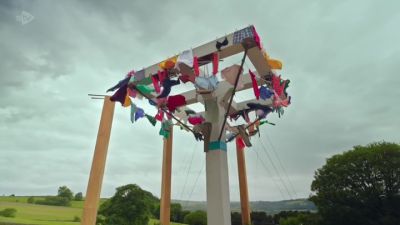 A giant rotary washing line, almost 7 metres (three-and-a-half Richard Osmans) tall. This show did not skimp on its props.
Such lies pervaded the entire production. Not necessarily from the producers, but from the households, Almost every action was second-guessed, "what will the neighbours say", "what will the other households think". Contestants – perhaps subconsciously guided by the producers – chose not to be honest about their actions, to lie for the sake of appearances. It's a teetering, tottering tower of twaddle.
Handcuffed brought us something like this. Remember how Charlie was worried that she was going to spend time handcuffed to a smut-maker. What would the neighbours say? How will this affect her family? Turned out that the neighbours were completely unruffled, the family got through a rough patch (as good families will), and the pair survived to the final challenge. If Charlie had been like some contestants on The Neighbourhood, Jonathan Ross's show would have had a very different finish.
Corner to corner
A good reality show will have a regular rotation of elements. The Traitors is a simple example: each show goes from breakfast to mission to banishment to murder, and they only deviate from those corners when there's a good reason. Back in the day, Big Brother would cycle across a week, going from cash challenge to nomination to reward challenge to eviction.
The Neighbourhood only had two elements: the immunity challenge and the removal. That's the eviction, where each household votes for the one other household they'd most like to get rid of, and the household with the most votes is out. Quick to describe, but hideously over-wrought on screen, each one occupied almost half an episode, which is an awful lot of faff to get one team out.
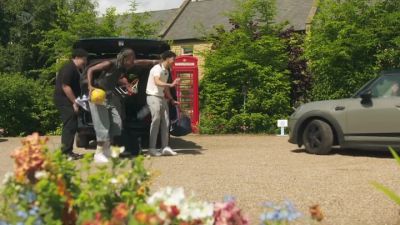 Hello as yet another new team enters.
And, for most of the series, as soon as a team had been thrown out, another one would arrive to take their place. It's like a particularly virulent weed, or the head of the Hydra: as soon as you chop one off, it's replaced. Not until episode nine (of eleven) did we get down to as few as five households. We know that producers like to keep their formats with "the right" number of contestants, but this verges on the ridiculous.
Immunity challenges were challenges, set by Graham, for immunity in the next "removal" vote. (They also gave the immune household(s) tie-break powers if the removal was tied). Many of these challenges were similar to other existing game shows. A challenge to find a hidden code in a greenhouse was suspiciously similar to CITV classic Finders Keepers.
Another challenge rewarded players for their ability to stay awake, perhaps riffing on Shattered from a few decades ago. There was a random draw from winning tickets (as seen on Channel 5's NFL Big Game Night), and a plunge into a pool of water (a less messy idea than Get Your Own Back). There was a dinner party, because that's become almost a format point on its own. The final challenge was almost a lift from Supermarket Sweep; earlier there was an actual episode of Stephen Mulhern's Catchphrase With Stephen Mulhern with yer actual Stephen Mulhern.
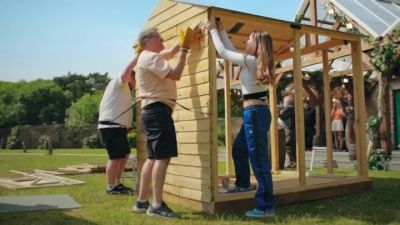 Contestants build their own sheds, for some reason.
Further challenges included a treasure hunt in the car, like on Hewlfa Drysor, except the S4C show was plotted with wit and was entertaining. There was a short revival of Give Us a Clue and Win, Lose or Draw, both pitched as "parlour games". A task to build a shed – this could have been like Dùbhlain DIY, except the BBC Alba show doesn't give contestants the instructions, and probably has more viewers than The Neighbourhood. And, for some spectacularly rotten audio dubbing of the host, they were clearly evoking The Mole on Netflix.
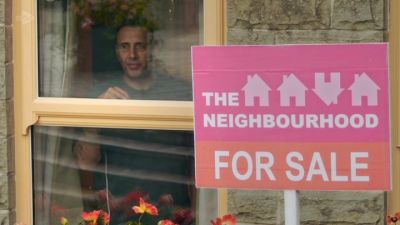 Removal votes were cast by placing a "For sale" sign outside a house, while the occupants looked through the curtains. Sounded great on paper, fell flat on screen.
Going back to the first episode, and The Neighbourhood introduced all the contestants, and both of its format corners, in one hour. A lot to pack in, the pace was hectic. Many viewers will have been put off by the incessant demands on their brain: this was hard work, it's not easy Friday night viewing. But, having set up the pace, subsequent episodes slowed the process down: a removal on one episode, and an immunity challenge on the next. We've gone from two big events in an episode, to one – and in the case of episode 5, neither an immunity nor a removal, just an awful lot of fannying around.
The fannying around was in a reasonable cause, to remove a household that had been manipulative and deceitful; some people in the household struck us as more than a little misogynistic and perhaps there was a sprinkling of homophobia. But we didn't get any sort of emotional payoff in that episode, it was left as a cliffhanger. Again, the producers wanted us viewers to concentrate on the arguments – not the fire of stand-up rows, but the ice of being gently ignored and frozen out.
And if we hadn't got the message, a later episode contained two full segments where households talked to each other in an effort to dispel other rumours they think they've heard. It came across like a very bad soap opera. We can say many bad things about Coronation Street and the like, but we're always glad to see that they are written by paid writers, acted by trained actors, and everyone involved knows the story they want to tell and works to that goal. The Neighbourhood was completely improvised, made-up on the spot by untrained non-actors, each with their own divergent motivation. The Neighbourhood really didn't want to try to be a soap opera, because it would always fail miserably.
Architectures of pretence
Fail miserably, that's what the programme did. Perhaps because it was so devoid of content, the programme just dragged on. Rather than have action on the screen, we were treated to masses of the households giving rounds of applause to pretty much anything, a surefire filler. Bonding activities, like games of rounders and art classes, added to the feel that this was a holiday camp set in a simulacrum of a particular type of village.
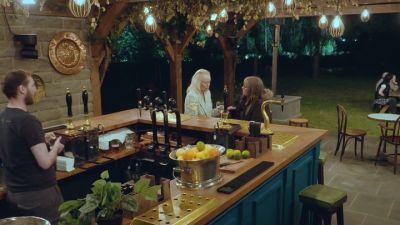 After dark, contestants gathered in the bar, the "Uppin Arms". (Up in arms, gettit?!!?!).
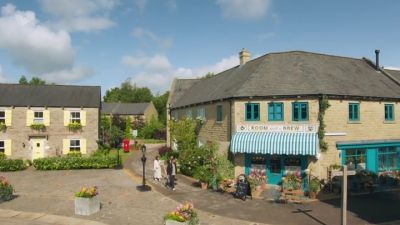
What type of village? One with gnomes and DIY, a village green, a small town square. A place with greenhouses and a lake and low white picket fences. Somewhere that houses a modern café and a traditional pub and curtain-twitching neighbours. Somewhere with all the mod cons, where people use a neighbourhood group chat, but also use a physical bulletin board where pieces of paper are posted. It's like a village fete – a pleasant distraction for an hour or two, but who would want to live there?
It's a very narrow vision, perhaps one that only a narrow section of society finds appealing. Narrow in social class, and certainly narrow in geography – we got the impression that all nine competing households were based in England; if that's right, it's a poor performance for an allegedly national broadcaster. The final challenge was – in Graham's words – "typical English lawn games" like quoits and welly wanging, summing up the show's very narrow appeal.
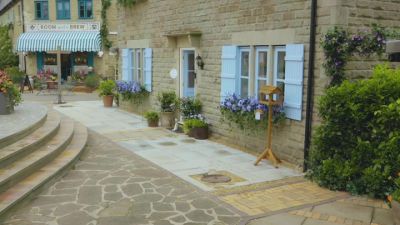 One of the colourful cottages, just by the cafe, and the steps leading to the square.
This column reckons the producers managed to evoke a small dormitory village that wants to be considered a market town, a relatively new build just outside the Green Belt in Hertfordshire or Berkshire or somewhere like that. A place that hasn't got any genuine history, so tries a bit too hard to pretend it does.
Compare and contrast to Grassington; the show Love Thy Neighbour may have been execrable, but the village had firm social foundations and swaggered with the quiet confidence associated with being established for many hundreds of years. The architecture on The Neighbourhood – both physical and social – reeks of contrived antiquity, it clearly wants to pretend it is something it's not. The series was filmed in the Darwin Lake holiday resort in the Peak District (the houses pre-date the recording, though the Village Square was constructed for the show).
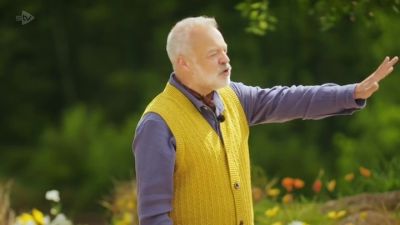 Graham Norton was the host.
Graham Norton was the host, and – just like on Wheel of Fortune – proved to be less valuable than he might have been. His commentary rarely went beyond the basic "say what you see, but in an Irish accent and with a slightly wry tone in your voice". There was plenty of opportunity for the programme to be unexpectedly funny, but every time the show in general – and Graham in particular – seemed to take evasive action as though being funny was against the rules. A harsh critic may note that Graham Norton is desperately funny when he's got a script, or been able to think about what he's going to say, but he's not shown skills at improvisational comedy.
Once again, contestants demonstrated their complete aversion to any sort of "game playing": if you're going to canvass for votes or influence on shows like this, you've got to be so very subtle. A household can marshal votes to have another eliminated, but there is a significant social cost, and they then needed to be very humble to all the others, and especially not suggest that they were a shoo-in for the remaining evictions. Social games tend to be won by risk-takers, and it seemed that The Neighbourhood was not a format to reward risk-takers.
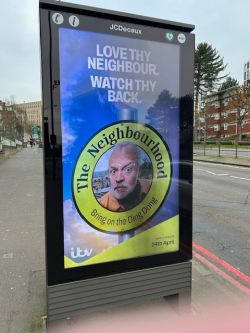 Three weeks before transmission, we saw this advert hyping the show.
ITV did themselves no favours with the incessant advertising for The Neighbourhood. Three weeks before transmission, we saw a digital billboard showing Graham's face and the tagline "Bring on the ding-dong!" In retrospect, they should have advertised it with allusions to be Family Big Brother, perhaps given us undertones of "it's an experiment". Perhaps they needed to give more screen time to the calm and sensible households: the first half of the series was dominated by one particular voice, and when they were removed it was like silencing a car alarm.
But no, ITV wanted to say The Neighbourhood was like The Traitors, because everything is meant to be like The Traitors, and nothing is ever going to be as good as The Traitors, and ITV really need to build on the moderate hits they've already got. They cancelled The Fortune Hotel to make this. They cancelled Genius Game to make this, and ITV would saw off their left arm for ratings as good as Genius Game got last year.
Is there anything good to say about this programme? We want to be positive, but we're having great difficulty finding anything positive. It is possible that tighter editing, and more careful introductions, might have made the programme more palatable. There could be a perfectly adequate six episode series lurking in all this fluff and palaver, but it's spread over 11 hours of telly like a spoonful of jam eked over a loaf of toast. Richard Osman suggested that there's a perfectly workable format here; he may be right, this column didn't particularly see it, and in any event people don't watch formats, we watch shows.
 Would the last household to leave please turn off the taps? Thanks.
Ultimately, The Neighbourhood was holed below the waterline. It was weighed down with poor formatting, and the ballast from unreliable advertising. It was built on a myth: the cosy villages of England have to accrete over centuries, and can't be imposed in five minutes. And The Neighbourhood felt like a pretence through and through: the producers seemed to want to make a show somewhat different from the one we actually saw on screen.
We love to watch authentic programmes, people being themselves, showing the diversity and wonderfulness that make us all human. But we didn't get that from The Neighbourhood, the programme came across as hollow and fake and completely inauthentic.
Viewers are not stupid, and we turned off in droves: barely a million saw the opening episode, and the show was pulled from 9pm and burned off later in the evening when no advertisers were watching. The final episode spluttered out on Tuesday night to barely a quarter of a million viewers.
There goes The Neighbourhood. We will not see it again.
Other news
BAFTA Television Awards were presented in a glittering ceremony last Sunday night. Congratulations to The Celebrity Traitors, which won the Reality category, and also the Memorable Moment – though it was for the final reveal. not for the series' most actually memorable moment. Last One Laughing won Entertainment, and Bob Mortimer took the Entertainment Performance award. The BAFTA Fellowship, the greatest gift the academy can bestow, was given to Mary Berry, and quite rightly.
Big Break is back! Two years ago, when we were doing the Big Massive A-Z of Most Broadcast Game Shows Ever, we wrote, "The Big Break format remains strong, and with snooker becoming more popular in the last few years, we wonder if some bright commissioner might revive it." A bright commissioner has revived Big Break, it'll be back on BBC2 teatimes sometime soon. Paddy McGuinness is the new host, with Stephen Hendry playing the referee.
The former favourite button Richard Osman has been named as host of ITV's this-or-that quiz The Golden Elevators. Three more years of The 1% Club for ITV, including another Rollover week and a children's special next weekend.
Junior Eurovision has been announced. Surprise! Malta is to host, and the event will be on 24 October – somewhat earlier than we've become accustomed to. Last year's winners France Télévisions declined to host, and speculation linking the contest to the Podgorica Pointless Arena or San Marino Village Hall has proven incorrect.
This week, Race Across the World reaches the end of the road (BBC1, Thu). Scotland's Home of the Year is named (BBC1 Scotland, Mon). Round the Islands Quiz has its all-important Third Place Play Off (Radio 4, Sun). One Person Found This Helpful returns (Radio 4, Tue).
Next Saturday, ITV has a Soccer Aid special of Bullseye, and launches "strategic reality quiz" Nobody's Fool. We'll be back next weekend with some thoughts on the Eurovision Song Contest and matters arising.
To have Weaver's Week emailed to you on publication day, receive our exclusive TV roundup of the game shows in the week ahead, and chat to other ukgameshows.com readers, sign up to our Google Group.